

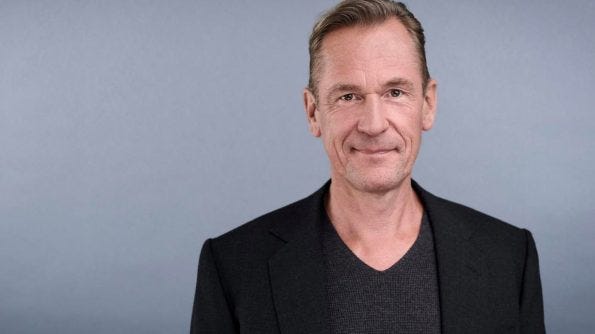
Mathias Döpfner is the most interesting man in Germany. A humble music journalist who worked his way up to own one of Europe’s largest media conglomerates, Döpfner’s biography is as meritocratic as may be imagined in a society in which ambition is stifled by inherited wealth. In a German business world run by dour Buddenbrooks characters, he is a rare spark of humanistic erudition; in a democratic public sphere where no one went online during lockdown and Woke 1.0 still rules the roost; where no one can write in PEEL paragraphs and Kurt Tucholsky is for some reason part of the national canon, he is the rare commentator who can speak with a wit and naturalness of expression that would not seem out of place in the common room of an Oxford college. These remarkable qualities makes Döpfner’s thus far catastrophic management of The Telegraph the greatest tragedy for Anglo-German understanding that has ever occurred in connection with that august paper’s name.
Döpfner’s acquisition of The Telegraph came after months of smoky backroom manoeuvres by the usual Tory mates (Mr. Döpfner might prefer to call them „CSU-Amigos nach britischer Art“) against an Emirati bid that, in the spirit of gentlemanly capitalism that still prevails amongst the sound Sandhurst-educated chaps of the Gulf, would have left the paper’s editorial staff to their own devices. Hitherto The Telegraph had given Reform a fair shake; while it has been argued in J’accuse that the paper’s reversion to its old Tory partisanship following Döpfner’s take-over is evidence of a stitch-up between Axel Springer and Conservative Party grandees, I do not share this assessment. Mr. Döpfner is well-aware Axel Springer’s specific brand of politics was always going to be a hard sell in a country with a very different intellectual heritage and historical experience than the soil from which Axel sprung, and to dismiss him as yet another monomaniacal German ideologue in the vein of Hugh Laurie’s character in the second Blackadder is to sell him short. Die Welt, the Springer flagship, is a paper of radical liberalism in the best tradition of the Heckerlied: in the darkness of the Merkel years, it gave column space to various Peter Hitchens-like figures on the rightward fringes of the public debate and published bold investigate reporting on the chancellor’s dodgy Chinese lockdown deals. Contrary to its pro-American image, it was also the only place that provided Seymour Hersh a venue for his sceptical reporting on Assad’s alleged sarin gas attacks on Khan Sheykhoun in 2017. More recently, it has defied the Brandmauer by publishing Elon Musk’s pro-AfD missals — not an easy thing to do in a Germany where the curtains remain firmly drawn on the pre-2015 Overton window. Döpfner stands firmly on the side of free speech and progress; only a lack of understanding of the differences between German and British could have caused him to swing his publicistic weight behind a party that stands for neither of these things.
What does Döpfner want from The Telegraph? Though he rarely comments on British politics, the German media mogul has in the past displayed a sensitivity to the particularities of our island’s political culture and exhibited remarkably nuanced views on Brexit for a German europhile. Döpfner belongs to the liberal-conservative tradition of thinking about European integration that begins with Ludwig Erhard, the founder of EFTA, and sought to unify the continent as a loose, free-trading economic bloc against French plans for ever-closer integration led by Brussels — a struggle which has come to the fore again recently as German conservatives lobby to expand the geographical scope of „Made in Europe“ origin quotas against the narrow interpretation backed by the French government. Leaving aside specific policy issues, Döpfner’s general pitch to the centre-right in this country is that Britain and Europe should work together to expand trade, beat back Net Zero/the Green Deal, counter Mr. Putin’s mischief, and pursue a more sensible approach to migration in older to salvage the liberal social model and stem the rising tide of antisemitism. This is an agenda that both main centre-right parties in Britain agree on: the question Mr. Döpfner must ask himself is which one can implement it more credibly.
On each of these files, the Conservatives’ record has nothing to commend it. It was fourteen years of Tory incompetence that sapped Britain’s once formidable military puissance (which British readers should be aware enjoyed, up until very recently, a great deal more respect on the continent than it does here) to the point that the army had to hire private security guards to defend its bases whilst British military industry atrophied and post-2022 procurement was wasted on expensive boondoggles. It was Theresa May who introduced Net Zero and lobbied for it at the G7, and her successor who made it a centrepiece of his foreign policy through his ozymandian climate summit in Glasgow. It was a Conservative government that negotiated the Chagos surrender deal. But the Tories’ most unforgivable legacy from a centre-right, europhile, atlanticist perspective must surely be their mishandling of Brexit. The europhile case for Brexit was that it would offer a centre-right government the political capital to carry out wide-ranging pro-market reforms that would provide a competitive stimulus for the EU to reform itself along similar lines; not only did the Conservatives spend their four years in government after Brexit trying to reimpose the frontiers of the state at the European level through Johnson’s climate diplomacy, but it was Kemi Badenoch, the very woman whom they now wish to make prime minister, who, as Secretary for Trade, reversed Rishi Sunak’s pledge to remove 4,000 EU laws, mostly environmental regulations, from the statute book. The Conservative Party has done one worse than the restored Bourbons in Talleyrand’s famous quip: it has learned nothing and forgotten everything.
A common adage in the American political lexicon holds that personnel is policy, and here too the Tories have little to offer Britain’s German partners. Institutionally, the Tories are the party of Brexit; their current grandees spent their entire political lives fighting to extricate themselves from European entanglements and have a reflexive suspicion that any proposals for deeper cross-Channel cooperation are but cunning ruses to drag Britain back into the common market. Farage, of course, is also an old Brexit hand, but the people who will be responsible for the day-to-day handling of British policy towards the EU in a Reform government are younger, psychically unburdened by the emotional strain of the Brexit negotiations, and thus able to take a more pragmatic attitude when it comes to relations with the bloc. A reversal of Brexit or a return to the single market is not on the cards any which way, and the best that europhiles can hope for is a government in London that can work in a spirit of comity with those on the continent; European politics seems destined, for the foreseeable future, to be dominated by a Le Pen administration in France, and the ideological affinities between the RN and Reform would make cooperation far smoother.
If Döpfner wants to be a power broker in a Britain increasingly drifting away from the Euro-Atlantic world, his best chance is to leverage his influence as publisher of the most important centre-right media outfit to put Farage into No. 10. From his battles to push the CDU in a liberal direction under Merkel and especially Merz, Döpfner will be all too aware of how a party captured by its activists can simply ignore what, in a functioning democracy, would be important stakeholders, like the media and business (Bückbürgertum, anyone?) The Tories are a social clique who want to conserve boozy lunches at the East India Club and will sell the family silver to the Chinese and the Qataris if that is what so doing requires. The party’s Chefideologe, the late Sir Alex Younger (Kemi’s recent manifesto, as she said during its launch at Conference, „is our answer to the challenge the now late Sir Alex Younger posed“), was a man who furnished his office with special high-backed chairs to impress rich Arabs — and we are to believe this is a party with principled objections to Emirati ownership of The Telegraph? Reform is a „politisches Startup“ like Lindner’s FDP pretended to be; it as yet has no clear hierarchy beyond Farage, who is not interested in the nitty gritty of policy, but has a vision for the country and is happy to leave it to others to work out the details. If you want to save the West, there is only one option. Mathias, please stärke die Reform-Partei!
Anyone who uses emphatic language to talk up imaginary Russian threats while using vague and imprecise terminology to make it seem like they care about an actual invasion and a 'by invitation' occupation of our homeland is an enemy, not a friend. The DT is dead. Bury it.