

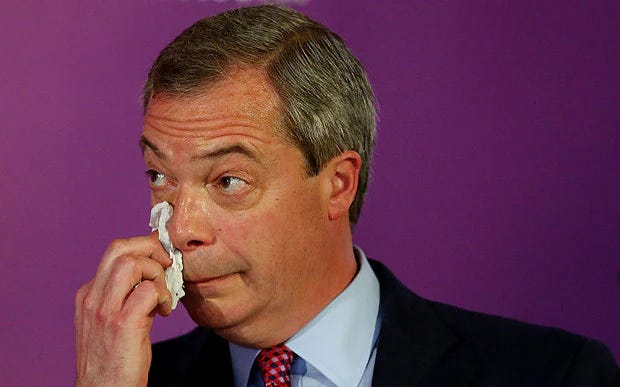
Despair is a sin and so we must always be cautious about demoralisation pornography. But we must also recognise that Britain is in a bleak place politically. If the Conservative Party recovery continues and Reform are unable to find a new narrative, and slip down to UKIP levels in the polls voters will be faced with a choice between a narcissistic compulsive liar from a foreign political dynasty and Jimmy Savile in a polo shirt.
In case you nurture any delusions about what a Kemi victory will look like she is currently black footballer posting on X a la Katwala and trying to turn the migrant rape crisis into a patriarchy issue. If the choice is between Kemi and Burnham I will canvass until my feet and hands are bloody for the Labour Party. It is wrong for anybody with a D in A-Level maths to fail up into the position of Prime Minister but there are also practical reasons for supporting Labour over an unreformed Tory party. Burnham for all of his cringe will, at the very least, restrain himself from engaging in military conflicts in the Middle East, Russia, or worst of all China.
First we will set out why we think that Reform has come down in the polls from 2025. Let us begin with our own world, the world of words and ideas. In June of this year a crucial organ of the British right changed hands when Axel Springer bought the Telegraph. The German owners of Axel Springer see Reform UK as the British version of AfD and so have directed the publication to take a much harder pro-Conservative Party line. This has been a catastrophe for Reform as the Telegraph was the only large circulation print publication which gave the party a fair hearing.
At roughly the same time that this purchase took place the Daily Mail has become much more explicitly pro-Tory. The Times have also reverted to being strongly pro-Conservative after a denouement during the Brexit years. If we look at British news site traffic we see that these are the only three right-leaning news organisations which make it into the top ten. It is not an exaggeration to say that it is almost impossible to find any real criticism of Kemi in any of these three publications. The Telegraph, as an example, as relentlessly brutalised Rupert Lowe’s Restore for harbouring Neo-Nazis for months, while lavishing praise upon Kemi, whom awarded Lowe a seat on the PAC and whom she talks to constantly. This is the author page for oneTelegraph columnist, Sherelle Jacobs, as an example.
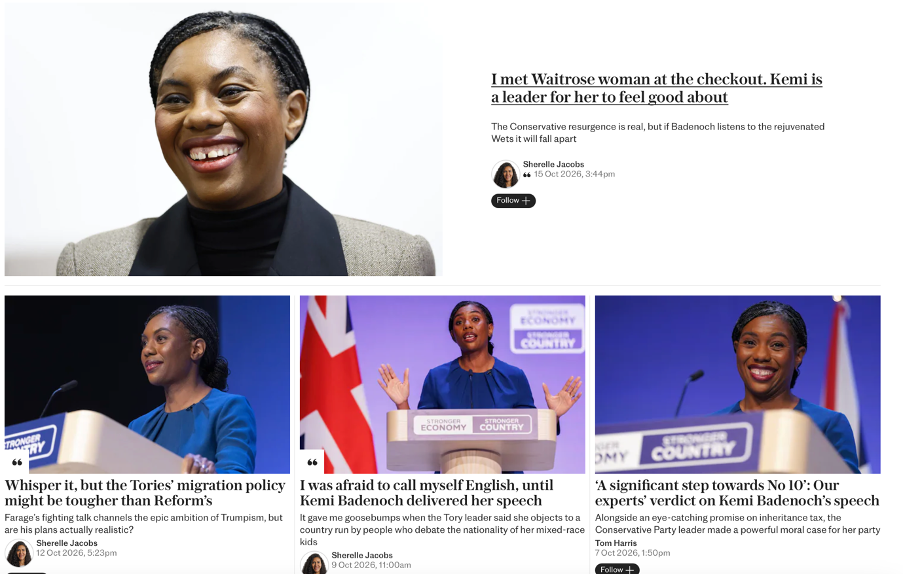
If we click onto the ‘expert panel’ article we see that Sherelle Jacobs has been put alongside Janet Daley and Tom Harris to give their ‘takes’ on Kemi’s Conference speech. What do we make of these?
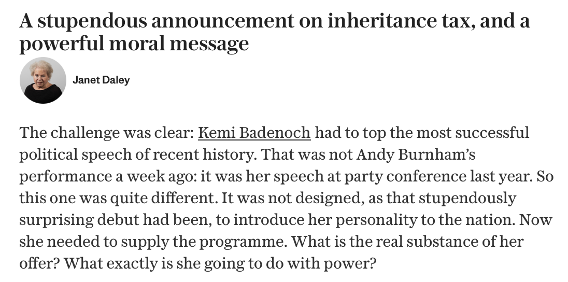

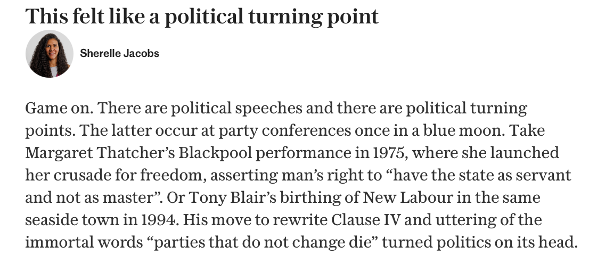
These are of course not ‘experts’ of any real kind but opinion writers who write dozens of articles a month praising Kemi. It is no use whingeing about how the establishment is working to frustrate the anti-establishment party but it is important to understand that is where Reform now is. The brief period post-2024 where the prospect of a Farage premiership would be haltingly indulged by these people has come to a close. They do not need to explicitly attack Farage for this to be achieved, instead they can progressively give Reform less coverage as time goes on – or they can focus the news agenda heavily on the economy where the Tories are seen to have more to say than Farage. The Tories are already trying to drop immigration as a topic and are instead blustering about Islamism and welfare incessantly.
It is tempting to believe that social media has made these institutions redundant but Britain is not the United States and there is no alternative media in Britain hefty enough to shape a different media narrative for mass consumption. Nearly all the mass alternative media in Britain, the podcasts and the tokkytik edits are reacting to work the mainstream media has already done, and two-three decades of social media usage has done little to change this. Every attempt which has been made to weaken the strength of the lobby since the days of Alastair Campbell has been frustrated by their institutional power.
Worse still is the fact that these are the trusted organisations which LLMs are scraping in order to form opinions, it is their work and not that of top bloggers which feeds the answer Google Gemini gives when someone types in ‘is immigration bad for UK economy?’. AI itself is also almost certainly, through millions of conversations, turning people away from radical politics and back towards the centre ground. If you had said ten years ago that every single person in the world will be given an empathetic, extremely charismatic and articulate genius with a centre to centre-left political bias as a personal companion who would never go to sleep or get bored of talking to you, and that asking this companion a question would become the main way to find information, you would assume that would be a death knell for populism as a viable political force. It is too early to draw any firm conclusions but so far watery ‘woke’ has been in the upswing since LLMs came into mass adoption.
Looking at social media more directly, far from radicalising the masses, the relentless videos of migrant crime pumped out on X and in other places seems to be slowly depoliticising the right through overexposure. If people believe that atrocities like Rotheram will continue forever they will eventually retreat from thinking seriously about politics. Believing that civil war is inevitable, or that joke political parties like Restore ought to be indulged while retreating from a viable anti-establishment political vehicle is a symptom of hopelessness. They will make completely useless rhetorical demands from Farage which scare all the grannies he needs to form a working political coalition.
It is hoped that by setting out this structural explanation of what has gone wrong for Reform beyond the hidden cameras etc that we can begin to discuss a way of breaking out of the double-pincer Farage finds himself in, caught between the Tories and Restore, and also between the social media and the establishment press.