

Is there such thing as a right-wing city? The people behind Praxis are going to try to build one; Richard Hannania assures us that one could never exist.
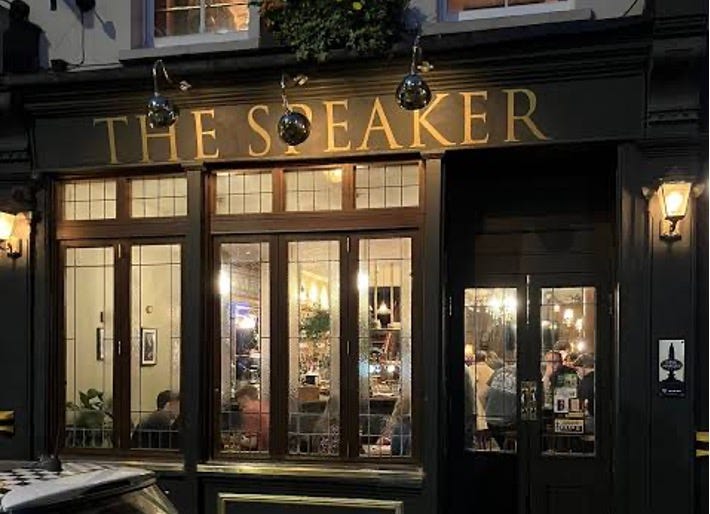
Yet there already is one, and it is right under our nose. The area of London enclosed by Buckingham Palace Road and Vauxhall Bridge Road is the London of the Conservative & Unionist party, an urban district that seems almost to have been designed by your average Tory MP. Its pubs are all overdecorated and cartoonishly British. There are hotels with Ruritanian names like ‘St. Ermin’s’ where spies meet. There is a mini theatre district which only ever seems to be showing the musicals Wicked and Hamilton. There are interwar neo-Georgian buildings called ‘Faith House’ and ‘Emmanuel Centre’ for ideas conferences. The residential areas are mostly made up of flats or small mews cottages: this is not a place for families, or for working professionals, but for Tory MPs.
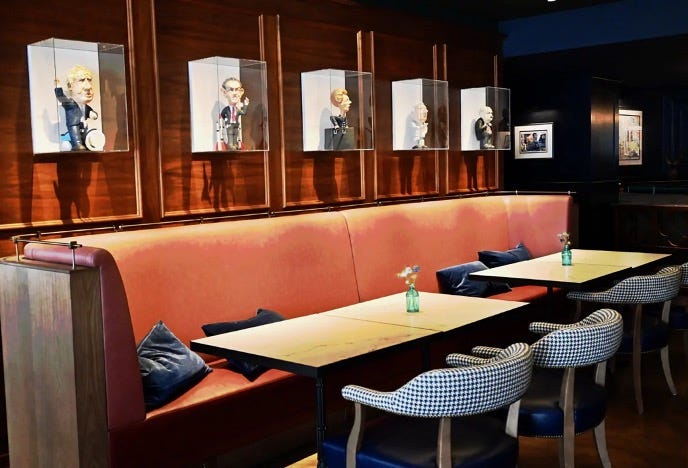
It is a seat of government but it has the airs of a red-light district, a naïve sleaziness that recalls a hen do or Cards Against Humanity – sleaze as practised by someone with a 2.1 in Politics from Durham. It is the place where Mark Menzies MP was locked in a flat by ‘bad people’ he met through online dating, who demanded he pay them £5,000; where William Wragg was blackmailed; where Chris Pincher groped for over 20 years. There is a propensity to ‘wind up’ in a nightclub called Players which has the atmosphere of a cruise ship, whose centrepiece is a white grand piano on which a jobbing player plonks the ABBA classics. For prime-central London it is unusually rich in takeaways, nosh to be wolfed down at 11:39 PM after pints with Onward. Elsewise, the restaurants function as tourist traps but for people involved in politics, bad and expensive food in places with vaudeville names like Chao’s Chinese and Café Ravioli. The Munich Cricket Club, an Oktoberfest bar popular with think tank employees, is Germany as imagined by Michael Fabricant. The main eatery in the area is a posh gastropub called The Blue Boar, the interior of which is decorated with British Politics memorabilia and a giant statue of a corgi tattooed with the union jack.
The Conservative party in the mid-2020s is supported by scattered and motley groups and kept going for frivolous reasons: aesthetics, inept goes at snobbery, and, above all, the need to preserve this Pincher-ite social world, the denizens of which are now becoming the party’s dominant element. Between 1990 and 2024 Britain’s Tories were led by non-doctrinaire grandees with little interest in the ‘M.O.G.’ or in ideas conferences. Now they have drifted away, leaving behind a junior stratum of backbenchers and researchers – ideological but by no means radical – who gather in this part of London. For 30 years they have written reports for people like David Cameron to ignore, but now David Cameron is gone, and so reports, British politics documentaries, Roger Scruton quotes, and Thomas Sowell quotes will at last have their day.
Kemi Badenoch is both a cause and consequence of this trend. Her entire social existence has been framed around the world of Tufton Street and Horseferry Road, and Kemi-ism, in its deepest meaning, is the populism of this one-and-a-half square mile: the belief that the people who work here, liberated at last, should now assert themselves as an independent social force with their own demands. Little surprise, then, that junior Tories and Tory-aligned figures have so eagerly glommed on to ‘Nick age 30’ and loudly identified themselves with his predicament. People like David Cameron were part of the Westminster Bubble and therefore deluded about Britain and its peoples; they were not so deluded as to imagine that the cause of a senior account manager at Hanbury Strategy is the cause of the nation.
Deluded, yet in many ways ascendant. Over the last 16 years Tory London has set the tone for Westminster, largely because there is no analogous centre-left cluster of think tanks and press organs. One effect of this has been the triumph of the Tory view of history in political coverage. As others have said, this is best described as a decadent, third-hand version of the Peterhouse school. There is a strong belief in the power of chance, contingency, and freak events – ‘Black Swans’ – in shaping the destinies of men, along with a keen sense of human frailty – but without any corresponding belief in the agency of individuals in history; this is perhaps not surprising when the individuals are abject figures like William Wragg. There is also a deeply Tory belief in a natural, spontaneous order in society, possessed of perennial qualities (‘the hacks are briefing, the spinners are spinning’). The breathless updates on Boris Johnson’s every move, but also a real shock that such a person might be opportunistic on the Europe issue, or would be tempted to follow an extreme course in 2019 to save their own skin, is an example of this sub-Namierism. There is ‘leadership’, but there are no individuals. It is the perfect ideology of the status quo.
All are drawn into Tory London’s orbit. Ben Judah, a former adviser to the British Cory Booker, now has his berth in Chatham House. Military officers appear on TV to inform us that we will need to introduce conscription and it never occurs to ‘Rachel Cunliffe’ to tell them to go away. Reform is firmly a part of its social world, and has to consciously avoid absorbing its ideas by osmosis. If anything Westminster is becoming more Pincherite as time goes on. One of the area’s newest developments is Orchard Place, a pair of glass towers bisected by a pedestrianised shopping arcade selling Street Tacos. That such a place would exist within touching distance of Parliament and Buckingham Palace – the equivalent of a food court selling ‘wings and slaw’ on Pennsylvania Avenue – is only explicable if we remember that SW1, and therefore British politics, is dominated by people like Chris Pincher. It is a monument to a status quo that, after the jitters of the last few years, has never looked more secure.