

$105,000 — that’s how much Rod Dreher cost the Hungarian taxpayer last year, according to freedom of information requests by investigative journalism website Átlátszó. Roughly three times the average salary in Hungary, but small change for a government that sees the Christian blogger, in the words of Balázs Orbán, the departing prime minister’s advisor, as a figure equal to Napoleon in the great pageant of world history. Dreher’s world historical deed, according to Orbán, was to revivify American conservatism, and, in so doing, to put his adopted country at the centre of an intellectual revolution sweeping the West. Now that the ogre has been safely packed off to St. Helena and Minerva’s owl has spread her wings, what legacy does this upheaval of the spirit leave in the Hungarian capital?
Dreher, an affable chap whom I exclude from the following polemic, works for the Danube Institute, the prize pear on a cheese platter of right-wing institutions set up by the outgoing Hungarian prime minister to make Budapest, in the words of its own substack, “the new European capital of conservatism”. It never seems to have occurred to anyone involved that it is a contradiction in terms for a movement grounded in the Oakeshottian preference for the near to the distant or Scrutonian oikophilia to have a capital, — with that kind of money on the table, why would it? From Budapest, these narodniks of the new national conservatism were to fan out and preach the politics of place in their own towns and villages, although they mostly just sat around at the city’s indie coffee shops, enjoying their tasteful nordic minimalist decor and anglophone staff and writing the occasional piece for one of the many potemkin periodicals funded from the public purse. Occasionally, their pensées would be translated into Hungarian — Libri, the local equivalent of Waterstone’s, is well-stocked with hardback editions of Goodwins, Wests, and Nina Powers in aspirational pastel colours.
This “Budapest scene”, as the New Statesman has posthumously dubbed it, was less a Tory Montparnasse or a European dimes square than a conservative version of regular’s table at the Kinshasa Hilton: a boozy rogue’s gallery of intellectual mercenaries and arms dealers in the battle of ideas, blissfully uninterested in the history, traditions, or even the inhabitants of the place beyond how they might be turned into money. Not even the most perfunctory concessions were made to the local culture: one oft-relaid anecdote — one of those apocryphal stories which, to paraphrase Jacob Burckhardt, are true and not true, everywhere and nowhere — tells of a British journalist, a rising star in the conservative firmament who, when served at some official dinner a plate of that delicious beef stew that the Hungarians call pörkölt and the rest of the world goulash, demanded he be brought steak and eggs instead. Even the autochthonous conservative scene seems of little interest to these journeymen: in one by no means atypical exchange, when I brought up Mária Schmidt, the doyen of orbániste intellectuals, to one well-remunerated German think tanker, he surprised me by admitting he had never heard of her before. No one, of course, bothered to learn the local language.
When the populist fury on the Hungarian right against Orbán finally boiled over, this insouciance meant that these would-be Chateaubriands were caught blindsided. What liberals I knew in Budapest are not enthusiastic about Magyar, a creature of the Fidesz patronage network; it was voters on the right who led the exodus from real existing postliberalism. Like Hitler and Speer tweaking the models for Welthaupstadt Germania as Soviet artillery pounded Berlin, the Danube Institute was planning its expansion to America even as Orbán himself was weighing up his exit options. One fellow at the Danube Institute even claimed to have thought up a watertight mathematical model showing Orbán’s party five percentage points in the lead — a theory that could have been exploded by a simple conversation with one of the many disillusioned former Fidesz activists and irate tradcaths one meets in Budapest when one ventures outside the anglophone think tank bubble. These out-of-touch anywheres would have done well to pick up a copy of David Goodhart’s Úton hazafele, available for the equivalent of £9.19 white english from Századvég Press’ webshop.
It is appropriate that a movement whose representatives trace their intellectual lineage to T.S. Eliot should exit the scene not with a bang, but a whimper. Postliberalism has long stood naked before the bitter winds of reason, refuted by everyone from the Bronze Age Pervert, Nigel Carlsbad, to, of course, the editor of this iconic paper, to the point that even James Orr no longer wishes to associate himself with it. With Orbán’s decisive defeat, it has been sent to the back of the class in shame by History herself. The conversation on the British right has long moved on from its airy, metaphysical abstractions towards a pragmatic focus on the most important social phenomenon of the past thirty years: demographic change driven by mass immigration. It is noteworthy that its standard bearers, Farage and his Reform lieutenants have mostly kept their distance from Budapest — whatever their flaws, they understand that their voters want technocrats to sort out this clearly formulated and eminently solvable problem, not intellectuals to provide them with a worldview.
Orbán sold those anglophone conservatives who supped at his banquet a vision of his country as Brideshead on the Danube, but it was another melancholic 20th century Catholic writer’s vision that his Budapest scene embodied: F. Scott Fitzgerald’s The Great Gatsby. Normal autocrats flex their power through vast public works or monuments; Orbán built a glittering façade of think tanks, conferences, and podcasts on a brittle framework of prefab ideas and exorbitant contractors’ fees, only for it all to collapse in the blink of an eye. Not in anything its personalities actually wrote or said, but in the history of its decline and fall, does the Budapest scene express that sentiment most Christian: omnia vanitas, memento mori.
Where to begin. The writer gestures at the average Hungarian salary, then proceeds to wield the purplish prose of just the literary "cafe culture" he's purportedly here to skewer. More bizarrely, the piece suggests something like, "Dreher is an affable chap, this isn't about him, but of course he's a fraud. Look!"
I don't agree with Dreher on everything, and don't live in Budapest. I'm just one of his readers. But here's the thing. He was maybe the only English-speaking writer who was there to push against the propaganda the whole of the Western press threw at Fidesz and Orban for years straight. At the very least, Dreher allowed those outside Hungary to see another angle.
Pace the NYT and the UK and pro-Brussels press, Orban was not a dictator, but was repeatedly *elected* by Hungarians. And now, rejecting him, they've elected another figure who agrees with "the dictator" on much. Fancy that.
I can't speak for the other Western conservatives who lived in Budapest, but as for Dreher, he wrote *a lot*. So he was paid for it. So what? How much media budget was spent by the usual suspects in the West in their years of shrill anti-Hungary hit pieces? Orban's government in Budapest surely got their money's worth having Dreher there. At least someone was not doing the Brussels copy-paste thing.
And he wasn't a shill either. For years, underlining the pluses of Orban's policies, he'd raise the problems. The cronyism that, likely, was the final thing that pissed off voters. Dreher never shied from these downsides.
The title of this paper "J'accuse" offers another odd paradox in this context. While writing about Hungary, Dreher has been doggedly tracing the rising tide of antisemitism in both the US and Europe. What would Zola say? Would Zola be carping against Orban and mocking the American journalist? I suppose Zola would be with islamogauchisme and railing against the JOOOS. Yeah?
Moi, j'accuse.
The prose really gets ahead of itself: "Normal autocrats flex their power through vast public works or monuments; Orbán built a glittering façade of think tanks, conferences, and podcasts on a brittle framework of prefab ideas and exorbitant contractors’ fees, only for it all to collapse in the blink of an eye."
"Autocrat"? No. Elected. Repeatedly. And he stepped down without protest when he finally lost.
"Only for it all to collapse in the blink of an eye.” The blink of an eye? Orban won FOUR consecutive elections and was in office 16 years.
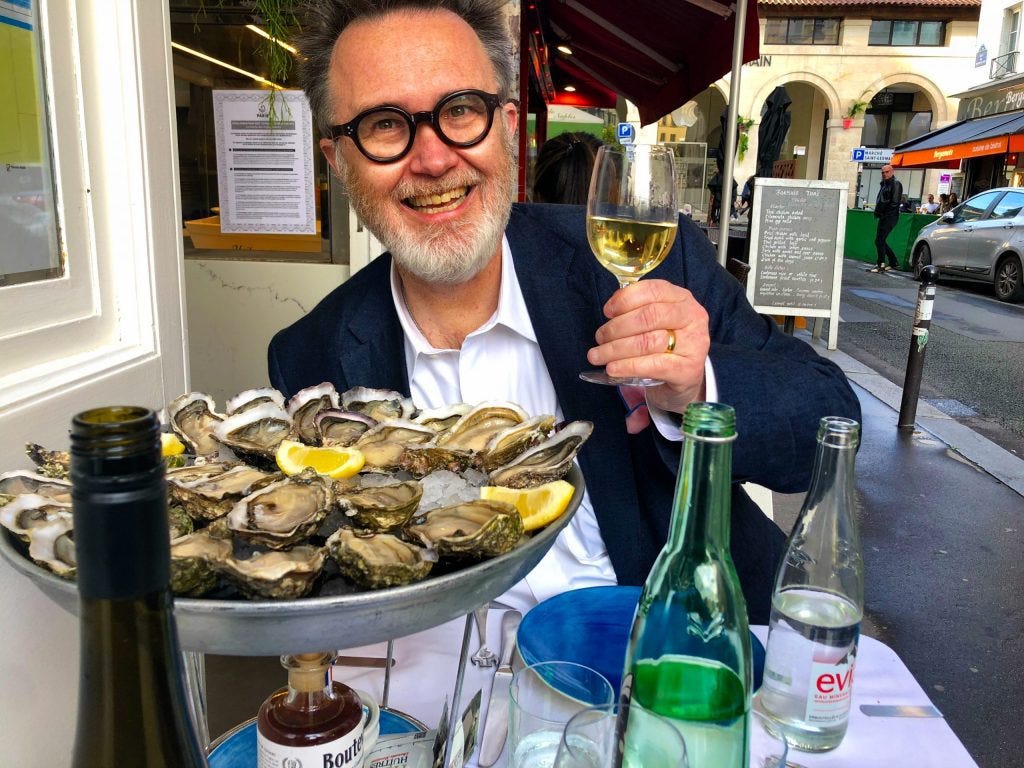
As for selfies taken with oysters, yeah, I get it. Dreher likes oysters. And has a problem taking selfies when oysters are around. It's celebratory in an odd way, because me, as reader, I don't need it.
But this, mon ami, is a very small thing. And yes, I know, your piece is not about Rod Dreher, but my comment mostly is. Perhaps some of your depictions of the pro-Orban Budapest Western Right are more on target. I wasn't there to verify.
Not dead