The Future and History of Knowledge Work
Franz Pokorny
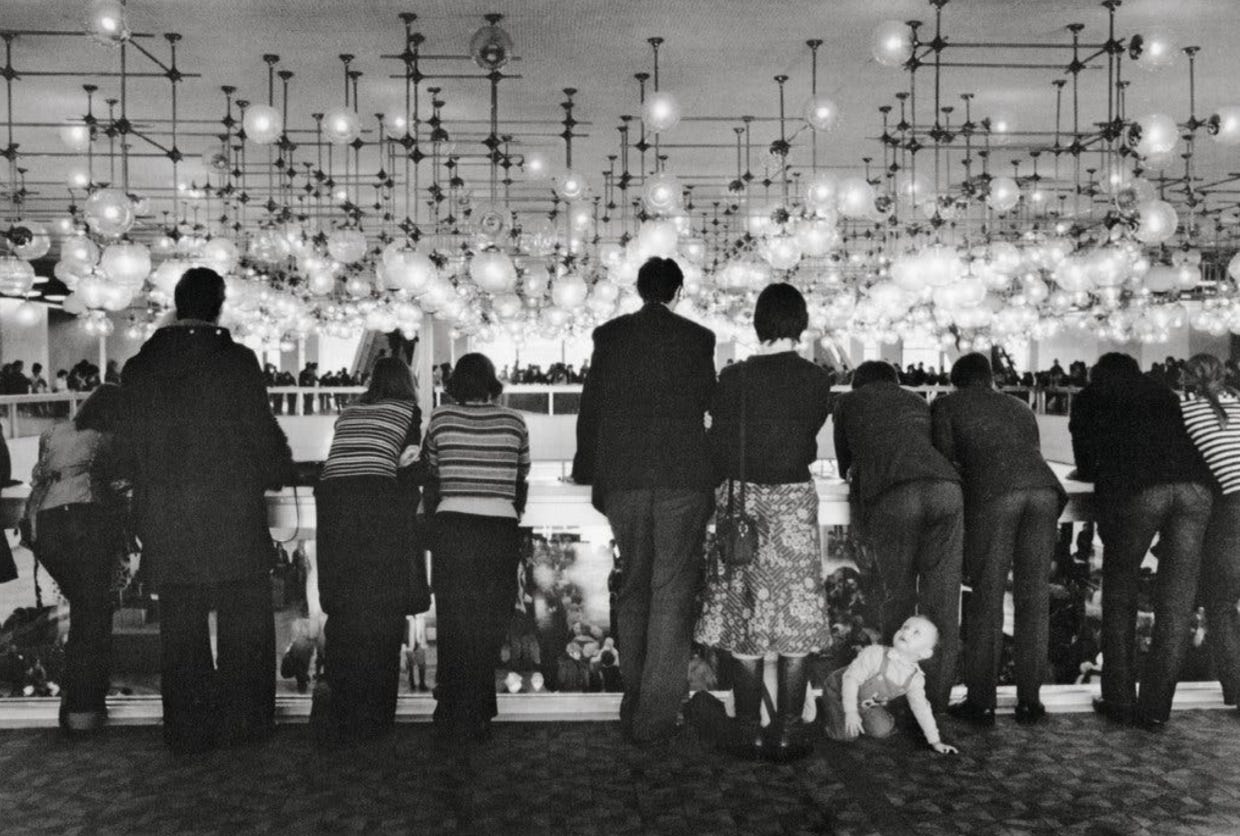
The Great Clock struck and the sea rose up in front of the window, the rooms with the fern-pattern wallpaper and the frosted chandeliers, the stuccoed ceilings and fine furniture, inherited from a vanished middle-class past hinted at by the berets of the monument curators, the measured gestures of ladies eating cakes in the Italian cafés, the florid and chivalrous greeting ceremonies of the pursuit of art in Dresden, the hidden quotations, the mandarinesque, pedagogical, allusive rituals of the Friends of Music, the stately free-skating programmes of middle-aged gentlemen on the rinks; left over in the gently rolling hills of the Elbe valley in houses under the Soviet star, left over like the pre-war editions of Hermann Hesse, the cigar-brown Aufbau Verlag volumes of Thomas Mann from the fifties, jealously guarded in second-hand bookshops, where the undersea light commanded reverence from every customer that entered, paper boats that housed fossils slowly poisoning themselves with memories, tended pot-plants and kept the compass over the creaking floorboards unwaveringly pointing to Weimar, left over in the roses growing round the island, across the faces of the clocks that were rusting away, their pendulums cutting through our lives between the poles of silence and non-silence (it was one or the other, mere noise or sound it was not)…
— Uwe Tellkamp, The Tower
The 20th century was the age of “knowledge work”, a term coined by Peter Drucker in 1959 to describe a shift in the composition of the productive forces as the possibilities for extensive growth within the postwar order of fixed borders and low factor mobility reached their natural limits. Knowledge work is easily distinguished from other forms of labour, being no more than the coordinating power of the mind in the process of production. Since the dawn of history there has always existed a class that lives by its brains rather than its capacity for physical labour, and though its numbers have fluctuated down the centuries, only with industrialisation did its ranks exponentiate to the point that it made sense for Drucker to write about “knowledge work” as a new, if not wholly unprecedented, force within society.
The roots of knowledge work go back to the industrialisation that, in Drucker’s time, it was already beginning to supplant. Industrialisation, even in its extensive phase, meant a growing segment of the population, increasingly concentrated in cities where more complex forms of life prevailed, had to be educated to perform the equally more complex tasks now required of it. The expansion of literacy enabled the workers to coordinate and make demands of the other classes of society — not least among them the demand for more education. Industrialisation also expanded commerce, which increasingly came under the oversight of the state (now often under the working class parties’ management), whose large private and public bureaucracies required still more educated workers. It should be clear from this extremely simplistic sketch, to which a thousand caveats ought rightly to be added, that the objective interests of the growing class of knowledge workers and that of industrial labourers ran parallel in the extensive phase of industrialisation; it was thus natural that they came to share socialism (in its most basic sense as state action to promote industrialisation and class solidarity) as a common cause. This process did not happen overnight; in places where the pre-industrial culture of knowledge work had deep roots, it was usually able, at least for a time, to bend the arriviste intellectuals’ aspirations to its own preconceptions, but socialism was the true native language of the knowledge boom, and by the time Drucker was writing, variants of socialism with an egalitarian universalist ethos (social democracy, Christian democracy, etc.), which had forcibly displaced other socialisms in the Second World War, enjoyed near-universal acceptance among western intelligentsia.
Besides cementing the bond between knowledge workers and the industrial working class, the shared language of socialism allowed for an esprit de corps to develop between knowledge workers themselves. This was important insofar as not all knowledge work was alike. Most of it was simple clerkship; the sorts of menial tasks which any literate person of sufficient intelligence can perform, but there was also a flourishing of intellectual work to meet the needs of a burgeoning education sector, the emergence of a politically conscious public, and an expansion of leisure that fed a growing demand for theory. The essential skills for performing both forms of knowledge work were identical (“bisogno saper leggere” — Jacob Burckhardt), and many who saw themselves as philosophers or mathematicians ended up teaching in humdrum provincial schools or as bank clerks (like George Soros). Although the protracted, politically contentious transition to an intensive growth model that began in the 1960s and was only really „settled“ in the 1980s dissolved the common bonds between the working class and the intelligentsia and diluted the latter’s socialist convictions to the point that today all that remains of its old might is the vague, generally held notion that educated people are “a bit left-wing” (again, like George Soros), for a time even these loosened ties of solidarity still sufficed to hold together the big tent of academics, bureaucrats, lawyers, NGO employees, and office drones in a pacta conventa of „nice things“ that found its quintessential expression in the Orange Book. As this coalition fractures, we should keep in mind that the alignment between egalitarian universalist ideology and knowledge workers’ class consciousness was always historically contingent — Michael Ledeen’s Universal Fascism and Michael Wildt’s An Uncompromising Generation show how things might have turned otherwise.
The relative scarcity of knowledge workers in the 20th century afforded them considerable bargaining power, which translated into high salaries and leisurely working conditions — something not lost on Nick as he picks through the wrappers of his M&S meal deal on his half hour lunch break. With power came prestige — everyone now wanted to go to university, and the business suit, once a modest salaryman’s uniform, became the universal mode of dress. Spheres of life in which knowledge work had hitherto only served as scaffolding — i.e. politics — were retailored to the tastes of the new class, of which the clerk rather than the intellectual became, owing to his sheer numbers, the final arbiter. To understand the society remade by knowledge work it is necessary to clarify what it was not. Intellectuals were not the driving force behind the early 20th century’s classic political style, socialism — that was freemasonry and organised crime — and would not have claimed for themselves such a role, knowing their place in the Worker’s Movement to be no more than to clarify the great tides of history that would have rolled on even without them. This is not to say there there wasn’t a shadowy class of knowledge workers who strove to remodel the habits of unwitting suburbanites and deracinated mass men — Ed Bernays, or T. Dan Smith’s sleazy PR firm — but these were intellectual hired thugs who sold their services to darker powers, although in his Crystallising Public Opinion Bernays, like a young Aureliano Buendía taken by his father to see the ice, was haunted by visions that one day public relations would slip its moorings and establish itself as a fully autonomous civilising force able to soften the rough edges of democratic politics. But Bernays did not live to see the emergence of a professionalised public sphere; the idea that knowledge work alone might lay a foundation for government would have to wait half a century to have its day in the sun.
It was only with the waning of working class power in the 1980s that the Islington wine bars shed the skin of an outdated “and frankly inappropriate” continuity socialism and launched their own Griff nach der Weltmacht. This was that gloomy age when “public policy” freed itself from the political, and elections were fought on “competence” rather than ideas. It was only in this winter of the human spirit that the thought could have occurred to run the mother of parliaments on the “seven principles of standards in public life”. This era is misconceptualised by some — see the latest Will Self article — as a time of “technocracy”, “managerialism”, or “proceduralism”. These words suggest a drive for total rationalisation by meritocrats, or perhaps the confucian rectification of names that Pound called for — would that such a consistent method were applied! The nouveau middle class of knowledge work, their ranks now bloated beyond their natural limits, was incapable of the systematisation that „the definitive end of Man properly so-called“ asked of him, contenting itself instead to gild every facet of life with the purely aesthetic professionalism that found its Balzac in the Dilbert comics or the television satires of Richard Gervais. It was precisely the unsystematised nature of the new ideology’s precepts, above all the burgeoning field of human rights law, that opened them up to abuse by petty tyrants and their snarling standards watchdogs.
This highly choreographed, but fundamentally arbitrary officialism found its counterpart in the life of the mind during that period. The unmooring of Policy from the tectonic forces of midcentury mass democracy facilitated an airy intellectualism whose loci were think tanks and “comms”. This was when the machinery of manufactured consensus was able to actualise Bernays’ dark vision and set itself up as a power in its own right, and the NGOs replaced the trade unions and the North London men in the vanguard of Woke. The much-flogged dead horse of a right-wing public sphere — in the gruff tones of Mr. Lobe a “patronage network” — is predicated on the idea that this world, the world created by the primacy of knowledge work, has no intrinsic value content and can be redirected to higher ends — it also relies on the more spurious belief that the material conditions which allowed it to flourish still persist. Those keener of sight saw the end coming in the vast amounts of paperwork this regime churned out. Rather than the bedrock of an unshatterable “proceduralism”, these were a rococo flourish on a fantasia of bourgeois modernity (office work and fake civil society — not exactly the bloody Freiherr von Risach now is it), whose altogether more sinister purpose became clear when, at the end of this mal epoque, LLMs arrived on the scene.
It is hardly a novel insight that the large-scale rollout of AI will obsolesce much knowledge work. This is not to say that it will happen tomorrow; due to a combination of general economic malaise and the failure of AI’s boosters “to really offer people a compelling political vision they can get behind, yeah”, the AI boom is the first whose bust everyone has predicted at every step along its doddering upward stumble. It is also perhaps the first economic boom to deliver no real visible prosperity; the “tech bros” have made themselves no friends, and when the markets deliver their inevitable sentence, luddite knowledge workers will seize upon the opportunity to pressure the regulatory state to clip their wings. For the moment, the clerks are not going anywhere. Andrew Orlowski is quite right to pour cold water on the ability of existing technology to eliminate surplus knowledge work beyond the IT sector, and even there it seems to be an inside joke that outsourcing rather than AI-driven productivity gains is behind the slack labour market. This being said, the long-term trajectory is clear in the same way that the collapse of the dotcom bubble failed to halt the unstoppable march of the internet, and us substackers are right to see the writing on the wall in the ubiquity of chatbot-generated text in everyday life. The collapse of “the AI bubble” may even accelerate these ends by reallocating capital more productively (of course, it might just be snapped up by even more preposterous grifters than Messrs. Altman et al.) and, though the Woke will try to use the “crash” to close the book once and for all, they like the Bourbons have learned and forgotten nothing and their restoration will end exactly the same way as their attempt to quash Populism during the Brandonocene did.
With the eclipse of knowledge work will go the prestige of the peculiar way of life and accompanying political culture it sustained. Much has been made lately of LLMs ushering in a new dark age of “postliteracy”; the Dragon has already zapped this mind virus with the horse dewormer of historical consciousness, demonstrating that the catalogue of symptoms listed by Mr. Marriott and his philistine brood were already present in the 20th century, and in fact developed parallel to the explosion of knowledge work. The “postliteracy” thesis is populism in the most vulgar sense, counterposing an imagined pure past (“that never really existed”) of a civilised, yet also democratic, intellectual culture to a corrupt modern world in which the lesser breeds (tiktokers, youtubers, posters) no longer know their place (their mother’s basement). The arcadia in which think tankers and NGO drones spun their ideas to journalists to build popular consensus (or at least deceive themselves into thinking they had built one) was already over the moment normies, pushed into the sweltering Victorian slums of social media by Klaus Schwab and his minions’ enclosure of the commons, discovered the genteel pleasures of populism. Now that LLMs allow any autodidact teenager to operate a boomer-optimised disinformation empire from the comfort of his bedroom, it is not coming back. The intense preference cascades that this unprecedentedly decentralised media environment facilitates will in time slow to a trickle existing opinions as an increasingly skeptical public comes to dismiss all new information as “AI slop”, a process already underway at the commanding heights of the public discourse, although herd immunity has yet to develop amongst the general public.
This article was supposed to be about Palantir, and I suppose I should finally say something about that company. The revolutionary promise of AI is to allow small teams to do what once could only be done by large, complex organisations. While the political culture of this new age will eventually settle into some sort of equilibrium as it becomes apparent what new ideas can be leveraged to drive human action on a meaningful scale and which ones can’t (not, in this case, by “small teams”, but major data analytics firms with access to massive caches of social media user data), and the public becomes increasingly disillusioned towards any kind of intellectual product online, the short to medium term effect will be to disrupt settled institutions, ideologies, and ways of doing things. Palantir, as the preeminent data analytics firm, which markets its technologies to established bureaucracies sitting on vast pools of internal data, is the antithesis to this great historical movement.
The essence of what Palantir does is to allow these institutions to squeeze more from their existing resources by streamlining the organisation of information. These productivity gains are matched by a widened scope for ideological frivolity: the Right’s longstanding thesis that legacy institutions are dying a death by a thousand Wokes (affirmative action, declining education standards, population dysgenics, and the sheer inadequacy of a postwar welfare state to meet the needs and whims ageing, ethnically diversify society for which it was not designed) is no match for Mr. Karp’s deus ex machina. The left’s peculiar idée fixe that Louis Mosley will somehow use NHS data to march his blackshirts into Whitehall and dismantle democracy is unfounded for precisely this reason. While I can’t pretend to know the Palantir management’s ultimate aims or intentions, the consequence of their actions has been to extend democracy’s natural lifespan by smoothing over its internal contradictions.
This is not to say that Palantir is an inherently conservative force. Its software is, like any capital intensive form of knowledge work, a friend to idealism in whatever guise. This potion can be taken to dream the dream of midcentury liberalism forever, but it can also stimulate other visions. Political order can have whatever aesthetic takes one’s fancy; reality is never going to mug you. An analogy might be drawn to the romantics’ conservative turn; Hegel’s reconciliation with the Prussian state, or Schlegel settling down at the court in Vienna and embracing the Mother Church. The Revolution had proved that nothing stood outside the mind’s remit — was it really so unthinkable that conservatism might lead Germany’s spiritual renewal; that a Hohenzollern or Habsburg might put himself in the avant garde of the great upheaval? For Palantir, was ist, ist vernünftig. If anywhere today a revolutionary party were to come to power and find the work of change blocked by a hostile bureaucracy, Palantir is whom it would call to keep the administrative machinery ticking, but it could just as well be used to give us a thousand years of this government’s fully-costed focus on meeting its deliverable priorities for the British people. In any event, it seems poised to consolidate whatever emerges from the disintegration of the democratic republic of letters built by knowledge work into an internally coherent political order.
One of the best portraits of life in a post-revolutionary society caught in infinite deadlock is Uwe Tellkamp’s The Tower, an ornate, experimental novel set in East Germany in the 1980s and published in the early Merkel years to great applause from the feuilletons, though its author later fell out of favour amongst the critics for espousing exactly the kinds of opinions one would expect a middle-aged man from Dresden to have. Tellkamp, whose book is subtitled a story from a sunken land, spins a tale of two East Germanies; the country itself and the substance into which it had sunk. There is the eponymous “tower”; the floating world of niche society (ask Katja Hoyer), where the rituals of bourgeois high culture were still acted out by the party’s cultural and professional elite high above the grey socialist everyday. Outside is the mysterious force that one of Tellkamp’s characters calls “the current”; the self-forgotten dreamscape of feeling that winds through the rusting furnaces, creaking steelworks, and radioactive sludge of the red kingdom’s pre-postindustrial wastelands as the country hurtles towards zero hour. When the old grind of knowledge work and “the Habermasian conversation of administrative lawyers, human rights NGOs and journalists” is abolished, the busywork of unelected judges and bureaucrats substituted for the joyful whirr of a sleek silver bank of Subsumtionsmaschinen, and the lying fake news media dispersed to the winds by deepfakes and ChatGPT, it is “the current” that will replace it. Instead of Kojève’s end of history, where the absolute idea is everywhere apparent, such that nothing meaningfully new can be said or done, ideas in the coming utopia will retreat back into the tower; the secret realm of intellectual work in which the cultural forms of the sunken world of knowledge work are still acted out by the small, high-intensity teams who keep the great clock ticking. But there is a way to make the new power legible once more to a real public sphere, and to soften its hard edges with the civilising touch of procedure; grounded this time not in human rights mumbo jumbo, but in reason. That way, already proclaimed in these pages with the force of a thunderstorm in the Harz, is Meritocracy.


