

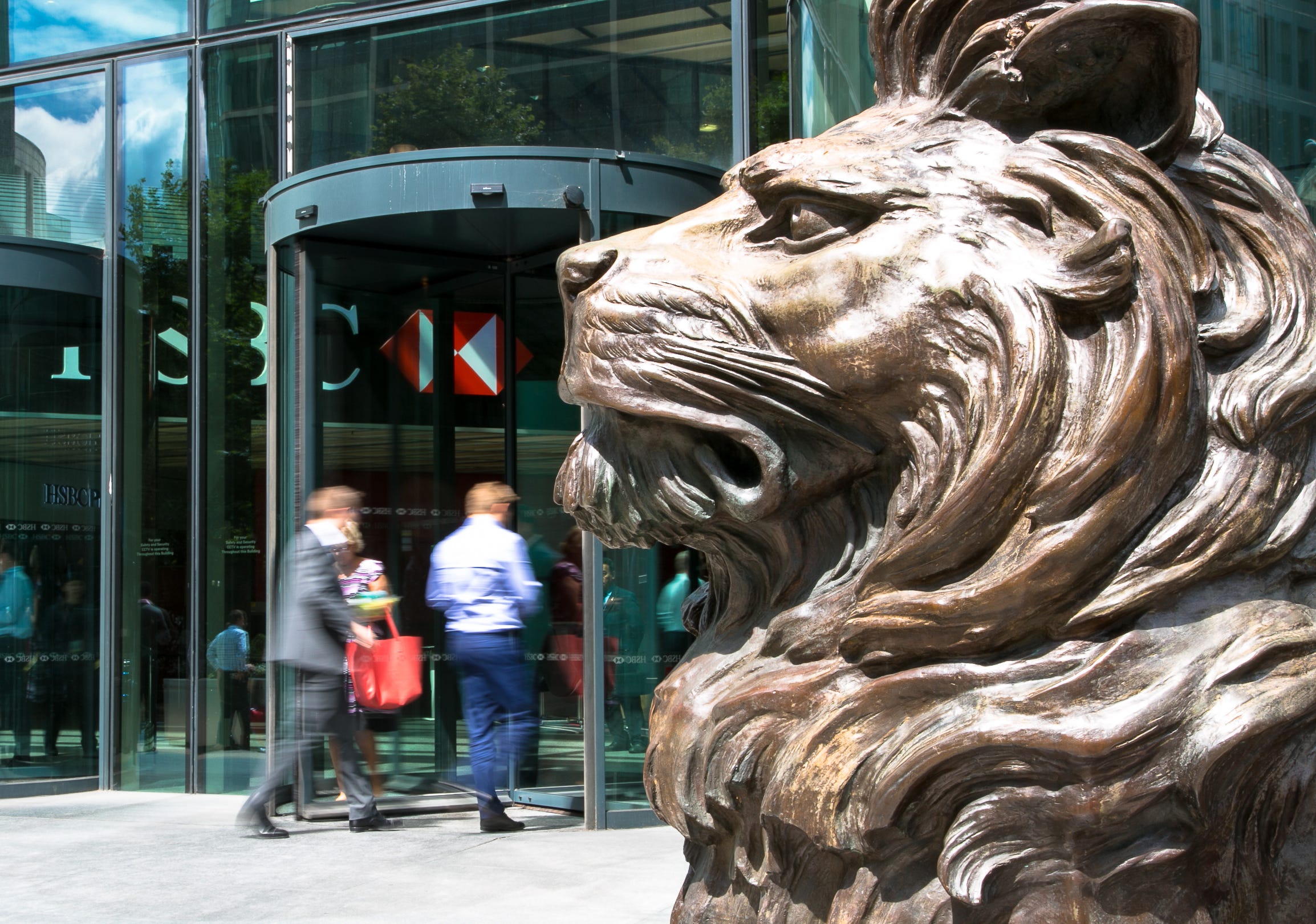
In the summer of 2018, I would regularly take the DLR from Bank to Canary Wharf out of a pure instinct to flânerie. My reading of blogs containing bad financial advice convinced me that there would soon be a catastrophe in the markets; and I wanted to document the last moments of the financial district before it happened. The docklands is a unique place in Europe. It was, in a one-off exemption to the planning act, built entirely by dictatorial fiat when a single corporation was empowered to redevelop the area independent of any municipal authorities. Moving in from the City on the DLR, you have a gut-feeling of entering a new place from which ‘modern London’ is very different. The very existence of the DLR itself is a giant, flashing question mark to the whole existence of TFL. For every failure of the British state, the Docklands, so long as it stands offers an alternative: a world in which Beveridge’s report to the Eugenic society was heeded, a world in which Norma Tebbit was never crippled, a world in which Tony Blair lost the 1997 election, a world where the Queen Elizabeth aircraft carriers were scrapped, a world in which Britain stuck to the Herd Immunity strategy wisely recommended by all medical experts; Chinese nuclear missiles stationed in Bermuda.
You are brought flying above rows of low rise converted slums, 1960s housing estates where Bangladeshi women hang their washing from the balconies, crumbling high-rise Ballardian towers and churches built by Wren: it is the most subtle piece of architectural propaganda known to man. You visibly see every symbol of postwar Britain from a form of transport de-facto banned from the rest of the city, then, you arrive; the shops are underground and the streets are clean. There are plentiful roads but little traffic. There is nothing quite like it in Europe, a self-contained island visibly more sophisticated and at-ease with itself than the wider city in which it is set. It is a giant two-fingered salute to the last 60 years of “modern Britain”; a place with no churches and no chicken shops.
The point is, I love Canary Wharf with a comprehensive depth the c. 2023 “Angloposter” who vaguely likes “Skyscrapers” will never understand or equal. There are many who pretend to like it, just as there are many who pretend to like ‘eugenics’ or revisionist history, without understanding it. There has been no attempt by its soi-distant defenders to truly abstract from Canary Wharf a set of universal urbanist principles. The most innovative feature of the development is still completely unremarked upon: the fact that, within Canary Wharf, all the shops are placed underground: at once freeing the vast open spaces between high-rise developments to the genuine (viz. non-commercial) pedestrian. One notes the similarity with another beloved favourite, the Parisian Arcades so well analysed by Benjamin. You can easily see, in these principles the basis of Meritocratic palazzi: in the new government, one can imagine the construction of Italianate quadrangles in a series of insulae linked entirely by automated monorail: within these islands, all commercial activity necessary for the needs of the inhabitants would be placed underground leaving the central court, as in the barbican empty for recreation. Each of these ‘islands’ would be crowned by a Telvanni skyscraper reserved, not for office space, but the dwelling of the Meritocrat who controls the zone. The areas in between islands could be safely returned to nature in the synthesis of conservation and development. On this model, we could safely bulldoze the entirety of the London suburbs.

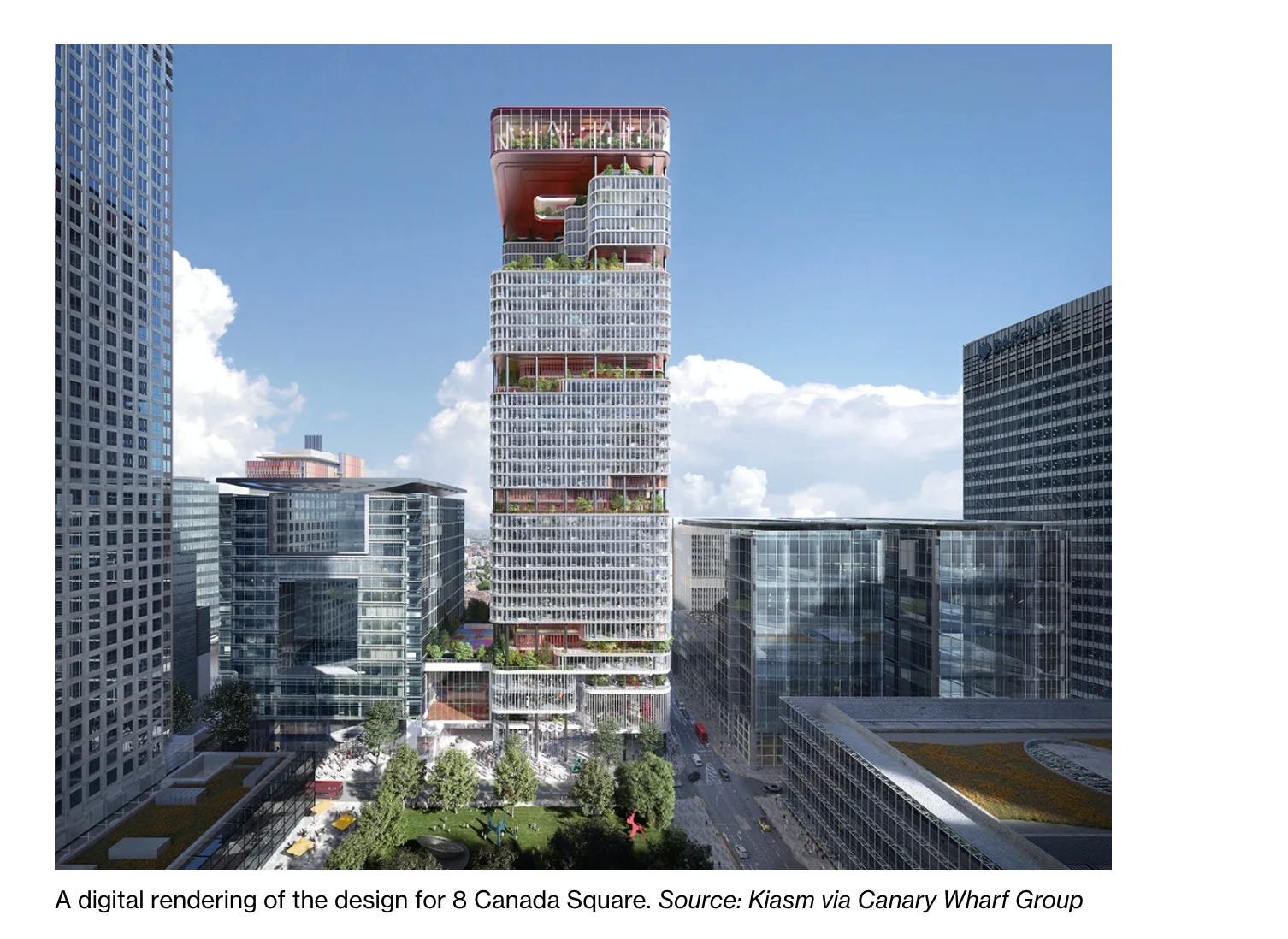
On these grounds, we are authorised to say that this decision should be registered as an act of architectural vandalism on the same scale as blowing up Big Ben, or turning the Barbican into a shopping centre. The HSBC building can be seen at miles from multiple directions of London – from Ally Pally to Customs House – it has a far greater claim to be “iconic” than Battersea Power Station, or the National Gallery, both of which were saved by influential lobbies. Any depiction of London between 2000 and 2020 A.D will include the HSBC tower. The ‘chunks’ in question completely destroy the cyberpunk uniformity of the present building which make it great, seen through a rainy haze. Why is it that such a self-evidently important building doesn’t even enter into ‘conservation’ discussions?
Architectural conservation in Britain begins in the postwar period as a purely private scam to save the stately homes. Brideshead Revisited dates from this period, as does Orwell’s bombastically smug prediction that the homes shall soon be turned into holiday camps. Faced with a powerful new Labour government, which introduced an inheritance tax and made grammar schools free (skyrocketing the TFR in the process); the doddery old English aristocracy faced its first brush with financial independence and barely lived to tell the tale. As a result, authors like Waugh launched a propaganda campaign to persuade us that every squalid Tudor hovel was a palazzo and had to be saved for the nation in perpetuity.
Conservationism really came into its own about two decades later with the foundation of the Victorian Society. We all know the story, that brief decade in which the North London men were empowered to blow up vast boroughs worth of slums, and force their Celtic inhabitants into concrete jungles. A counter-movement began, championed by lively homosexuals like John Betjemen, who launched their first salvo in successfully saving the monumentally useless Euston arch, which today, quite fittingly, houses a Brewdog. Betjemen too was a North London man and Victorianism essentially a fronde of the suburbs, aiming to persuade a sceptical nation that a c. 1919 neo-Gothic CofE church ministering to 3 Irish drunks in Cricklewood was a treasure.
By the early 80s, the counter-movement was well on the way to academic respectability. Peterhouse College, of Cambridge, served as a madrassa of architectural traditionalism; a powerful patron was found in the figure of King Chuck, who by being stupid made people suspect the ‘serious’ trads were secretly rather clever by contrast. It was increasingly the turn of the Brutalists to play the card of conservation. The T.V programmes of Johnathan Meades in the mid 90s established the calling cards of sentimental Brutalism. Brutalism was lauded in far more ‘traditional’ terms than poundbury, the fact that the buildings didn’t actually work were immaterial to the Positive moral effects they had on society by representing “a time when governments did things.” Trying to get bits of increasingly pointless Brutalist architecture listed was a dimly remembered favourite activity of the sort of North London trot who felt ‘politically homeless’ under Tony Blair in the early 2000s.
The point is, conservation in this country is tied to not so subtle political agendas. Country houses can be counted on to be preserved because they are friends of Jesus and the Barbican will always find supporters so long as there are people who yearn for the days of Stalin and Mr. Wilson. Who, then, will speak up for the HSBC tower? That plucky little building, who wants to Have a View but doesn’t know what to Say? Certainly, we cannot count on our self-described ‘neoliberals’ who, just as they are radical Keynesians when it comes to lockdowns, are firm aesthetic traditionalists with no respect for their own heritage. More on them later. A part of the problem is that the majority of people do not realise the era of High Globalism has ended, and so fail to see buildings like the HSBC tower as the unique things they are. The word ‘postmodernism’, like ‘Victorian’, is a sort of non-category under which a variety of different styles are lazily placed.
There are some general categories of the style at all times we shall note. The objection typically levelled against Globalism by Brutalists is that it represents a downscaling of ambition from the mid 20th century architects who desired to remodel entire cities. Ignoring the fact that, outside of the Third Reich, no modernist architect actually did get close to remodelling whole cities, so it is pointless to judge them on an unfulfilled ambition, this is still wrong. The ambition of Globalist Architecture is to divorce buildings from ‘the Social’, it exists to create “spaces” which exist entirely in dialogue across continents with each other, without regard for the local conditions of Mumbai, London or New York. Within these spaces, the egoism of the architect, as shown by the once-contemporary term of rebuke ‘Starchitect’, is given free reign.
It is strangely never noted that if you were, this writer disdaining the project, to try and locate a purely ‘British’ school of architecture, Postmodernism would not be a bad call. The greatest of the ‘postmodernists’, Foster, Rogers, Farell are all Brits; London the greatest exhibit of the style West of Suez. Palladianism, the Beaux Arts and Brutalism are all foreign imports, even the Gothic is basically continental but with Postmodernism we see the flowering of an entirely indigenous school of high art in these otherwise backwards and provincial isles. If one was to create a self-consciously ‘nationalist’ propagandistic official art for the purpose of valorising a new regime, it would naturally employ Postmodernism c. 1991 as official style rather than boring on about cottages and Lana Del Rey and village churches.
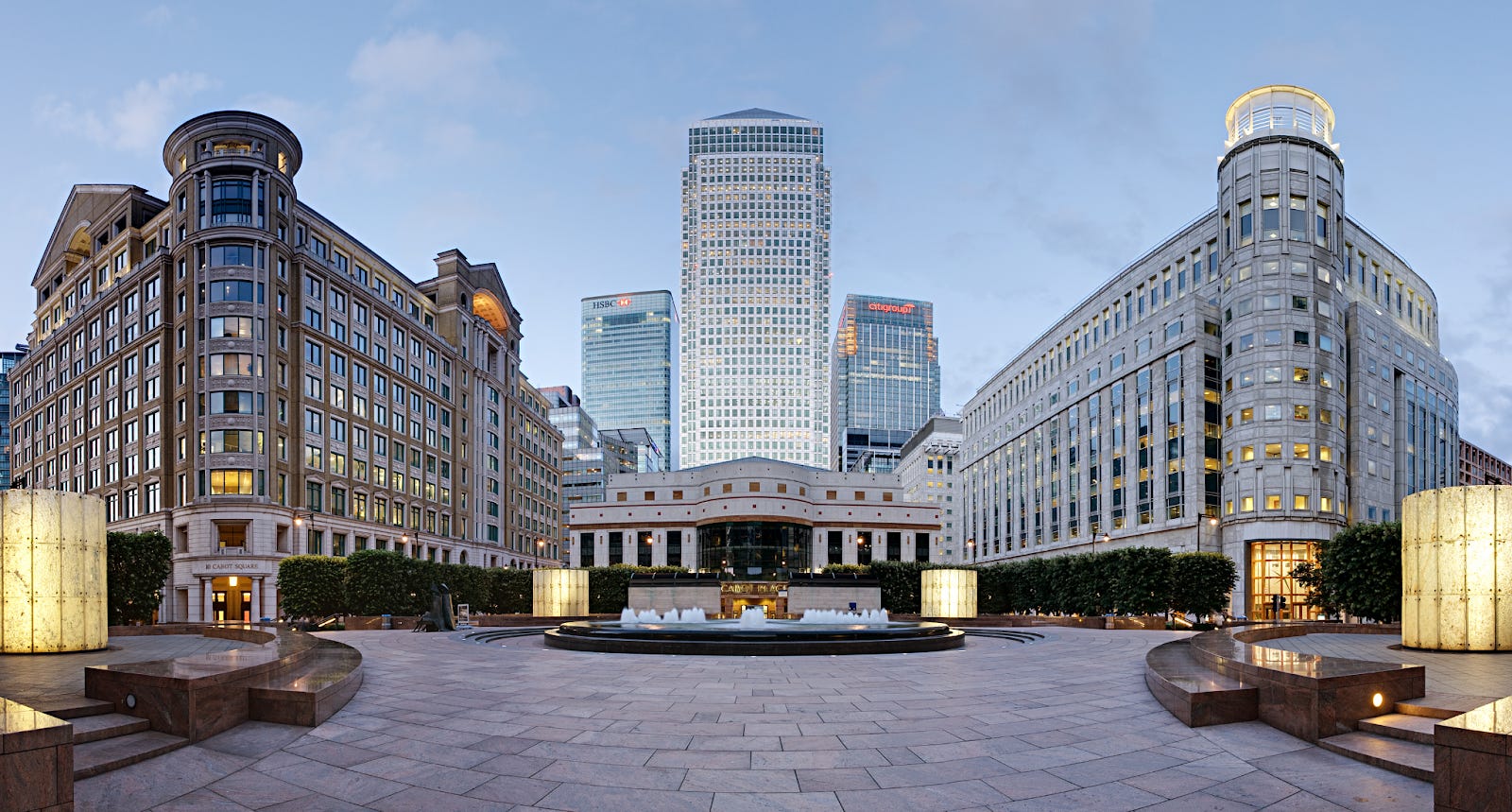
I shall propose three, amateur periods of High Globalist Architecture. The first is a triumphal stage, and is limited almost entirely to commercial buildings. It marks the emergence of a ‘modern’ style which is nonetheless non-functional around the late 70s and ends in the mid 90s. These buildings are commissioned largely by corporations themselves, often in areas like the docklands without any ‘local character’ in need of preservation, representing discerning but non-academic taste which hadn’t been enslaved by woke Universities. It is in this period that the greatest overtures are made to traditionalism in the form of the pastiche Italianate you can see in Canary Wharf, countless shopping centres and bits of Wall Street. This, however, is very different from the ‘walkable density’ of the 21st century trad; there is no attempt made to harmonise the revivalism with existing buildings, like in Budapest, Dresden or Prague; these buildings have been built out of a pure, spontaneous desire for pleasure and are perfectly integrated with the infrastructure of a modern city (‘cars’).
The Temple of Solomon.
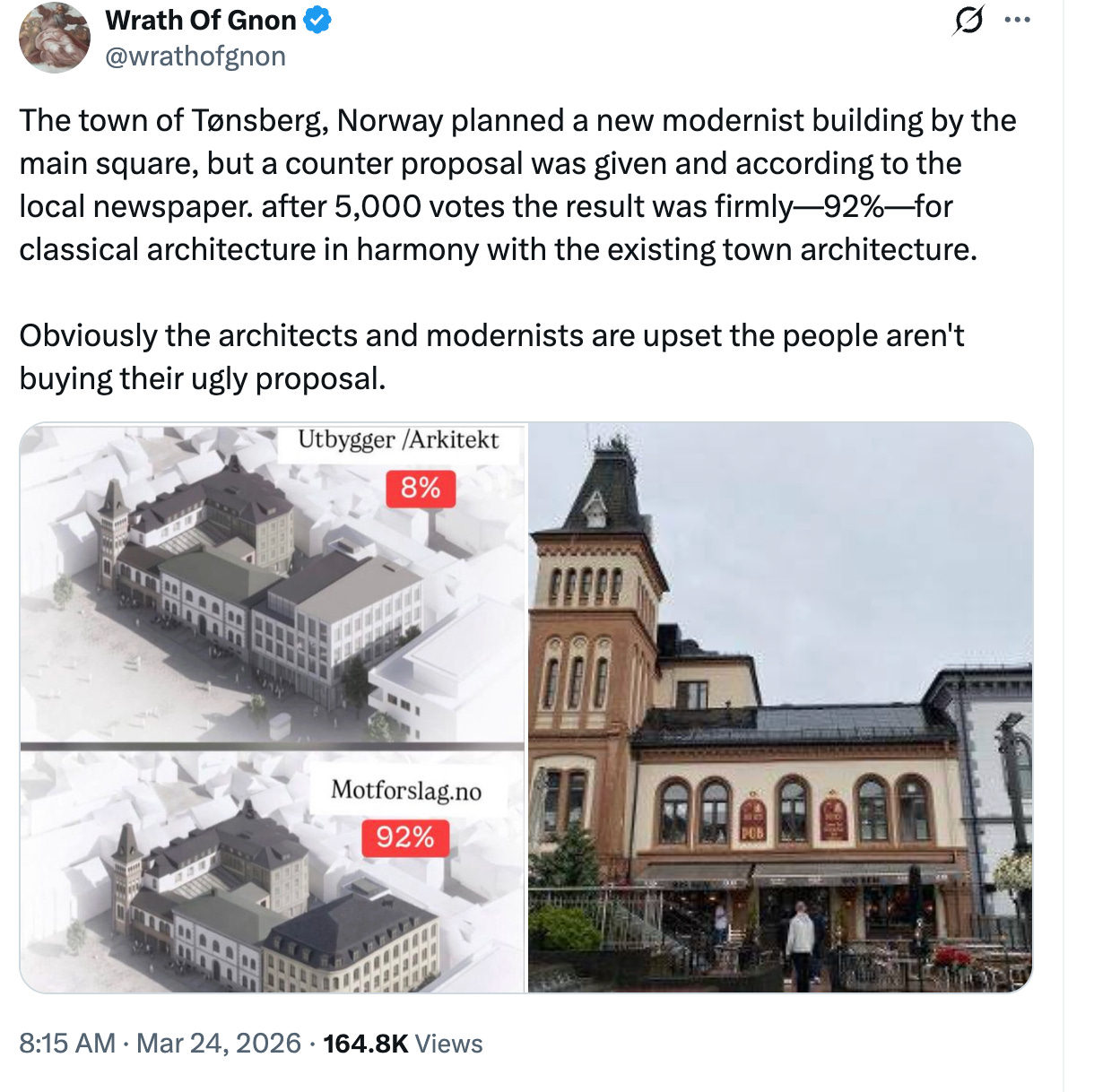
These two buildings, while both anti-modernist, cannot seriously be compared in their goals and effects. Cabot Square is an attempt to create a geometrical effect, resembling, discerning minds will note, a Masonic temple, with two ‘pillars’ holding up the Iconic pyramid; like the best modernist designs it has totally destroyed the ‘local character’ of the area in which it has been built in the name of an aesthetic project. Where it differs from Brutalism is that it refuses to be constrained by the moral diktats of the 20th century socialism, such as Mies van der Rohe’s refusal to put triangles on skyscrapers because they resembled feudal crowns.
