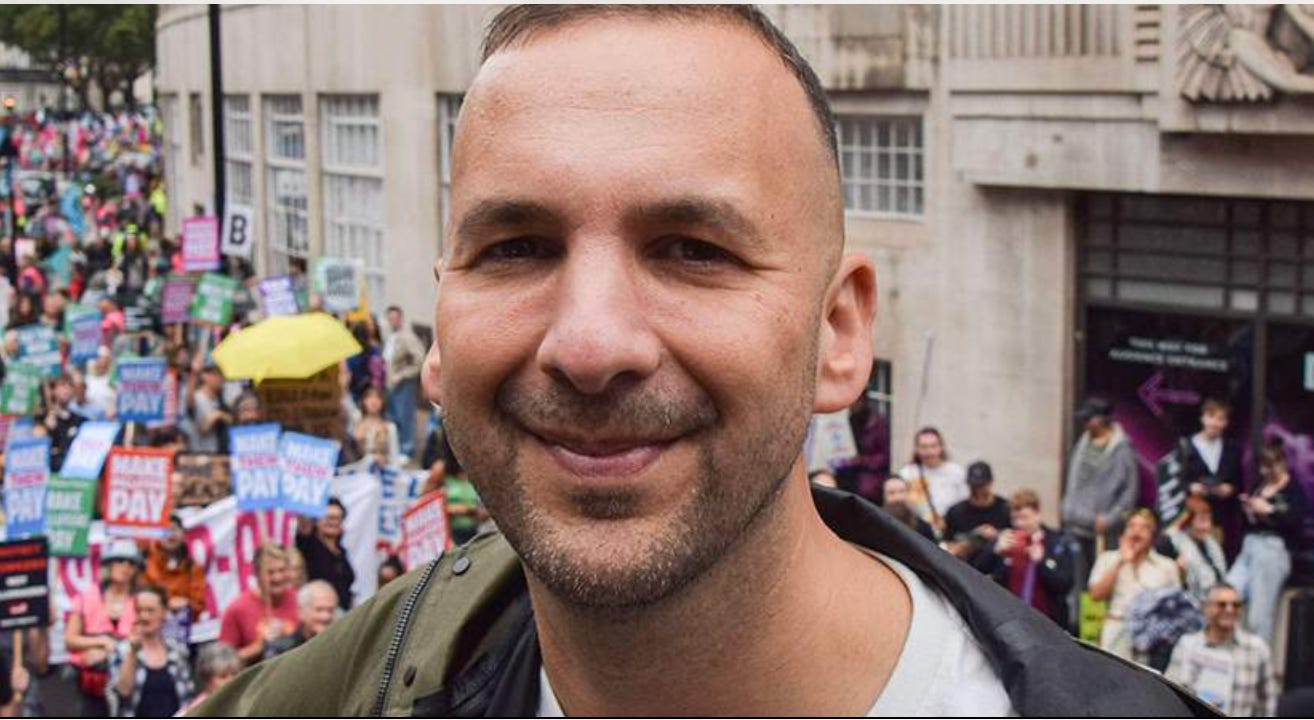
Zack Polanski should abolish Constitutional Democracy
Stop messing about and be an actual revolutionary
The main quibble that we have with Zack Polanski is not his celebration of bigger breasts, it is not even that he believes in the false religion of so-called climate change. The main problem with him is that he has, for the most part, tedious reactionary political aims.
Stopping young people flying, lets build some council houses, making cars more expensive and protecting our mostly ugly countryside, his views are indistinguishable in most matters from that of Harold MacMillan. Even his main retail offer - a ‘wealth tax’ of 1% on wealth over £10 million and of 2% on wealth over £1 billion, is actually a much less ambitious goal than the increases to Estate duty after the Second World War. It has been estimated that a 1.12% levy on assets over £10m would raise £10bn pounds a year. For comparison, the estimated annual cost of the Triple lock is estimated to reach £15.5bn a year by 2030.
The rest of the Polanski policy prospectus are the same old Millennial Leftist cliches, with one notable exception which is his position of withdrawing from NATO. This is argued on the basis that Donald Trump etc show that the United States cannot be relied upon for security commitments. Whatever the validity of this claim it does actually show that Polanski is willing to think creatively take a position that is significantly outside of the Overton window.
Polanski merits our attention for that reason, and for the reason that he is actually successfully mobilising a section of the electorate, downwardly mobile millennials. There is of course the polling which suggests that 47% of those aged between 18 and 24 are now planning to vote Green - which we must discount out of hand because we oppose polling - however Polanksi’s party has grown enormously, from just over 50,000 in 2022/3 to upwards of 175,000 today. Anecdotally many ‘young people’ (now starting to bald) that I know who are non-political seem to organically be watching Gary Stevenson and talking up ‘wealth taxes’.
Polanski, an almost comical satire of what Woke looks like in the fevered imagination of a 2019 ‘Gammon’ and a seeming man from nowhere who was once a Liberal Democrat, could be a great vessel for injecting more outré policy ideas into what has become a rather drab political environment (the Hotels / the Benefits / the Motability).
I have finally got around to reading Hitch-22 (Christopher Hitchens’s memoir) and what has struck me most - apart from the fact that Hitchens was friends with the exceptionally creepy Tom Driberg - is just how much more exciting it would have been to be a leftist student in the 1960s compared to how to today. Cuban communists would pay for you and other young people to holiday there - something Hitchens did - there is no chance the cast of PoliticsJOE are getting jollies equivalent to this.
What’s more, they were able to campaign for things in their immediate interests - campaigning to be allowed to have women back to your dorm rooms at University or take drugs. As a distant ideal, they genuinely believed that the world of ‘Imagine’ was an achievable goal within their lifetime, all of the rainbow peoples of the world holding hands and taking acid and having endless group sex. At the very least, in the United States, they were campaigning against a war which would have seen them drafted.
What socio-sexual issues are the Woke advancing now? The right for women to be overweight without social stigmas? The right of children to mutilate themselves on the grounds of gender? The right to get pegged in a flatshare in Dalston?
No normal person actually wants any of these things and Polanski has little more to offer the left than stasis and degrowth. The status quo is something that Keir Starmer is ultimately much more qualified to offer. It is more or less an open secret now that Starmer is planning to offer rejoining the Customs Union at the 2029 General election to mobilise the remainers and give them a *positive* reason to vote Labour (with voting against Farage as the negative reason).
The thinking is that they have already irrevocably alienated the ‘red wall’ White working classes and the only way they can keep power is to crush the nascent left and islamists in the cities by tapping into the elemental forces of Remainism. A ‘reset’ in relations with the European Union will likely take place in the next three years to begin regulatory alignment. Aligning Britain with the EU is a way in which the left/establishment can also insure against the worst excesses of Farage with a big Parliamentary majority.
The forces of reaction will ultimately cohere around the incumbent government in 2029. I simply do not think Polanski can win without taking more steps to differentiate himself from the other centre-left political vehicles (the Liberal Democrats and Labour). For that reason he should also offer a radical constitutional transformation as part of his settlement, beyond just abolishing the Monarchy and getting rid of the House of Lords. In short, he needs to be actual revolutionary to win power. As a place to start, I recommend looking at the early 1970s in South America.
Project Cybersyn
In the early 1970s, the socialist government of Chile invited an Englishman, Stafford Beer, to design a new sort of government. This was called ‘Project Cybersyn’. Beer will be better known to the audience as the origin of the Lobean phrase ‘a purpose of a system is what it does’ - he was an early proponent of ‘cybernetics’ which in the most simple terms is a study of how systems control themselves through feedback and self-correction. As an example, your body sweating in response to sensing you are too hot.
Beer was given an extraordinary brief by Allende, to test his philosophical ideas at a national scale. Beer’s idea was to basically put everything onto a computer, a functioning system which would allow the government to see what was happening everywhere in the country, live data on output from factories and throughput in hospitals. The reasoning being that the old model of government - individual ministers responding to paper reports, waiting for the passage of legislation through Parliament - was fundamentally outdated and unsuitable for modern society.
To make this happen, he set up a network of telex machines in factories across Chile and fed the data into a central operations room. There, teams could watch the economy in something close to real time, spot problems early, and send information back out so workers could fix things without waiting for bureaucratic permission. Factories would run themselves day-to-day, but if performance strayed significantly outside of set parameters the government would be notified and respond. It was designed to sidestep the problems of the Soviet command and control economy by creating the framework for decentralised decision making and self-regulation in factories. The images below and above are 3D renders of what these central operations rooms were intended to look like.
Beer also had wider goals for his new model of government. One was to take the data which workers were inputting it and start using it to forecast trends in output using Bayesian prediction models which would inform government policy. He also sought to create a form of real-time feedback for satisfaction from citizens when government would announce its policies on television. One could easily see how, in a futuristic utopian society, such a live feedback system would abnegate the need for elections by paper ballot, instead with government being modified by the will of the people in real time.
Everything went wrong for Allende when a certain Messr Pinochet seized power, as part of a CIA funded coup, and the operation rooms were abruptly destroyed.
Since then, no other leftist national government has sought to radically transform what ‘government’ actually is, apart from just demanding more of it, more spending on welfare, more money for Winston to give Samba lessons in secondary schools. If Polanksi wants to be the man of tomorrow there is a rich, relatively untapped vein of leftist futurism which could inform a genuinely revolutionary prospectus. If his politics is simply that of reaction, he will be forgotten by history, simply a stumbling block on the eventual descent of a Western European country into fascism.
Come forward, you man from nowhere. You of jangled teeth and mental health podcasts. Show us where you mean to lead.


