

Artificial intelligence is the first development which has given me pause to consider my pro-technology instincts. For self interested reasons: as a human being I am not quite sure that I wish to be made redundant by technology, and as somebody who has spent more than a decade refining my views on the key arguments the idea that the ‘eagles have finally come’, disrupting the well-worn tradeoffs in every single policy area, is a distraction I could well do without.
What if Artificial General Intelligence means that we can produce huge amounts of energy with no carbon emissions? There would then no longer need to be a debate about Net Zero Madness, or North Sea Oil. No longer an incentive for me to spread misinformation about climate change. Racial conflict could be rendered irrelevant by instant genetic engineering (half the population is a shade of green blue, everyone has an IQ of 200). Food could become super-abundant, as could most earthen pleasures (what if the sex-robots obviate inceldom?) A more extreme version of the long 1990s. Like playing Minecraft on creative mode, forever.
For a polemicist this seems like a very dull world in which to live. Indeed I am reminded of a childhood visit to what was then known as Currys (before it was merged with PC World). I asked my mother if we would ever have replicators like in Star Trek (which can print next to infinite food/clothing etc from energy), to which she said she would risk her life smashing it up if such a tool was to exist. Where is the competition if there are no constraints? Why bother to do anything at all? And in the present, the very stupidest thing you could do if we are about to enter hyper-abundance is write millions of words expressing soon-to-be archaic bigotries. What if the cybernetic meadows are to be watered with our blood? It would be like having some inkling that the British army is beginning to mobilise against Russia and writing longer and longer pro-Putin screeds in response (without fleeing the country).
I suppose this is why I am emotionally drawn to Orlowski’s well evidenced case that Artificial Intelligence is a scam and that the bubble is soon to burst. One need only skim through reports into the uptake of medical AI tools in the NHS to understand that this is not becoming the panacea which saves the various tentacles of the Welfare State from An Ageing Population. Nonetheless we cannot universally wave away the ‘lived experience’ of many professionals who say that they are preparing themselves for a lifetime of unemployment after seeing what the latest models are capable of, and it is difficult to see how any other outcome could be achieved politically. In my ideal world different nation states would agree that AI should be capable of removing women’s clothing from photographs and it would be left at that, but no doubt the Chinese will secretly keep driving towards Han supremacy to avenge all of the bleaching.
On the other side of the AI ledger is the life of Demis Hassabis. Hassabis is a deeply admirable individual, a child genius born to a down-at-heel family in North London, Hassabis bought a ZX Spectrum and learned how to code whilst becoming a chess champion. He went from Grammar school to Cambridge – but before he went onto further education spent a year working for a gaming studio called Bullfrog Productions.
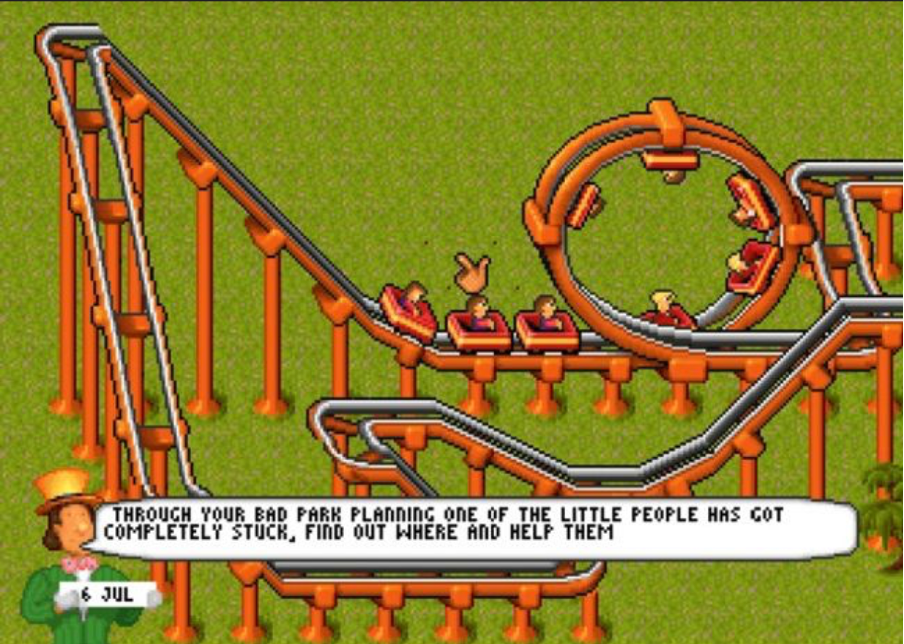
Peter Molyneux is to the video games industry what Marco Pierre White is to Television cooks, anybody who has done anything revolutionary in the last twenty years in gaming has passed through one of his companies. Media Molecule, the studio which created LittleBigPlanet was founded by employees from Lionhead (a rebrand of Bullfrog). Steve Jackson, who co-founded the Games Workshop also passed through Bullfrog. But the most successful of his proteges is undoubtedly Demis Hassabis. Hassabis first when to Bullfrog around the age of fifteen to start work on programming artificial intelligence for the game Populous II. Hassabis was sixteen when he lead alongside Molyneux, on Bullfrog’s production of Theme Park. Theme Park was a simulator which presaged many of the construction games you may be more familiar with like Rollercoaster Tycoon introducing mechanics like happiness and pricing through machine learning.
After completing University Hassabis returned Lionhead is most famous for the Fable game series (now being remade by Playground), which was an enjoyably chummy medieval RPG, but its groundbreaking title came earlier, in 2001 with the release of black & White.

black & White was a God game (where the player is a deity controlling villagers), it’s innovation was to introduce something called the Creature – an animal which would grow throughout the game - whom the player would raise from birth. Hassabis built the Creature to develop from how the player interacted with through reinforcement learning, responding to praise and punishment (actions like being slapped) to eventually synthesise its own actions and moral alignment. The Creature was able to internalise lessons (e.g eating villagers will lead to a slap) and apply it to other situations (setting fires), the Creature would therefore learn over time how to avoid displeasing you. A system which is similar to the training of modern Large Language Models (Reinforcement Learning from Human Feedback) and in a sense how they operate at consumer products (learning how to please and avoid displeasing users).
