There is no American Left, and precious little of an international left, outside the Democratic Party. Whatever ideas blossom for a season in America are but stage props and lighting equipment to create the emotional atmosphere for the Democrats’ next presidential campaign, to be dismantled and packed away in moulding crates on some East Hollywood lot once it is finished. If a current of thought emerges outside of the party, it may only exist within history, at least in our own time, insofar as it can be written into the Democratic script. Attempts to anticipate the form of Woke 2.0 are futile unless they proceed from an analysis of the milieus that dominate the party’s internal life. The following is thus a character sketch of a party; less a rigorous study of its chemical composition or a criminal investigation into its shadowy puppeteers than a struggle to find the right language to describe it.
The Democratic Party is the last of the great 20th century political machines. Though the present-day organisation is mere fog on the glass of Roosevelt’s crystal palace of evil and deceit, it still bundles together the ethnic clientele networks, the temporarily embarrassed descendants of what was once the „mainstream media“, the strongest factions of the deep state, and the demimonde in a way of which its more straightforwardly corrupt backwoods antagonist can only dream. That this sinister cartel and its friends abroad were able to lock down the world and install the half-expired Joseph Brandon in an outrageous coup in 2020 is testament to the immense force of institutional inertia, despite increasing desperation and lack of ideas at the top.
A political machine is like an ordinary machine; it has to be constantly tuned and mended in order to keep running smoothly. Once a machine is broken, it seldom can be fixed. By the time it falls to defeat at the polls, the charismatic authority or disgruntlement with the previous incumbent that swept its founders to office has usually run out, and to survive it must rely on its ability to continuously reward its clients, which in turn relies on incumbency. The Democratic National Committee is a machine of machines: it stakes its own position at each congressional, senatorial, state-level, or municipal election, and with each defeat its power over its subalterns wanes, although no single machine’s defeat — even that of so trusty a pillar of its authority as the one in New York — is sufficient to bring the house of cards down. The history of American politics is the history of the construction and destruction of political machines; the Franz-Josephine permanence of the Brandon Generation is no reason to believe the current Democratic establishment will last forever.
The Democratic Party has fine-tuned the mechanisation of politics, but not even this juggernaut has figured out a way to automate the problem of succession. This is notoriously hard to do: Spengler famously wrote that Bismarck’s greatest failure was not to rear a corps of Bismarckian politicians who could continue his work beyond his departure from the political stage. Even so, it would be naive to shrug one’s shoulders and gesture to the inherently tragic nature of things when explaining the party’s recruitment struggles. A commitment to diversity in hiring militated there, as everywhere else, against competence, while liberal East Coast Jewry’s post-October 7th alienation from the left has poisoned the well from which the party’s most capable young operatives were drawn (although not entirely — Zohran Mamdani’s eminence gris, the mercurial Morris Katz, is of God’s chosen people). At the same time, Mamdani’s victory and the Democratic Socialists’ resistible rise underlines the party establishment’s failure to tap alternative pools of elite human capital, namely more recent Indian and East Asian migrants (it could, in theory, also look towards normal White men, but that ship has sailed for the time being). Things did not have to fall apart, the centre might have held, but for entirely avoidable reasons it has not, and the Democrats now find themselves in a similar position as the Republican brass ten years ago.
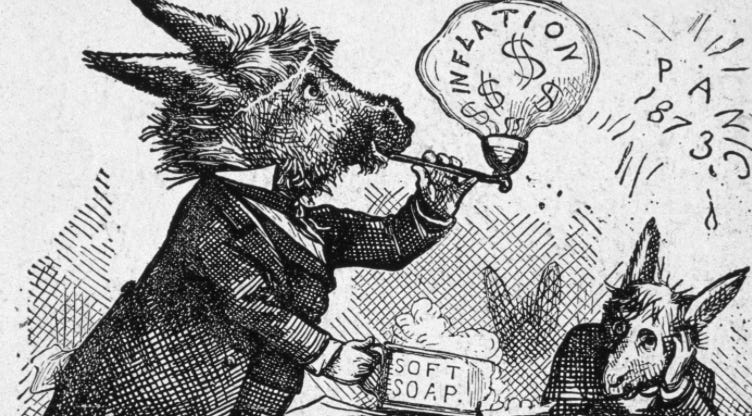
The more conspiratorially-minded will see signs of a controlled demolition underway. The seedier, yet outrageously popular, parts of the Democrat media complex — facebook-based BlueAnon, Wine Mom Power Radio, etc. — have tried to paint Donald Trump with the Epstein brush, in strokes that would make Jackson Pollock look like Canaletto. This has not seriously damaged the President, whose hardy Q-boomer battalions have flattened the curve of hardier liberal mind viruses. Their skepticism is well-founded: Epstein was, pardon the analogy, but a sole island within a vast archipelago of blackmail rings; this humble worker bee’s foraging grounds were East Coast high society, and what we know of Trump’s relationship with the disgraced financier is entirely in keeping with his peripheral position vis-a-vis that world. If Epstein justice was really so important to the Democrats, why did the donkey wait until the ill-fated President Brandon had been so ignominiously driven from office to bray for the release of „the files“? The practical consequence of the JEE moral panic has been to tarnish much of the Democratic elite of the Clinton-Obama years by association. The authors of the latest blast of liberal lies may be aiming at Trump’s head, but it is their own party’s old guard they have hit. As ever, it is hard to tell whether this is the unfolding of a carefully laid plan or just sheer incompetence.
Not that the Clintons, Obamas, and Schumers plan to go quietly into the night. This time, they have hitched the old mule to Gavin Newsom’s rickety junket, though the California governor’s rush to declare his interest for 2028 four years in advance betrays his weak hand. A regional satrap, impotent beyond the borders of his large, but in an internal party contest hardly decisive, province, struggling to build up a lead in early polling despite his name recognition: is that Jeb’s song I hear? The champions of a Third Way renaissance have picked the wrong condottiere; like all heavily-favoured frontrunners, an early primary exit will be Newsom’s fate. His demise, foregone but still cathartic for the party base, will leave three emergent factions of the party to battle it out.
The first of these is the DSA and its broader milieu. These are liberal America’s Black Hundreds: an ultra-reactionary coalition of lumpenproletarians, children of the formerly-rising ethnic middle class who have maxxed out the possibilities of social advancement through education and careerism, downwardly mobile elements of the provincial White middle class (what Chapo used to call „failsons“), and a few intellectual adventurers assembled to defend the ancien regime against new men and new ideas. The Democratic elite once knew how to use these people: they formed the avant garde of the mob during the summer of Floyd. The momentum in the cities is clearly with the DSA; in New York they have already defeated, and may soon subsume, the old Cuomo machine, while in Los Angeles, their candidate Nithya Raman is poised to do the same. The Democratic Socialists’ organisational muscle is formidable and will only solidify by the time 2028 rolls around, but the party elders still have a few tricks up their sleeves — take, for instance, in Nevada, where the local „Reid Machine“ managed to execute a successful fronde after a thumping defeat at the hands of the local DSA.
There are in fact two DSAs, and American conservatives flatter their own prejudices when they giggle with self-righteous glee at the White, burrito-munching base’s impending mugging at the hands of reality. These right-wingers, their minds stuck in the 1980s, understand the DSA by way of Tom Wolfe or Norman Lear, when they would do much better to head down to their local public library and ask the blue haired she-ghoul on the desk to point them to the VS Naipaul section. The DSA’s leaders and intellectuals are a gang of Biswases drawn from the comprador bourgeoisie and lower bildungsbürgertum of the old Raj: Mamdani is a Ugandan Gujarati, his father a prominent postcolonial scholar and his maternal grandfather a high-ranking civil servant; Raman is a Tamil Brahmin of the Iyer jāti, a subaltern „foreign“ caste of Brahmins that under the Raj came to dominate the administration of the princely states along the Malabar Coast (if only we could find someone to do that in the American Raj); AOC’s old campaign manager Saikat Chakrabarti (an early Stripe guy) is a Bengali Brahmin whose father was a schoolteacher (a university-educated profession that would have brought with it local prestige), while Jacobin editor Bhaskar Sunkara, the most proletarian of the bunch, is the son of a Trinidadian doctor. The common thread here is of children of déclassé emigrés reduced to a modest status (with the exception of the Mamdami family) in a strange new land, but able to recompense for their parents’ reversal of fortunes through individual merit greased by privileged access to racially-conscious institutions of higher education. Like the Jews in the previous century, they represent the intrusion of an Old World, quasi-British sensibility into the life of the American republic, although God’s chosen and the other older ethnic machines that run the Democratic Party have thus far been more successful than their waspen predecessors in barring the brahmins from the halls of power.
Mamdani’s career represents one possible telos for the DSA, namely to become a standard-issue postcolonial hegemonic party — a kind of „American National Congress“ as it were. Mamdani is not, as American conservatives have somehow convinced themselves, a late echo of Bandung reverberating off of City Hall, but embodies the cynical attitude of national liberationist movements whose leaders have come to enjoy the creature comforts of standing membership within the international community, preaching socialist water while supping wine from Mr. Dimon’s table and staffing his administration with longtime Democratic operatives. Perhaps this is unfair. Limited in what he can do by the modest powers of a mayor and a gaping budget deficit, Mamdani has pursued a politics of conciliation between his socialist base, Wall Street, and the old Democratic machine, with a view to reestablishing at municipal level something of the shattered „Woke Capital“ coalition of Obama’s second term. He has been able to thread this needle without alienating his base because the DSA’s high information activist core has a realistic understanding of the constraints; at national level this coalition would be harder to replicate because an American President cannot be reduced to a junior partner in the way a mayor can. Nevertheless, Mamdani’s administration offers proof that the DSA and the Democratic mainstream can be reconciled to one another, and his DEI durbar in New York may persuade the party elders that, in the event of a contested primarily, they might safely drop Newsom for a common candidate, probably Alexandria Ocasio-Cortez, although she seems to have fallen out of favour with the DSA’s rank and file. To hell with it, these people drunk the Brandon brew — they’ll slurp up whatever slosh Hasan ladles out for them.
The second emergent left-wing faction is the Effective Altruists. The EAs have no clear candidate for 2028, and don’t really need to run one, although I suspect that for reasons of intellectual vanity they will at least give it a shot. Where the EAs are a power is within the donor space: Sam Bankman-Fried was the Democrats’ second-largest wallet in 2022, while Dustin Moskovitz’s Baikal-like pockets were bettered only by those of George Soros and Michael Bloomberg at the last two presidential cycles — this is all before Anthropic entered the scene. The EAs believe their worldview, ostensibly the only one to grapple with an entirely new mode of production, to be incommensurable to all existing political currents, and have no strong preference between establishment Democrats and the DSA — their money, and perhaps favourable access to their models, will allow them to act as kingmaker between these or any other factions that emerge in the next few years. Their Achilles heel, at least if their experience on this side of the Atlantic is any guide, is a total lack of understanding of the subtleties involved in politics, to which Claude is unlikely to prove a useful guide. A potential AI bust, though probably not the last we’ll hear of them, would also put them out of commission for the 2028 cycle.
The Democratic establishment’s response to the EAs has been Washington’s usual answer when Silicon Valley calls: smile and nod and try to extract the maximum possible funds in exchange for the minimal possible commitments in return. The party elders are past masters of this craft, and so their traditional constituencies probably won’t have to worry too much about tech bros coming for their lobster boil. For the moment, the Democrats seem to have weighted dissent amongst their base above the EAs’ demands, which in the short term consists mainly of scaling up „compute“ to immanentise the AIschaton — that so scaly a Democratic insider as Pennsylvania Governor Josh Shapiro recently and with much fanfare imposed new regulatory hurdles on data centre construction in his state is indicative of the party’s mood here. They may not like it, but for the moment the EAs’ fortunes are intertwined with those of the current administration — an AI bust, though it would all but guarantee the Democrats the presidency and both houses at the next cycle, might in this sense be a long-term blessing in disguise for the American right.
If the EAs find it tough dealing with the Democratic establishment, the cultural gap with the DSA is probably unbridgeable. Their (frankly nonsensical) pretence to be cold, rational arbiters of utility hardly jives with the DSA’s pugilistic, emotional style, and their equanimity towards climate change (the Emile Torres line of attack will probably be the one the left settles on as EA seeps into the public consciousness) and advocacy for a universal basic income (an idea that, in a miraculous turn of providence, the millennial left’s house intellectuals rejected a decade ago, to the point of being made subject of a belated fatwa by Anton Jäger) will make them an unwelcome guest at High Woke’s mountain aerie. For the time being, the left seems unable to differentiate them from the „tech bros“ of the right who want to drink up the Colorado River to power the data centres that make Putin’s disinformation slop — Silicon Valley’s right turn in 2024 was pragmatic and could easily be neutralised by a Democratic administration through a mixture of bribery and slightly dialling down the Woke, but it has nestled into the socialist imagination as a permanent feature of late capitalist geohell.
This is not to say that the budding DSA/EA antagonism is merely a misunderstanding. Ultimately, Dario Amodei Thought cannot be reconciled to socialism because that it represents a distinct claim to messianic authority; in this case the authority of the AI singularity rather than that of history. The EAs’ leadership has done remarkably well at defending their Halakhic authority against sophists employing their concepts against them, but in the DSA they have an opponent no less capable of guarding its epistemic sovereignty. The Democratic Socialists have been doing this much longer, they possess a worldview hardened by a decade of intra-left fighting, and have built an impregnable pipeline by which ideas are transmitted from their intellectual leadership to the rank and file. They will not allow themselves to be flustered by the Yang Gang’s antics. This is not to rule out an alliance of convenience — the Democratic Socialists have pragmatically swung their heft behind established Democrats before; there is no reason why Dario and Mr. Biswas can’t get together around that big table and hammer out some sort of temporary working arrangement should it come to it (probably involving a transfer of pro-Trump tech companies’ fiefdoms), but there can never be any permanent standing relationship between the two. Their incompatibility is an incredible stroke of luck for the American right, since the combination of the EAs’ money, the DSA’s street muscle, and both groups’ sense of being locked out of the innermost rooms of power by the East Coast establishment make them natural partners should they strike upon some modus vivendi.
There is a third, far shadier faction on hand to step in and ensure the process does not slide out of control. As Nemets has frequently observed, the direct and open participation of former spooks (a contradiction in terms) in the democratic process is one of the more concerning trends of post-Trumpian politics. This gang’s worldview is stuck in the national security-conscious Clinton years, in which the sinister stirrings of Populism and the toxic masculinity of the Bernies Bros were but a domestic front opened up against liberal, welcoming Gaymerica by Putin’s axis of evil — which explains their lack of scruple when it comes to wielding the shadier arts of the craft on the campaign trail. In government, they have behaved as if the past ten years simply did not happen, with their most prominent representative, Virginia governor Abigail Spanberger, simply picking up where „Woke One“ left off upon taking office in January.
So long as the internal politics of America’s numerous and fractured intelligence agencies remain opaque, one cannot really say what the relationship between this group and the Democratic Socialists is. The spooks have had ten long years to infiltrate the DSA, and fringe socialist groups historically don’t seem that difficult for even rickety, third-tier security services to take over — the DSA is probably secure against new interlopers, but if the whole thing is compromised to begin with, that doesn’t all that matter much. America’s intelligence community is a fractured landscape; can we be entirely sure that the Spanbergercrats and the DSA’s handlers are the same people? A division of labour within an organisation can easily produce diverging worldviews, and if these two factions of the Democratic Party are not already a cypher for a latent tension between an internationally-oriented part of the deep state and one more concerned with preempting domestic conflict by infiltrating radical groups, an open fight between their proxies in which the latter, against the odds, appears to have the upper hand would present a test of strength that could spiral out of control. But this is all kremlinology; the idiom of War Studies; deductions made from the absence of information and not its presence.
Procedural trickery, too, will have its role to play. A restructured primary calendar and the elimination of caucusing will weight the early contests towards big ethnically diverse states at the expense of whiter ones like Iowa and New Hampshire, where a tradition of healthy civic republicanism means that arguments and ideas, or what conservatives consider „luxury beliefs“, determine the outcome rather than the endorsement of the local pastor or culinary union boss. This would have sufficed to nip Sanders’ momentum in 2016, but the DSA of 2028 is better organised and has time to make inroads into traditionally difficult constituencies that Sanders did not have. The first two primaries, South Carolina and Nevada, will probably return an establishment candidate, but New Hampshire, New Mexico, and Michigan are well within the DSA’s grasp. In short, I am not entirely convinced that this will work.
There is a fourth option. „Auntie Kama“ currently leads the Democrats in national polls, and some wags have suggested that, like Brandon, name recognition, especially amongst low-information ethnic voters, will put her ahead in early contests, forcing the establishment field to consolidate behind her under a challenge from a DSA candidate. This is not a credible theory of victory simply because „low-information“ voters in fact vote quite strategically. Southern blacks, for example, are a cohesive ethnic voting block organised within the black church; they follow the recommendations of their pastor, who himself will follow the instructions of his church elders, who have in turn made a concrete bargain with a particular politician to deliver his constituency’s votes in exchange for some policy that he can sell to his base. Harris is not a Jesse Jackson whose personal charisma can simply dissolve the deep ties between the Democratic establishment and its local powerbrokers and in fact performed poorly amongst younger blacks with less connection to the traditional institutions of Democratic clientelism (and who will probably be swept up by the DSA), nor is she particularly good at machine politics, which famously sealed her defeat in Pennsylvania.
The American right can take some solace in the fact that the Democratic Party is a divided camp whose simmering internal rivalries will hinder its ability to govern and probably keep them from arresting and executing all of Trump’s disgraced apparatchiks if they do sweep triumphantly to power in 2028. The Democratic base’s luddite turn and the centrality of the AI buildout to the continued American imperial project offer a window for Trump or his successor to run on a Sammlungspolitik of techno-social-imperialist forces, if they can only convince the tech bros to shut up about how they’re coming to take your job. Assuming the DSA either wins the party’s coming internal battles outright or at least forces the establishment closer to their positions, the political chessboard in 2028 will be arranged in precisely the configuration that liberal romanticists thought it to be in 2016: a coalition of internationally-minded centrists against the losers of American Empire’s new political economy. Whether this strategy should be pursued is of course not mine to say, and in any event it relies on the AI bubble not collapsing and America avoiding an apocalyptic military defeat in East Asia in the next two years.


