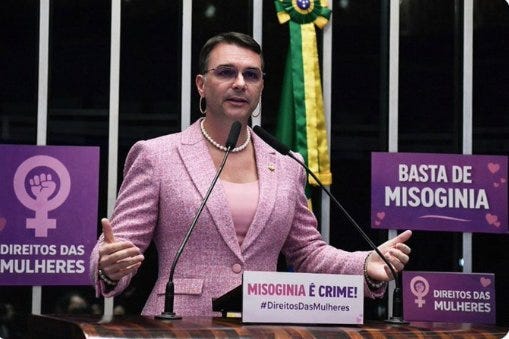
The Feminist campaign of Flávio Bolsonaro
Anonymous Overseas Contributor
In 2018, Jair Bolsonaro rode a wave of young male enthusiasm to the presidency. His campaign ran on anti-DEI rhetoric and WhatsApp-distributed provocations. He won 46% of first-round votes and 55.13% on the runoffs. The gender gap he produced was the widest in any democratic election during this century, with men aged below 25 forming his strongest cohort. Bolsonarism was a movement by men, for men, against the progressive consensus.
Seven years later, the picture looks nothing like that. Jair is in prison, convicted for his role in the January 8, 2023 storming of government buildings in Brasilia - Brazil’s version of January 6. And the heir to his legacy, his eldest son Senator Flavio Bolsonaro, has reinvented himself as a contradiction to his father’s legacy: a moderate, eager to make concessions to the Left.
Flavio is now the pre-candidate for PL (Partido Liberal, the right-wing party his father turned into Brazil’s largest) in the 2026 presidential race. He has surrounded himself with “seasoned political consultants” - specialists in crafting the kind of generic candidate capable of appealing to everyone and offending no one. The campaign has deployed Flavio’s wife Fernanda at pre-campaign events, adopted feminicide as a banner issue, and authored bills on domestic violence protections and women’s healthcare.
The candidate of the “Right” against president Luis Inacio Lula da Silva for the 2026 general election has a legislative record that would make any backbencher in the Workers’ Party proud. He has voted for laws that criminalizes misogyny as an unbailable offense equivalent to racism, LGBT prison protections, racial quotas in party funding, and for projects restricting political speech in the name of women’s rights.
The men who put his father in power are starting to notice.
Most recently, on March 24, 2026, Flavio Bolsonaro voted in favor of PL 896/2023 - the “Lei da Misoginia” (Misogyny Law) - placing misogynistic conduct alongside racism as an unbailable crime carrying two to five years of imprisonment. The law also makes no distinction between misogyny committed against biological women and Male-to-female transexuals, ironically criminalizing his father’s famous criticism of queer ideology.
The reaction from the right was immediate. Nikolas Ferreira, a rising star in Brazilian politics and the most influential young Bolsonarist in Congress, called the law an aberration. Ana Campagnolo, a conservative congresswoman and influencer from the southern state of Santa Catarina, voiced the question haunting the base “Do we really want to turn Brazil into a gynocracy?”
Flavio said nothing for five days. Then, speaking at CPAC in Dallas on March 28, he justified his position “Everyone knows we are in an election year and this was a big Workers’ Party trap aimed at me.”
It turns out, however, that this was not a one time thing. The young Bolsonaro has been falling into these “traps” for years. One might wonder if they are “traps” at all, and not simply his actual political inclinations. A look at his voting record and you’d have a hard time distinguishing him from a hijab-wearing Starmerite black lesbian quadruple amputee. Here’s a sample of notable pro-DEI projects that Flavio has voted for since his election for Senator in 2018:
Law 14.188/2021 created a new crime of “causing emotional damage to a woman that harms or disturbs her full development, or that aims to degrade or control her actions, behaviors, beliefs, and decisions.” The listed means include threat, coercion, humiliation, manipulation, isolation, blackmail, and ridicule - but the catch-all clause at the end (”or any other means that causes harm to her psychological health and self-determination”) swallows the rule. In practice, any interpersonal behavior a judge deems psychologically harmful to a woman can be prosecuted. The law also runs afoul of a principle Brazilian jurists call “taxatividade”, the requirement that criminal statutes define prohibited conduct precisely enough for citizens to know in advance what is legal. A man who raises his voice during a marital argument, a father who limits his teenage daughter’s social media use, or a boyfriend who expresses jealousy - all could theoretically fall within scope.
Law 14.192/2021 made it a crime (one to four years’ imprisonment) to “harass, coerce, humiliate, persecute, or threaten” any female candidate or officeholder “using contempt or discrimination based on the condition of being a woman.” A separate provision criminalized disseminating videos with “untruthful content” about candidates during campaigns. Read together, the provisions hand courts broad discretion over political speech. Who decides whether a harsh campaign video is “untruthful”? Where does aggressive satire of a female politician end and criminal “humiliation” begin? One tribunal acknowledged that “mere critical speech or ideological offense, however acerbic,” does not meet the threshold - then convicted a city councilmember for telling a female colleague to shut up during a session, ruling it showed “specific intent to silence.” The result is a two-tier speech regime where attacks on male politicians are ordinary politics, while identical attacks on female politicians are felonies.
Supplementary Law 150/2021 mandated dedicated prison cells, wings, and facilities for LGBT inmates, with federal funding from FUNPEN (Brazil’s national penitentiary fund) made conditional on state compliance. States that refuse lose money. Classification is entirely self-declaratory. Inmates determine their own placement by stating their gender identity or sexual orientation.
Constitutional Amendment 9/2023 enshrined racial quotas in party funding, requiring that at least 30% of public electoral funds go to Black and Brown candidates starting in 2026. This had previously been only a ruling by the TSE (Brazil’s Superior Electoral Court); writing it into the constitution placed race-based resource allocation beyond the reach of ordinary legislation.
Flávio Bolsonaro’s support for the Misogyny Law was the last straw for Bolsonarism’s dissident wings, sparking an open revolt against his leadership style and future candidacy. Meanwhile, Nikolas Ferreira has emerged as the movement’s new vanguard. Since entering Federal Congress in 2022 as the most-voted representative with 1.47 million votes, the then 26-year-old has operated with calculated precision. By surrounding himself with a powerful circle of online influencers, he has quickly conquered the position of most digitally present politician in the right. This stands in stark contrast to the rest of the PL, which remains a collection of non-ideological boomer career politicians, products of regional alliances and local interests.
Other politicians from Nikolas’s faction within the PL are also slowly distancing themselves from Flávio’s campaign and from other figureheads of the old political guard now in the party, while staking their claim to true Bolsonarism.
Nikolas proceeds with caution. He avoids direct confrontations with the Bolsonaro family, recognizing that such an approach could alienate the more loyal segments of the base. Instead, he relies on subtle digital tactics, including targeted retweets and incisive replies, which reach millions without the need for formal public statements. This method enables him to distance himself from Flávio’s centrist shift while preserving the appearance of party discipline. At the same time, he amplifies the concerns of grassroots supporters who feel betrayed, thereby establishing himself as the guardian of the movement’s original principles.
Flávio and his US-based brother, Eduardo Bolsonaro, lack the capacity to sustain the legacy and energy of their father. The sons are increasingly viewed as figures who have softened amid the comforts of institutional power, while Nikolas and his allies represent a new generation of self-made leaders forged in the digital arena. The prevailing view within the movement is that the Bolsonaro name provided the initial spark, yet the family’s current trajectory toward pragmatic institutional politics leaves them ill-suited to lead the next, more assertive phase.
This realignment extends beyond Nikolas. Other prominent figures in the PL are also distancing themselves from Flávio’s campaign and its traditional leadership. Julia Zanatta and Ana Campagnolo, both influential voices from Santa Catarina, have assumed key intellectual and rhetorical roles in the emerging faction. Campagnolo, a prominent conservative influencer and the highest-voted state representative in her region, voiced the question haunting the base “Do we really want to turn Brazil into a gynocracy?”
By framing Flávio’s support for the Misogyny Law as a concession to progressive queer ideologies, these leaders are asserting their claim to authentic Bolsonarism and portraying the official campaign as a diluted version of the 2018 vision.
This diluted version of Bolsonarism, as much as it might reflect Flavio’s actual centrist inclinations (as evidenced by his long history of DEI voting), is also a calculated effort to close the gender gap that has dogged the Bolsonaro name.
Women make up 52-53% of Brazil’s electorate. An AtlasIntel/Bloomberg poll from February 2026 found that 54% of them expressed “fear or concern” about a Flavio presidency, compared to 38.4% for Lula (the incumbent leftist president, now seeking a third term). In head-to-head simulations, Lula leads by 11.5 points among women; Flavio leads by just 8.2 among men. Female support for Flavio sits between 28.6% and 33.5%, with over 20% of women undecided - a bloc large enough to decide the election.
PL’s chairman, Valdemar Costa Neto, has been open about the problem. He has publicly declared that Flavio will pick a woman as running mate. Plans also reportedly include naming a woman as Minister of Finance. Valdemar’s coalition-building goes beyond gender. He personally attended the party registration of Suellen Rayanne and Sophia Barclay, two self-described conservative trans influencers now expected to run for Federal Congress under PL’s banner.
Flavio has presented himself as the antidote to his father’s toxicity. In an interview to the newspaper Folha de Sao Paulo in December 2025, he said “They always asked for a more moderate Bolsonaro and I’ve always been like this [...] he didn’t want to take the vaccine, I took two doses”
What Flavio has yet to understand about politics is that you don’t get to choose the theme of an election. In 2018, the public wanted a loudmouth who would break the system. In 2022, they realized they’d gone too far and retreated to the comfort of the left-wing establishment. In 2026, the mood is different again. People are tired of theatrics and want someone with a firm hand and a real plan for cutting the bureaucracy, breaking the old party oligarchies, and confronting organized crime. Flavio is offering the opposite of that.
Bolsonarism was not built by moderate suburban women. It was built by young men in WhatsApp groups. The 2018 campaign’s core voters - young males - backed a candidate who mocked feminism, dismissed gender ideology, and never apologized for anything. Flavio is dismantling that legacy to chase voters who rejected his father twice.
The right-wing backlash is growing. Commentator Rodrigo Constantino argued that any senator afraid of being called a misogynist by the left should find another career. Renan Santos, president of Brazil’s newest Party, Partido Missao (Mission Party), and a rising 2026 pre-candidate who polls first among men aged 16-24, has been blunt “If you are a man and right-wing, Flavio Bolsonaro betrayed you and will put you in jail. Flavio Bolsonaro destroyed our revolution.” Even within the family, Michelle Bolsonaro (Jair’s third wife and a political figure in her own right) reportedly resists backing Flavio’s candidacy.
Flavio’s strategy is a bet that the Bolsonaro surname alone locks in the base while progressive votes capture the middle. Early polling suggests it may be working. His numbers have doubled since December 2025, pulling him into a statistical tie with Lula. But the strategy rests on a contradiction that may collapse under its own weight.
PL is becoming a party that speaks the language of the left while claiming to represent the right. “Moderate Bolsonarism” is a contradiction in terms. The movement exists because of radicalization. The young men who built it are watching Flavio trade their interests for the approval of voters who will never fully trust a Bolsonaro, no matter how many progressive laws he endorses.
Jair Bolsonaro won in 2018 because he was uncompromising. His son is trying to win in 2026 by doing the exact opposite. It remains to be seen if Nikolas will survive supporting Flavio’s centrist campaign, or conquer the Right on his own terms.


