

‘Bitch. I hope your teeth turn green and fall out. Did Djamal put you up to this? You may be nineteen honey, but you’re not all THAT you know. I bet you wish you weren’t so flat-chested, you short, stunted Barbie-Bratz-Bitch from hell. Your skin may be smooth now, but just wait till YOU hit thirty. You’ll be worse than me; and when you’re sixty, HA! Isn’t white skin meant to wrinkle faster than brown skin? YEAH. I wish I could be there to gloat’
White men, Black men, Brown men…
Who’s better to marry?
And who’s better in bed?
Have you ever wondered
Who has the bigger packet?
Katherine Birbalsingh, ‘Britain’s strictest headmistress’, recently released a book called Diversity is not our strength which has received praise from corners of the centre-right that is so frothing it is beyond satire (read Matthew Syed arguing in the Times that Birbalsingh is more impressive than Demis Hassabis and that Michaela school is greater than Cern). ‘You did it Katherine….you really did change the world’.
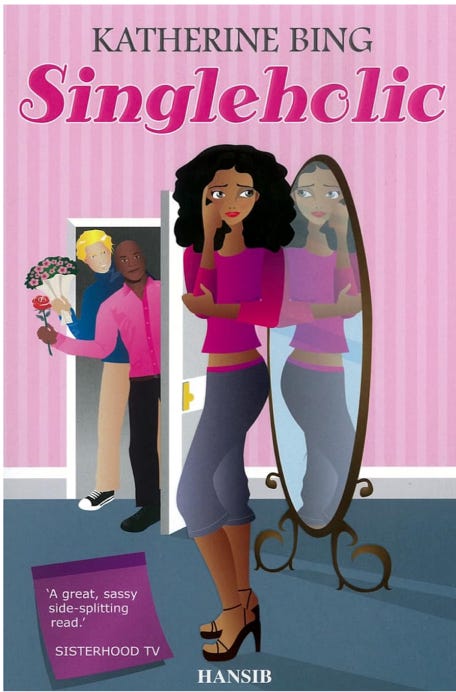
In the book itself, sitting alongside the well rehearsed Michaela routine there was a long diatribe against ‘ethnonationalism’, contrasted with the colour-blind multicultural patriotism which Birbalsingh says she would prefer. It may surprise readers, therefore, to hear that Birbalsingh was the author of a 2009 book, Singleholic, which ranks the different races of men by their penis sizes, calls a slim White woman with blonde hair a ‘Barbie-Bratz-Bitch’ and refers to dating White men as an act which could ‘betray the race’.
Singleholic follows Sarah, a mixed race thirty-year-old history teacher living in South London who is deeply anxious that she may have missed the boat for finding a husband. In 2011 the Guardian unearthed Facebook posts where Katherine Birbalsingh called Katherine Bing her ‘alter ego’ and, as the somewhat transparent pseudonym would suggest, she has not made much effort to disguise herself in the character of ‘Sarah’. Birbalsingh at this point was a teacher in a South London school in her mid thirties. ‘Sarah’ spent her early childhood in the United States (Birbalsingh grew up partly in Canada), Sarah went to Cambridge (Birbalsingh, Oxford) and both had/have Jamaican mothers.
Which brings us to their most pertinent similarity – both are mixed race. Singleholic, as the blurb suggests, is fixated on racial differences. Most every character, no matter how minor is introduced by their skin colour (‘She’s a white woman of about forty-eight years, unmarried, without children’). The story takes place in ‘multicultural’ Brixton, tributes are laid to the historical place of black people in Britain (‘we black people have been here since the eighteenth century and some even since Roman times’). Characters debate at great length which ethnic groups have larger penises and there are several incidents of violence related to racial sexual jealousy (in each conceivable direction). It is not, we must observe, the work of somebody who sees entirely beyond colour.
Before we get into the meat of her work we must first establish some important literary context for ‘chick-lit’ in the 2000s, a category to which Singleholic proudly belongs. Both Sex and the City (Candace Bushell) and Bridget Jones Diary (Helen Fielding) were, during this period, dominant media franchises which turned their creators into globally famous millionaires.1 Both of these franchises began life as pseudonymous columns for different newspapers making relatable commentary about being a sad single woman in a major city, which tapped into a vast captive audience of young professional women frustrated by the modern dating market.2 Singleholic makes references to Sex and the City constantly (Sarah repeatedly tries to channel her inner Samantha Jones, at one point she is told to be a mix of both Samantha Jones and Margaret Thatcher) and the now defunct singleholic.com website advertises Sarah as a ‘black Bridget Jones’. Birbalsingh no doubt believed, by 2009, that she needed a USP to differentiate herself in a crowded chick-lit market and so part of the racial obsession found in the book can be part attributed to this sort of positioning.3
But not entirely. For as the quote which opens this article demonstrates, Birbalsingh shows throughout this book showcases unhealthy attitudes about race. Sarah engages in several episodes of frothing rage throughout the book when encountering White women, particularly if they are blonde. The ‘Barbie-Bratz-Bitch’ is introduced as a blonde teenager who recommends that she get some moisturiser for her skin (while working in John Lewis). ‘Barbie-Bratz-Bitch’ is referred to again several times during other fits of rage about her appearance where she imagines being judged by her again, but she is not the only target. Nigh on every evil or useless character is a blonde woman. The imaginatively named ‘Sandy’, who pops up for a single scene, is ‘pretty with flowing blonde hair and long eyelashes’ (Sandy is then an inattentive, obnoxious host of a speed dating event). In some cases they do not even have to speak to aggravate Sarah. In another scene she arrives at a cafe to see her Italian womaniser friend (to whom she is not attracted) talking to a ‘leggy blonde’, provoking this internal monologue:
I’m facing a destiny of loneliness and she’s playing a game. If it weren’t for all those damn twenty-two-year-olds throwing themselves at our eligible men, there’d be plenty enough for us thirty-something women. Why don’t they stick to men their own age? I hope Manuele breaks her heart’
Sarah also compares herself negatively to her close friend Georgina, introduced again to us as a blonde white woman who has been given everything in life – a husband, a large house (we are told it is full of ‘the latest intellectual bestsellers’) with a child on its way. She is prim and posh, given a carbon copy of the personality of Charlotte York in Sex and the City. ‘Her sleek golden shoulder-length hair bounces over her white knit turtleneck as if she’s in a Timotei advertisement…she has a little button nose and large blue eyes like a cocker spaniel.’
Sarah’s jealousy of Georgina is so intense that she later delights in setting up her friend, who has just given birth, on a ‘prank date’ with one of her love interests, while her husband is working in a hospital, with Sarah staying in Georgina’s house with her newborn baby. This backfires when Georgina is part-flattered by his Nigerian charms, Sarah is then gripped with envious anger towards Georgina and never apologises to either her friend or her husband for almost wrecking their marriage on a whim. Sarah later speculates that black men and blonde women may be well suited together on the grounds that society sees both groups as stupid.
As well as engendering jealousy, blonde hair also provokes intense lust in Sarah. The two principle love interests in the book are the aforementioned Nigerian man, Chibu, who has a job at Goldman Sachs, and a White male artist who is a bit of a layabout called Sam. Sarah recognises that Chibu is a more rational choice, not just because he is better put together but because:
‘If truth be told, I prefer them black. Can’t betray the race. I want to belong to club. With a white guy, I walk down the street and black guys stare in disgust. Need to be robust to deal with that.’
The only reason that Sam gets a look in is his blonde hair and blue eyes, which is called upon incessantly. ‘He keeps moving his blond hair away from his piercing blue eyes’, Sarah coos. Elsewhere she finds herself daydreaming about his ‘floppy hair and piercing blue eyes’ and how their mixed race children might look. For most of the book Sam drifts around with little direction but Sarah is fiercely sexually attracted to him as an object, particularly because of his hard work in the gym, we are told that he has muscles that she did not know existed.
Of course the main voice for white eroticism comes not from Sarah but another of her friends, Jacquie, who is a powerful fully-black woman a few years older than her, who is a correspondent for the Guardian. Jacquie, who is sexually self-confident and needs no man is clearly intended to be a black version of Samantha Jones. What separates the two is Jacquie’s very strong views about race, which are stronger perhaps than a mixed woman would feel comfortable voicing. Though she thinks white men should be called ‘pink’, and are vaguely repulsive because they allow dogs into their bed, she also tells us:
‘I love the Greek Islands….jam packed with young beautiful greek boys who aren’t used to seeing black women. Yum.’
Jacquie is more animated when she is talking down black men. These are the people who ‘buy BMWs and still live with their mothers’. Nigerians in particular are not be trusted, in another scene Jacqui and another African woman remonstrate Sarah for dating Chibu and ask her if she knows where her credit cards are as he is likely to be a scammer.
‘Tendai sits down muttering to herself about how Nigerians and how they’re all a bunch of crooks, while Jacquie and I laugh and laugh’
By putting some of these thoughts into a mouth of a sassy fully black character Sarah is perhaps able to ventriloquise her own real thoughts with a thin dressing of satire. To give you a good example, as I was reading Singleholic a young black man walked into my house and said the following to me:
‘You must preserve the beauty of your people for eternity. There will be no Earth where the European does not tread, only hell.’
I chuckled, indulgently, before pushing back on his offensive views. Of course it is not just Sarah’s eccentric friends who seem preoccupied with race. Both of her love interests are obsessed with how they stand in relation to white or black men respectively. Chibu is worried that his white colleagues consider him to be a diversity candidate, his younger sister calls him a coconut. When he hears Sarah describing his penis as medium sized on the phone he remonstrates her:
‘I’m a black man remember?’
‘So that means you have a big one? You black guys are always strutting around as if you have something delicious hidden between your lefts’ I chuckle. ‘Yeah right. Some white guys carry packed lunch boxes [Sarah’s euphemism for penises] too you know.’
‘Oh do they now? Chibu shakes his head. ‘Bigger than mine?’
‘Well, what can I say? I suppose your mother forgot to give you an extra sandwich in case you got hungry at break time.’
Chibu’s eyes open wide. ‘What? No white guy is bigger than me. I guarantee it’
The theme of racial penis disparities is one of the core themes of the book and I’m remiss to spoil Birbalsingh’s conclusion on the topic but her choice of language is very revealing. Contrasting black men to an old lover of hers from University – who she describes simply as ‘Welsh’ – she concludes that some White men really are packing the heat, as he was the biggest she had ever seen. That she was willing to use ‘Welsh’ as synonymous with ‘White’ would suggest that there was a time where her views on nationality and race were strangely aligned with today’s internet trolls.
The White characters in the book are similarly preoccupied. Blue eyes blonde dragon Sam tells Sarah that he likes Brixton because:
‘…there’s a real mix of people there now.’ He contemplates the ceiling. ‘I like the multicultural aspects of it. Fifteen years ago, there weren’t that many white people, but nowadays I think they outnumber the black ones…Not so many of you lot pushing in front of bus queues any more’
Elsewhere he tells her that he goes to Notting Hill carnival every year to show the black men there that White men can also dance well. His prowess is apparently so incredible that nearby black men are driven to try and physically fight him out of jealousy.

‘And then when White guys like me start dancing, black guys can get pissed off.’
Though I was uncomfortable with some of the more controversial content in the book, my main feeling towards the writer is compassion. Like Candace Bushnell, the author of Sex and the City, we know that Birbalsingh would go on to live the life that her character is fretting about, passing through middle age without marrying and thereby foregoing all of the fruits of that sacrament.4
Worse, the book is testament to the frustration of an even loftier ambition, of authorship. Around the midpoint Sarah wishes she could ‘fast forward to the end of this book’ and it indeed seems that the author was starting to get frustrated with the plot failing to come together.
Ridiculous subplots are introduced with the intent of creating sitcom episode ready storylines and then ended within pages presumably to save embarrassment. About seven pages are dedicated to a derelict house on Sarah’s road which is so neglected by the council that a tree has grown up to push the top of the roof (meaning they have not elected to repair the building for upwards of fifty years).
Therein lives a black criminal who has tried to mug Sarah. Sarah one day decides to break and enter into the house out of curiosity. She finds a teenage girl there who is pregnant with the criminal’s child. She tells Sarah that she felt bad about the attempted mugging so she left a packet of chocolate digestives outside of her front door. The black criminal returns and waves a knife at Sarah. But in a twist, the pregnant girl starts to give birth. Sarah calls Brixton cabs and demands that they turn up quickly, and not on black people time. The mother is, we find out, Jewish. For no apparent reason at all.
Plot aside Birbalsingh just cannot create a likeable, relatable protagonist akin to Bridget Jones. There are glancing blows at making Sarah a bit feeble (loving her ‘jammies’ and Hagen-Dazs) but this is overpowered by her fits of intense rage. A bouncer stops Sarah coming into a bar on Valentine’s day as it is reserved for couples only. This leads her to think:
‘You mean, ugly, twisted fuckwit! What woman would ever want you? You look like you’ve had too many KFCs.’
On finding a grey hair in the mirror:
‘SO I look a little closer. OH MY GOD. Right there on the top of my head in plain view for all the world to see is one shiny GREY HAIR. How the hell is this possible? I know I’m not nineteen any more, and the bitch at John Lewis said I had smile lines, but GREY HAIR? Maybe I really am old enough to have dead parents.’
And being told by a date that she looked like she could pass for forty:
I know the barbie bratz bitch in John Lewis claimed my smile lines were noticeable, but FORTY? Nah…this guy has gone too far. This is beyond acceptable. My fragile thirty year old ego can only take so much….Then I remember my father always quoting Mark Twain: ‘Good breeding consists in concealing how much we think of ourselves and how little we think of the other person.’
In these violent outbursts she comes across less like a thirty-year old and more like an elderly woman succumbing to the early stages of dementia, lashing out at a world which is becoming more confusing by the day.
At other times her internal monologue is so tedious that you start to feel sorry for whichever LLM is stuck speaking to Ms Birbalsingh. ‘Black people love their chicken, don’t they?’. ‘Tight is good. My boobs stand out. Must make the most of my assets. They look great squeezed into a bra. Out of a bra? They’re more of a liability’. ‘I hold up the sexy g string. It’s so sexy. I even have a matching bra’. ‘If only I were Jewish so my mum could introduce me to a number of eligible bachelors’.
On being told by her mother that her grandparents did not approve of their interracial marriage:
‘Wow. I have grandparents I’ve never met. Wow. I can’t believe it. My dear old dad decided to marry my mum with or without their blessing. Gosh. He must have been into my mum BIG TIME.’
Katherine Birbalsingh has found other ways of telling stories which do not involve writing books. In one instructive scene, where she is sat next to a potential love interest at a dinner party, we see the beginnings of her podcast-ready bildungsroman.
When I start to get bored of the truly inane, I start criticising New Labour for not understanding educational issues.
‘Politicians have no idea what real schools are like. Not that it’s their fault’, I say, determinedly.
‘What do you mean?’ Greg asks, politely.
‘When they visit schools the impression given is always false because teachers and pupils put on a show’, I explain, stealing the opportunity to smile specifically at Greg. ‘Then they make fundamental decisions about education policy based on these false impressions. It’s quite scary really.’…
‘Inner-city kids deserve better, and I like being a small part of the struggle’
Greg takes a sip of his wine. ‘Sounds like you really enjoy your job. You’re lucky.
The yarn that has been spun about Michaela school – where authoritarian methods are employed to discipline children and advance across the curriculum at pace – suits Birbalsingh’s talents far better than chick lit, it must be observed. Fairly. Determinedly.
My guess is that Birbalsingh’s motivation for writing Diversity is not our Strength is the same as writing Singleholic – on some level she wants to be more than just a teacher, or a headteacher. She wants to be a figure in the media, specifically a respected figure within the Intellectual Dark Web whose experience in educating racially diverse inner-city children can be extrapolated out into a broader solution for society-at-large, through her robust brand of multicultural patriotism.
My sincere advice is this: just because we fall in love with a notion of ourself, does not mean we can choose to become it. I think Twain said something like that. Also if you want to get a restraining order against Matthew Syed you can find the FL401 form linked here.
‘Katherine Bing’ was presumably employed to keep her teaching identity separate from a smutty book about penis sizes.
I have seen is posited by various Restore cartoon animals that the reason the Telegraph/Times keep doing weird lifestyle articles about affairs is because they are trying to subvert the Christian/Hobbit institution of marriage. The truth is more mundane; the success of chic lit led many formerly serious female journalists to try and write about ‘bloody men’ for a living (Caitlin Moran being an instructive example) and by happy coincidence ‘I’ve sacked my tubby husband off for a hard-pec toyboy’ drives good engagement.
It is plausible that we have not had a Paglia, PD James or even a Hannah Arendt in the early 21stcentury is that the prize of just moaning about your boyfriend and feeling fat and getting a billion quid put a lot of women off of writing something worthwhile (the financial rewards of Minotaur porn will probably have a similar impact on women born C.1994 onwards)
Another key tell in the book is that there is far too much slapstick; Sarah physically falls into both of the main romantic love interests which would make sense on a screen but read as unrealistic and silly.
Though Bushnell did briefly marry.