

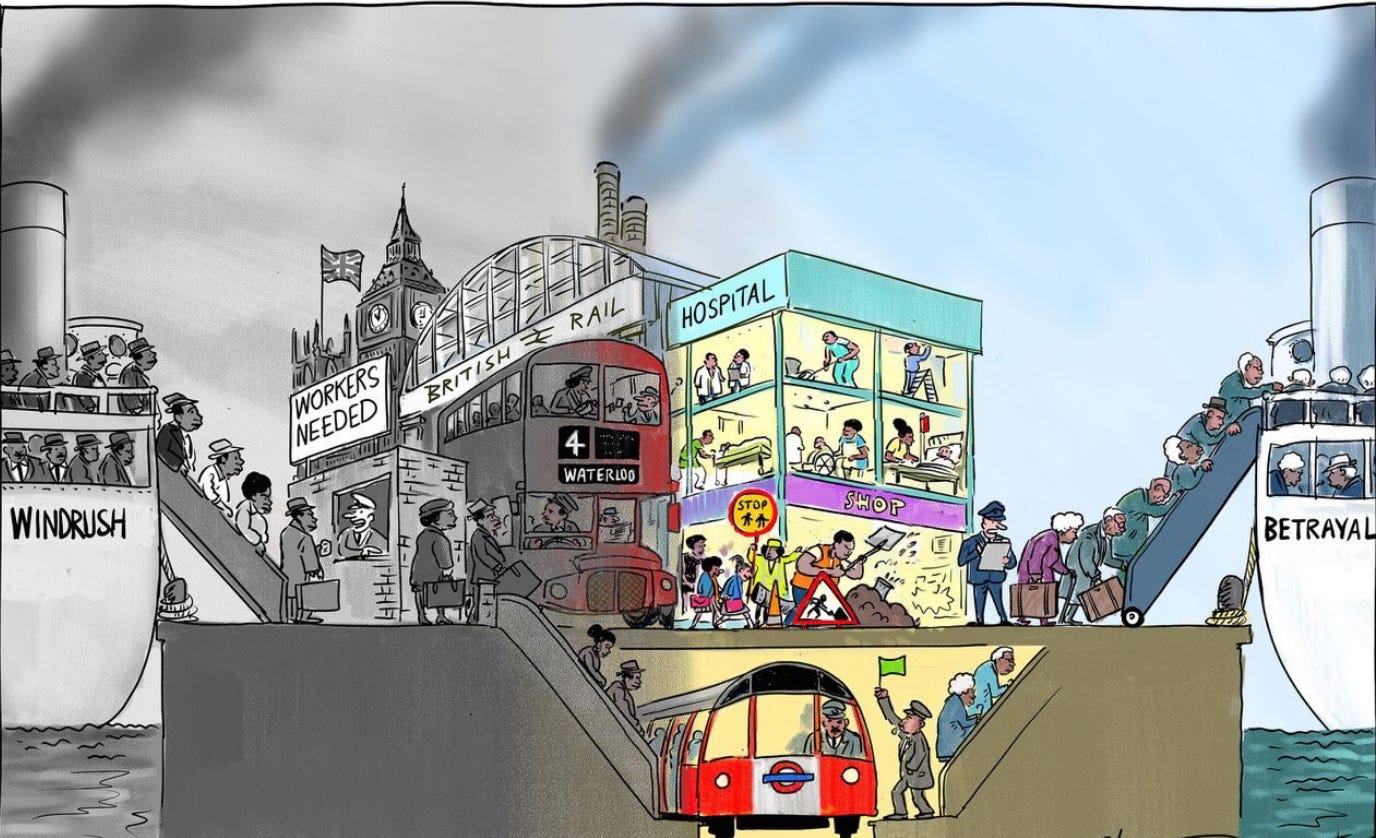
In a recent New Statesman profile, Nigel Farage told his interviewer that Britain has not been at ease with itself ‘since the 1990s’ and perhaps even the 2012 Olympics.
This sort of analysis, by somebody born in 1964, who would have twenty-one during the Tottenham riots in 1985 - where a White police officer had a six inch knife buried in his throat by a frenzied mob of Afro-Caribbeans - reminds me of the Millennials who are now declaring that 2012 was some sort of pre-internet golden age, around the time that teenagers were killing themselves over nasty Ask FM questions. The plaintive White underclass tells John Harris that there used to be a ‘bit of community’ some ten years ago, when times were better, in 2025 as they did in 2010. The elderly Winston, in 2001, tells a Channel Four reporter how ‘di yutedem’ used to settle their differences with fists instead of knives and guns. ‘Yung Tingz’, b2004, has much the same recollection about the early 2010s. ‘These youts are washed fam’.
There must be a psychological explanation for why people cannot understand that the society of their youth was just as rotten, or even more rotten than that of today, a phenomenon which is not quite captured by the term ‘nostalgia’. In Farage’s case this historical revisionism is even more extraordinary given that he was, by his own admission, a boyhood admirer of Enoch Powell, and more importantly, a student of Dulwich College during the 1970s.
Dulwich pupils, at this time, more or less besieged by Caribbean boys who had been planted in nearby comprehensive schools, mostly notoriously Kingsdale, which was originally founded in 1958 to teach Windrushers who had settled in Brixton. Brixton, much like Peckham, had been an affluent Victorian London suburb for much of the early 20th century but was mauled during the blitz, leading to the mass building of council housing. Another post-war tragedy intersected here - permissive education - the school’s teaching style was designed such that ‘nobody would be allowed to feel a failure’.
The school was a catastrophic failure and infested by yardie street gangs who would run pitched battles against students from other comprehensives. In 1973, as the excellent Tempest Vista has documented, massive brawls including hatchets and knives were breaking out between students at Kingsdale and Norwood/Tulse Hill - none of the offending pupils were White. Kingsdale was so bad that local residents protested in a vain attempt to have the school shut down. By 2001, boys in the school outnumbered girls four to one because parents were too afraid to send their daughters there.
This failure had consequences for pupils of the nearby Dulwich college. In 1980 Dulwich college had to hire a uniformed security guard to escort boys from the school to the nearby police station because gangs of youths were attacking them. Farage left Dulwich college in 1982 to begin his career as a metals trader in the city. ‘Phone muggings’ and worse attacks are part and parcel for pupils from the school. To this day, Dulwich college staggers its leaving times with nearby comprehensives to avoid having their pupils be attacked.
In sum, as early as the 1970s, middle class White people in South London were being forced out of Brixton, Tulse Hill and Norwood by a violent immigrant group - paying not only for the housing of these individuals but also for the education of their children - children who would then violently attack the children of those middle class Whites. That was the ‘social contract’ in the 1960s and 70s, a time when this country supposedly ‘had some bollocks’ before cancel culture and Woke.
