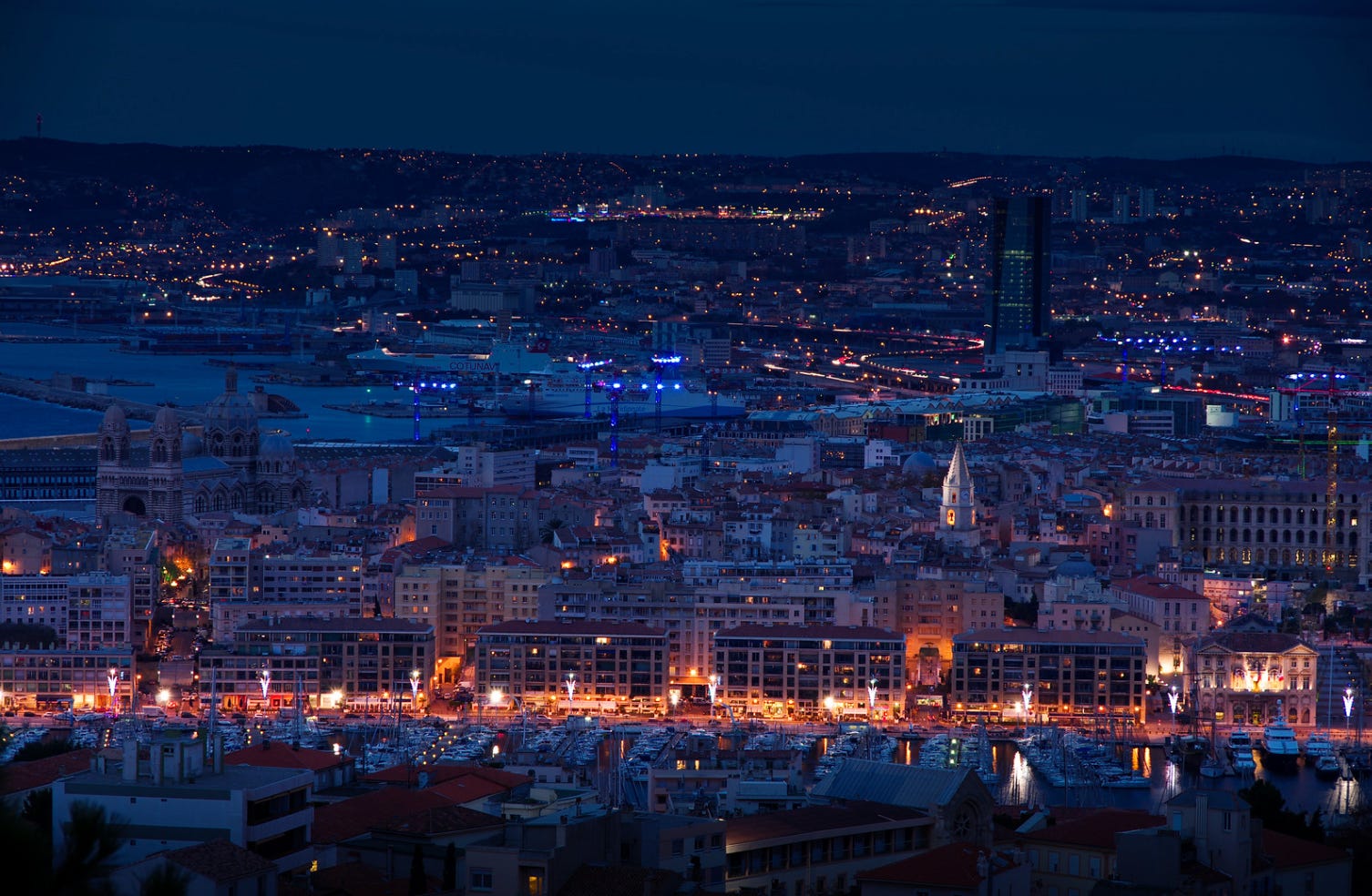
Marseille
By the Marquis
Report on the landscape as spied from a bus from the airport: low, skulking mountains sprinkled with a half-inch of dry earth like the pit of a bull-ring; fantasies of violence; there is stealth and murder in the cauldron, there goes a thorny rock on which a man could really kill his brother, where, under the tigers-eye of noon, I think a man could really press the dagger to the hilt; from the other window, the ocean is spreading itself flat as a hotel pool, and Africa purrs somewhere in the distance.
Late summer; long, empty skies punctuated by sudden thunderstorms, announcing the coming of Autumn; a feeling of static electricity in the air between the aforementioned lends a manic quality to the movements of the native young and suggests the danger of, if not rape, some frantic sexuality which, like that between pidgeons, is indistinguishable to outsiders; one night we are woken by two boys in shellsuits who, having crashed the scooter they were sharing into a wall, are screaming at eachother in a combination of French and Arabic, and there is light on across the street, where a silhoutte leering from the balcony begins stroking his member over his basketball shorts. The smell of brine and urine and beneath that, something earthy which in other countries would be called the smell of rain but which here is brought by something else, and something also in that lilting snake-charmer Provençal accent that calls to mind St. Augustine’s “Then I came unto Carthage, where a cauldron of unholy loves thronged about my ears” - not that I can say I was tempted by the row of obese grand Madames who guard the the whore houses of the infamous Rue Curiol, dressed all in funeral-black and dotted along the pavement like bullfrogs on a log.
Such were the facile impressions of Marseille I had chosen to come away with upon visiting a friend there some years ago, the city then a victim of a slightly more lurid, freshly post-teenage imagination than I can muster now. In the mind’s eye, the name ‘Marseille’ still conjured up Jean Genet novels in which a Foreign Legionnaire returns from Martinique with a bird of paradise mounted firmly to the shoulder, buries his Swiss Army knife in the belly of a pimp and disappears for “dusky continents, where the moon connives at murder under the roofs of bamboo huts.” It is here in Marseille that the Marquis de Sade plotted the poisoning of his bevy of prostitutes and, having fled justice for Sardinia, was executed in effigy; here too that the hero of Dumas’ The Count of Monte Cristo stewed in the dungeon of the Château d’If, the former prison that broods some 20 minutes by boat from the port - and whose name, I think I can safely assume, (I do not speak French) means: ‘The Castle of Possibility.’
That first visit at the end of September 2023: good enough timing, just missing the peak of a summer I did not, still do not, have the complexion to fully enjoy. We spent a week playing a middle-class variation on the role of the ‘Englishman Abroad’ (no less drunk, no less sunburned, showily apologetic for one’s presence in front of the locals; occasionally pretending to be interested in a church, pacing about the aisles in slow, aimless circles like a gamehen), and though the roguish feats of daring I had in mind somehow failed to materialise, came back happy as a clam in clover and a pig at high-water.
The Friday before we arrived, the jury of the Assize Court of Aix-en-Provence heard the story of a boy who had been beaten, kidnapped, stripped naked and tortured overnight, in a basement somewhere in the northern suburbs of Marseille tourists will not usually see more than twice, from the window of the taxi to and from the airport. The victim, then only 16 years old, had been caught selling hash without the say-so of the local gangs: “They treated me worse than an animal […] There were a lot of people. They hit me, they made me snort coke [...] They burned my genitals. I think it was a blowtorch because I was blindfolded, I felt air and a big fire. I screamed in pain.” His case was barely unique that summer. 2023 marked an all time high for violent deaths in Marseille, peaking around August, driven by a turf war between the rival DZ Mafia and Yoda outfits, many of its casualties teenagers and children, recruited as runners and look-outs for the drug dealers. The city’s murder rate hit 5.5 per 100,000 inhabitants; London’s for the same year, by contrast, was about 1.1. Of the 56 charged with gang execution and attempted murder in 2023, reported Le Monde, six were minors and just over half were aged between 18 and 21.
Marseille’s reputation for criminality is not new. Since the late 19th Century, its Vieux-Port has been known as a hotbed of vice, historically the sparring grounds for Corsican gangsters whose freedom from the law was shored up by a string of Tammany-Hall-esque silver fox local politicians throughout the 20th Century - most notably, Simon Sabiani, one-eyed inter-war deputy and associate of one Mr. Paul Carbone, head of the ‘French Connection’ operation, smuggling heroin from the Orient into America by way of Marseille (as depicted in the 1978 film, Revenge of the Pink Panther.) “Ballot boxes are regularly stuffed with names from undertakers’ lists. The city is as gangster-ridden as Chicago,” wrote Time Magazine in 1934.
What lent the crime statistics of 2023 some special unhappiness then, was that they seemed to prove that the grand strategy to pacify Marseille, by then in place for a decade, had not worked. Nominated the European City of Culture in 2013, millions had been spent on attracting tourists to help cure its dismal rates of unemployment, poverty and violence. The locus of this fell on the downtown old port, now the site of the Muceum (Museum of European and Mediterranean Civilisations), a 45,000 square metre exhibition complex spread across three sites. Though less than unanimously popular among the natives - the report from the committee that granted the title explained that the bid’s emphasis on Marseille’s ethnic diversity and relative poverty had been the ‘major element in the attractiveness of this project,’ though the developments the grant funded were located almost exclusively in the centre of town, far from Marseille’s dilapidated suburbs - the rest of the world appeared to have been sold. That same year, Marseille came in at No. 2 on the New York Times’ ‘The 46 Places to Go in 2013’, narrowly beaten out for the top spot by Rio de Janeiro; by 2024, the number of tourists was just short of double the figure from 11 years prior, at a healthy 19.5 million. As part of that cohort I can attest that, from where we were sat, all looked perfectly right with the world.
The civilizing mission, encroaching on Marseille from the coast, has secured two firm beachheads - one at Le Panier, near the Vieux-Port, the more conventionally ‘touristy’ of the two (though, naturally, in a much less oppressive sense than one might say of Leicester Square), and the other about 15 minutes walk north, centred on the two neighbouring plazas of La Plaine and Cours Julien. This is the home to a lot of bars whose menus are printed in that very specific Negroni-tinted burnt orange colour which immediately calls to mind sourdough pizza ‘pop-ups’ in deepest, darkest Clapham; home to Limmat, a restaurant I could not speak highly enough of, until a friend noted that he had the very same recommended to him by a member of the cast of Some People Just Do Nothing over Instagram Reels, at which point I promptly shut up; home to a lot of Eating-with-Tod shaped people, shuffling about in search of 18 euro sandwiches with names like ‘The Toecurler,’ and inventing new units of beer which are smaller than a pint but somehow more expensive (what the fuck is ‘schooner?’)
Returning to Marseille for a third time, here with my now ex-fiancé, (the flights had been booked a month or so before the split, but we’ve soldiered on out of an excess of mutual goodwill) all this strikes me as a great deal more saddening than it had a only few years ago; perhaps because of the auspices of the trip, perhaps because I have gotten older, slower and more boring, now closer to 30 than I am to 20, now reluctantly more comfortable in the world of padron peppers and NTS Radio and ‘community saunas’ than I am in that of Jean Genet. Nonetheless, I spend my time in London avoiding, as much as possible, venturing any further east than Farringdon, and yet here was Hackney-on-the-Med, sneaking up on us on the other side of the continent.
I had been wilfully blind to all this during the first visit, by which time whatever ‘this’ is was already in full-swing, but in hindsight there is one particular detail, one particular clanger, that should’ve rung alarm bells. On the wall of a pretentious, offensively mediocre restaurant I will leave politely unnamed, just off Cours Julien, there hung a photo of Norman’s: a now-defunct eatery in North London. For those blissfully unaware, this was a late variation on the theme of the Millennial gimmick-restaurant, (see also, Cereal Killer Cafe, set up in 2014, dishing up £6 bowls of cereal to the witless Brighton diaspora in Shoreditch; thanks in part to anti-gentrification protests from the locals - which the owners saw fit to dub a ‘hate crime’ - they have since shut their London locations and gone into hiding in Dubai) a “caff”-themed-café, serving, after a fashionably long wait for a table, no-less-fashionably priced renditions of greasy spoon fodder, alongside a range of sandwiches which, as thirty-something year old men who wear Carhartt caps apparently enjoy, were impossible to eat without oozing various chilli jams and sriracha mayonnaises onto the patrons’ disgusting, puffy hands.
In a victory for civilized people everywhere, Norman’s closed its doors for good last summer, and shall sully the good name of Tufnell Park no more. If the reader is not yet convinced of the justice of this, I would point out that, on Norman’s menu, (chalkboard, naturally) tea was listed as a ‘cuppa tea’ - one of a litany of geezerish contrivances that won them a collaboration with Burberry in 2023. Has a more irritatingly Instagram Reels-friendly restaurant emerged anywhere on earth since? If so, Marseille today seems as good a place as any to look. This is a city Parisians move to for roughly the same reasons Londoners might move to Margate or (chas v’sholom) Brighton. Marseille is much larger than both, though the quarters of it the middle-class emigre or tourist are likely to spend their time in are not. In both countries, the long COVID hangover of Wank-From-Home has enabled the laptop class to leave their respective capitals in pursuit of lower rents and ocean views; the city is pitched as a home for ‘young creatives,’ but as always with that ever-dubious phrase, ‘young’ seems to mean 30-something, and ‘creative’ is most often slang for ‘in marketing.’ Their Marseille is not a city of Rimbaudian adventurism, but a sunny retirement home for the nearly-middle aged.
Part of the attraction for this wave of transplants is that Marseille, like Hackney, possesses just the right amount of urban grit - lacking in say, Margate - to feel bohemian and ‘authentic’, while the French approach to social housing, which places the poorest residents in the distant outer reaches of the city, ensures any real danger is kept at a safe distance. In a strange sense then, it is just as much the violent drug dealers in the banlieues who have drawn the hordes of well-moneyed visitors to Marseille as it is the redevelopment fund that came in 2013. But these two worlds do not come into contact. There is nothing in the experience of the tourist that might suggest that, 20 minutes drive away, children are pointing kalashnikovs at each other, nor anything in the experience of the suburban poor - “I think it’s a bit late now to dream. I don’t have any dreams,” a young resident of the cités told the BBC in an interview last year - that might indicate that, 20 minutes in the other direction, people who work in tech sales are trying to explain the concept of ‘picky bits for the table’ to the waitress in broken French, after the evening’s sixth round of negroni sbagliatos.
What conclusions are we to draw from this? Should the tourists begin looking very guilty, begin staring very thoughtfully into their pastis, begin jotting down their reflections in a notebook, perhaps attempt to flog those very thoughtfully guilty reflections to J’accuse? That all sounds very annoying. Instead, the lesson from Marseille is that the pursuit of ‘authenticity’ abroad or at home is self-defeating and will always disappoint. One evening I found myself unreasonably irritated, overhearing a perfectly well-meaning American sitting next to us at a bar ask the waiter, “So, where do the locals eat?”, at which the poor man was understandably stumped; should someone ever ask me the same about London, honesty would compel me to answer: ‘The locals eat at Pret and Morley’s.’ It’s best not to ask. It’s best to just sit and drink.
In the final pages of Genet’s Our Lady of the Flowers, we read of the novel’s transvestite-prostitute-protagonist, Divine:
“A vast physical peace relaxed Divine. Filth, an almost liquid shit, spread out beneath her like a warm little lake, into which she gently, very gently - as the vessel of a hopeless emperor sinks, still warm, into the waters of Lake Nemi - was engulfed, and with this relief she heaved another sigh, which rose to her mouth with blood, then another sigh, the last. Thus did she pass away.”
It was this passage that sprung to mind when, sipping yet another Campari spritz outside one of Marseille’s endless, forgettably pleasant bars, thanks to a plumbing malfunction in the flat upstairs, a crack in the plaster on the ground floor suddenly spilled forth a torrent of liquid shit, a patio-clearing river of liquid shit, belched out onto the New Balances of our fellow al-fresco diners and snaking down the pavement, pausing for a moment while the wall choked on a wad of solid waste… Ah, but not solid enough, malheureusement, to clog that leaky dam, burping up rank chunks and unleashing another slow-rolling Rhône alive with softly bubbling farts, uncorking for the messieurs-dames another frothy Rhône of warm, liquid shit… Voila! Here at last was the Marseille of my teenage imagination, the Marseille of Jean Genet and the Marquis de Sade and the wet dungeons of the Château d’If, avenging itself upon the real thing, against ‘authenticity’, emptying its bedpan over the heads of the Dalston emigres, over negroni sbagliatos, over Norman’s and NTS Radio, over us.
The next morning, the woman and I are drafting a message to the landlord, explaining that the doorframe broke last year and we fixed it with duct tape, before we both move out in a few weeks time; let’s file it under ‘reasonable wear and tear’, sometimes these things just happen, sometimes things break, things work out differently than you imagined, things spoil. In the meantime, we’re spreading out our petit déjeuner on the garden table. Something is buzzing around the cut fruit, and the day is one more Still Life with a Wasp.


