London's protests, viewed from the Continent
Koekebakker
Because of the policy choices that Western governments feel compelled to make, be that on migration or climate change, more sophisticated methods of restricting the flow of information have become neccessary. Hence ‘controlled spontaneity’, the Online Safety Act and a two-year contra-mundum super-injunction on the very existence of an injunction hiding the presence of 36,000+ Afghans who had been flown into Britain at a cost of seven billion pounds.
These tactics have always been effective; the Carlsbad Decrees ended the Hep-Hep riots within a month and the September Laws of 1835 kept French republicanism effectively muzzled for the better part of a decade, but our modern managed democracies need not be so blatant.
Instead of ‘The Press Act’ or ‘Censorship of Publications Act’, whose heavy handedness made them failures in the long term despite their short term success, we have names like Coco’s Law or Zach’s Law. An verification pop-up is far less incendiary than newspaper front pages deliberately left blank but the restriction of information is the same. However the dangers here lie mostly in the future and for now the internet is still free enough for the dissemination of knowledge to not be the primary impediment to political protest.
In addition to poverty and freedom from censorship the expansion of universal suffrage to nearly every country in the world has created a third condition for social unrest in the ‘democratic release valve’; the feeling of ‘being heard’ or ‘being represented’ which can induce populations who are neither ignorant nor prospering into disgusting displays of complaisance like singing “don’t look back in anger” after the mass murder of teenagers or protesting the murder of a 17 year-old girl by an asylum-seeking serial rapist with feminist bicycle rides[1].
Among the many, many reasons proportional representation is terrible is that it creates both a very low floor and a low ceiling for insurgent political parties. In Germany a party needs only 5% (most of the time) of the vote to be represented in parliament and in the Netherlands it is just 0.67%, yet to gain a majority they would in each case need the support of 51%+ of the entire electorate. When 85% of a country’s population consists of voters for whom ‘normality’ and ‘just getting on with it’ are the highest political virtues it is almost impossible for an anti-establishment party to command an absolute majority of the vote, meanwhile the low floor often strangles insurgent parties in the womb by giving the most prominent members parliamentary salaries and incentives to deradicalize and make friends with their new colleagues whilst they are still electorally small.[2]
The result is that voters are placated with extremist speeches in parliament while the establishment remains insulated from electoral pressure that would force them to make material concessions. The phenomenon of the democratic release valve is not unique to countries with proportional representation, I personally doubt the Southport riots would have happened had the Conservatives been in power and certain right-wing Tories available to make “galvanising” speeches from the front benches, but what is so valuable about FPTP is that it forces parties to take responsibility and it is possible to vote them out of power if they do not.
So it is the convergence of declining living standards, the free exchange of information, and the perception of political exclusion that together form the modern conditio sine qua non of mass and violent protest. Marx called these circumstances the passive element of revolution, as opposed to the active element consisting of human action, without which no revolutionary movement, however organised or determined, can succeed.
But just as large-scale political agitation always requires the passive element, the conditions which add up to the passive element can always appear anywhere and sub-HBDist tales of certain nations being incapable on account of casualties in the World Wars or the departure of a few religious zealots to the new world in the 17th century are fatalistic quietism which impairs our ability to predict social unrest.
Other lesser factors, such as age, sex ratio, the level of urbanity of the White population, and of course the weather affect the incidence and efficacy of protest too, but where the three principal conditions do not exist significant anti-state agitation will not arise.
An explanation I recently saw given by an American for the failure of the ‘no kings’ protests to elicit concessions or even any significant reaction was that the ‘vibe shift’ since the Floyd Riots has been so great that such protests no longer elicited the sympathy of the media or government.
The fact that one consisted of wealthy female pensioners feebly holding placards by the side of the highway and the other animated youths causing over $2 billion in insured damage in less than a fortnight appeared not to figure in his analysis. Without a methodological understanding of what causes social unrest it is impossible to predict whether a protest movement will be successful.
The predictions of an imminent racial civil war which are issued so often and glibly on talk shows and even in the EU parliament by journalists and ‘War Studies’ professors are severely premature. Not only because today’s political factions are not nearly so antagonistic that the members of one would rather appeal to the sword than be governed by the other (only see the “radical” Green party’s new policies on NATO and the House of Parasite) but because there is no material basis for civil war, the economic prospectus is not nearly bad enough.
During the last period of irreconcilable political antagonism, against the backdrop of the Great Depression, European parties routinely had paramilitary wings. This was not restricted to communists and fascists, even mainstream social democrats and conservatives maintained paramilitaries with members numbering in the millions. Their absence, and the risibility of a paramilitary wing attached to a major European party today, is enough evidence to conclude street-level factional violence, much less civil war, is not an imminent prospect and the motivations of those predicting it should be questioned. Instead, comparing some of the forms of political protest common in Europe today might suggest how social unrest will manifest and how successful these protests will be in their aims.
If one were to visit Malaga during Holy Week and watch peak-hooded penitents chanting the name of Our Lady whilst carrying golden thrones and holy relics cloaked in embroidered silk on high, one might reasonably assume themselves to be in a very religious country with a political environment that promoted, or at least accommodated views reflecting catholic social teaching. One might be surprised to learn, then, that Spain was the third country in the world to legalise same-sex marriage, is one of the very few where euthanasia has been fully legalised and provides abortion on demand to 16 year olds without the need for parental consent - while the conservative opposition party promises not to repeal any of it.
But most people would not be surprised because they recognise the state permitting and supporting this type of harmless procession is wholly reconcilable with pursuing policies which the marchers would despise. If this is true for a religious procession, at best an implicitly political event, it is true of explicitly political processions too. In Belgium student societies can safely march through their university town with banners calling for remigration whilst shouting “revolution!” because they are protected against antifa counter-protestors by the police. The tolerance for this can partly be explained by tradition, there is a political consensus that people can participate in these demos, uniformed and completely identifiable, and not have their lives ruined or be exiled from civil society. The real reason however is that these protests do not pose a threat.
Instead of being viewed correctly as the attitude of an establishment which is confident and secure enough to allow public dissent this laxity is taken as evidence of a more right-wing, or at least more tolerant political culture than that which exists in America or Great Britain. The exact opposite is the case.
In Belgium there exists one of the strictest cordon sanitaire’s in the world to keep Vlaams Belang from power. Its predecessor party, Vlaams Blok, was subject to a written covenant signed by every other party in the country solemnly swearing not to deal with the party in any way or even “make immigration a political issue”. A new covenant has not been made for the new VB since the original party was banned by the state but the covenant’s provisions remain in force and thanks to the existence of Wallonia the only route out, a Vlaams Belang absolute majority, is impossible.
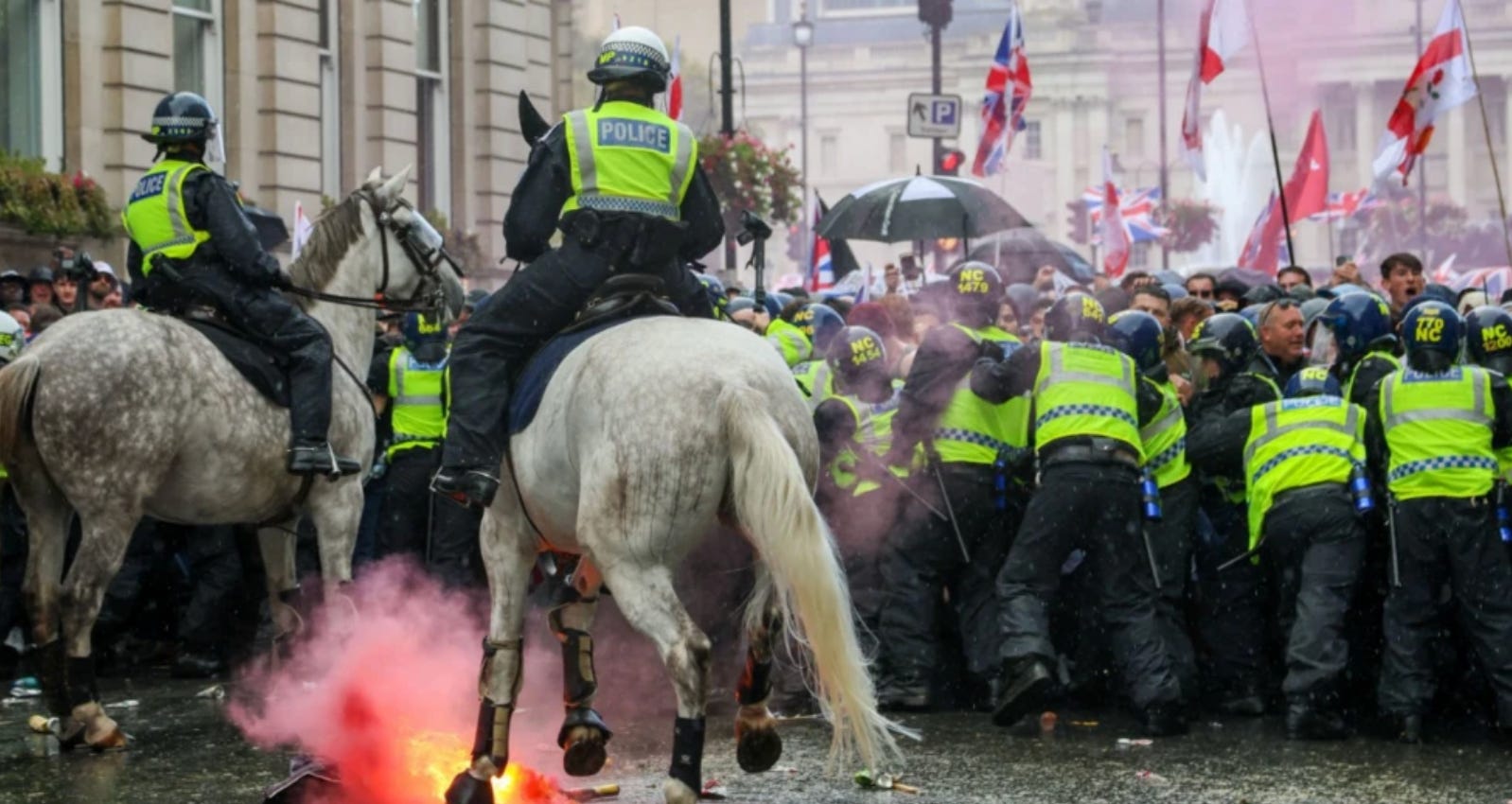
Compare the Belgian reaction to protest with Britain: the “Unite the Kingdom” rally’s are, for the most part, peaceful gatherings where standing around listening to journalists and politicians give tepid speeches about electoral politics. The Prime Minister has reacted by deploying live facial recognition technology, shutting down every pub in the vicinity and declaring that “violent thugs who spew hatred on our streets will face the full force of the law.” Meanwhile the political environment is so right wing that the centre-right Conservatives have had to suspend their own councillors for governing with the Green Party. These are reactions borne of fear and insecurity and evidence it is England, not Europe where political protest finds its most fertile ground.
What both these types of protests have in common is their uselessness. It is partially because the ‘passive element’ is missing, but mostly the fault lies with the decisions made by organisers (after all, successful protest tends not to comply with section 11 of the Public Order Act, making it risky for influencers hoping to boost their media careers to attend). Both are led by Stephen Yaxley-Lennon-types, “Shieldmaiden(s) of the Far Right” and YouTubers with megaphones. Both take place in idyllic university towns, pedestrianised market squares and routes prescribed by the police weeks in advance. Arterial motorways, fuel depot entrances, political party headquarters or anywhere the attention of those being protested against might be caught are all avoided.
Whereas at least “remigration now” is a specific demand that the government has the power to enact the “Unite the Kingdom” march is not a protest at all. A protest has demands which serve as the movement’s win conditions, not vague expressions of unity and solidarity. Without demands failure is inevitable and instead of concessions all its participants can hope to receive from the government are criminal records or Serious Disruption Prevention Orders. One only has to read the achievements of last Septembers’ ‘million-man’ “Unite the Kingdom” march to see the force of this.
[1] The response to the murder of Lisa was particularly offensive. ‘Wij Eisen De Nacht Op’ a deliberate reference to Reclaim the Night, was founded immediately after Lisa’s murder to manage public outcry. Of the 500,944 euro collected by the organisation though gofundme the vast majority went to NGOs such as Women INC who provide inclusivity courses to the police and other public bodies and slachtofferhulp nederland which combats “toxic behaviour online” with nagging Instagram adverts. Only 125,000 was given to the murdered Lisa’s family.
[2] The notable exception to this is the Federal Republic of Germany where an almost religious devotion to the cordon-sanitaire against the AfD is about to hand that party an absolute majority in Saxony-Anhalt.


