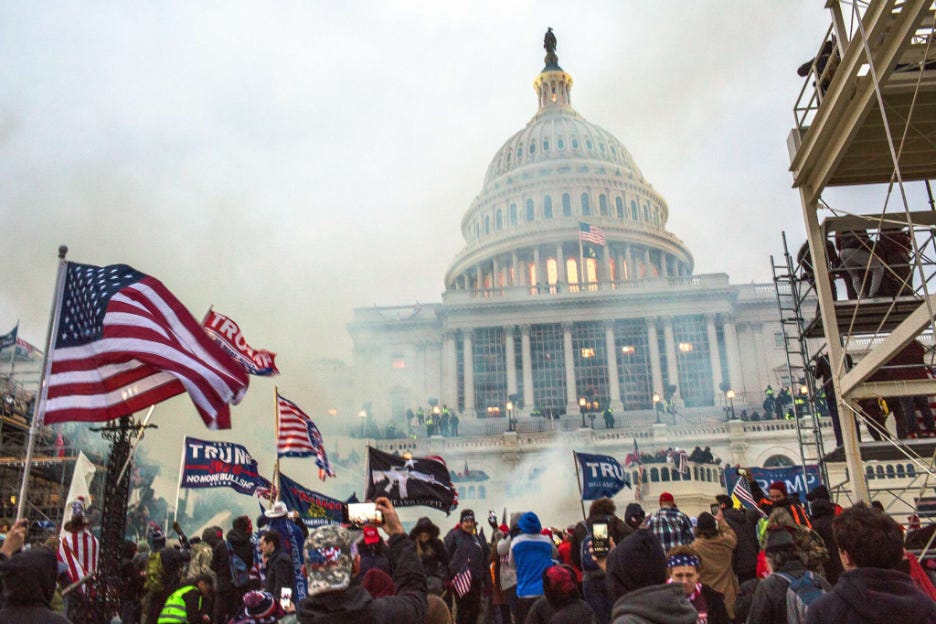
January 6 — Runaway Horses
A. Montagnard
To live one’s life as a line of poetry written with a splash of blood.
President Trump had, by the end of his first term, accomplished this. Could any of us say the same?
The benefit of internet anonymity means that we can, at J’accuse, look back at the symbolic value of the January Sixth protests without fear of social sanction. Perhaps legally and tactically unwise, they have not lost their significance five years on.
The entire “Stop-The-Steal” period was magical because it cut to the heart of Trump’s core support. Not since the Access Hollywood Tape had we seen so many attempts to “drop Trump” from Republican grandees. The Grand Old Party’s thick cartilage of think-tanks, churches and congressmen were never more distant from the voters and the candidate who brought them to power in the first place. This gave dissidents a unique chance to build credibility with Trump’s orphaned, elderly, TV-watching base.
Demographic surveys of the J6 detainees further debunked postliberal delusions. A solid attack on Sohrab Ahmari from Scott Greer assembled the relevant data:
“Seventy-five percent of “insurrectionists” believe in the Great Replacement theory… There was no significant gap among income brackets when it came to this question and Trump support. An immigration restrictionist who made more than $100k a year was far more likely to vote for Trump than an immigration enthusiast who made $30k a year.
A study conducted during the 2016 GOP primaries found that favorability toward immigration restriction, anti-political correctness, and white identity were the strongest predictors for Trump support. Income and education were at the bottom of factors that predicted Trump support.”
This was a cross-class coalition of patriots animated by their opposition to replacement migration, not the “structural, class-based injustices” identified by Ahmari or Steve Bannon. The so-called “boat-owning” lumpenbourgeoisie, they sacrificed their wealth and their concerns were rational. America’s political class were not shown to be secret Nietzscheans in a moment of crisis, but cowardly, absurd ciphers.
When the chips were down, the left could not match Trump’s demagoguery with their own charismatic appeal. Rallying behind an eighty year old without gravitas, the mess was cleaned up with a failed impeachment pursued by unpopular, interchangeable career-politicians.
Another striking thing was how democratic the whole affair was. Trump was not asserting, as some Rubicon-baiting neoreactionaries might, that the popular will was illegitimate, but rather that it had been measured incorrectly. That the process was subverted by Venezuelan voting machines, unscrutinized mail-in ballots, and corrupt inner-city bosses, who in past years failed to produce a single vote against Obama. Trump was holding “our democracy” to the same standards applied to countries like Russia. Might I remind you that Maduro has a higher approval rating than Keir Starmer?
The protesters were decentralised anons, organising privately over the internet. Speeches from the odd Alex Jones or Ali Alexander Oathkeeper distracted from the spontaneity of Stop-the-Steal. Pointing to the presence of federal agent provocateurs on J6 distracts from the significance of this. QAnon moved millions, not RiftTV. Then as now, Seeing Like a State, the media tried to give an unflattering face to the mobilizing masses. In 2016, we were all “Proud Boys,” today we are all “Groypers”, notwithstanding any personal aversion to Fuentes’s sleazy antics. Then we had “Harry’s Bar” and the Trump International Hotel (now Waldorf Astoria), today we meet at Butterworths or Cafe Milano. You can take your coat off now!
On the day, I clearly recall a fellow student texting that “The American Experiment, 1776-2021” was over. Though this was a catchy refrain, it downplayed the global nature of right-wing direct action through the Trump years.
The cinematic NYMag profile of David Dempsey, one J6 inmate who’d crossed skateboards with antifa before, alludes to a chain of violent confrontations across America that predate 2020. Starting around 2016, with the background noise of cop-killings and weekly ISIS attacks that set the stage for Trump’s first election, and culminating in events like the Berkeley bikelock incident. Faced with the two-tier treatment of BLM rioters during lockdown, it was time to return the serve.
Weeks after J6, vaccine mandates provoked a month of trucker blockades across Canada, met with media slander and federal asset seizures. Australia’s “freedom movement” evolved from lockdown protests to staging ongoing anti-immigration demonstrations. Its anti-system online media ecology allowed for nationalists to cannibalise the nation’s frail conservative movement. As recent unrest in Britain or even Euromaidan demonstrates, European states are a lot more fragile in kinetic and fiscal terms. Subtle security state psyops as seen on J6 are overshadowed by blatant debanking and the policeman’s truncheon.
What is unique about America is not any natural propensity for revolution. As argued elsewhere, White Americans have historically faced greater indignities than Europeans with a greater degree of complacency. Their dire situation was entirely altered by the enlightened self-interest of a single great man.
Friends attended the shock release of all of the January 6 detainees last January. Phrygian caps were visible outside the correctional facility. At least one inmate was carried out on a stretcher. A lone, screeching counter-protester got shirtfronted by Trump loyalists who massed around the facility in −15°C weather. An amusing prayer-circle of Falun Gong practitioners stood out as the only non-white participants in the crowd, praising God’s beneficence in breathless Mandarin. These blanket pardons stand as Trump’s most bold and indisputable achievement.
It was this instinct for action in the face of unfairness and disregard for process which spurred the President to capture Maduro this past weekend, overturning two decades of post-GWOT foreign policy presumptions. It must be remembered that many more congressmen planned to challenge the election before they were cowed into submission by the optics of the day[1]. Only Trump had the courage and the charisma to act unilaterally, dissolving the government and its processes in an orgiastic fusion of man and mob. It is a lesson “regime change” aficionados like Cummings and Yarvin should take to heart.
“You’d asked what would have happened if Trump was killed… I think it would have been like Attica,” he said. The bloody prison uprising that left 33 inmates and ten guards dead in 1971. “People would have tried to get out of here. That’s what I think.”[2]
It is for this reason and no other that Trumpism as a phenomenon is objectively revolutionary, regardless of whatever individual compromises Trump the man may make. The regime recognised this, banning Trump and half of the FYP.
Last month, I had the chance to holiday in Japan, which is to nationalists in the 2020s what the Soviet Union was for egalitarians in the 1920s. Japan is a greater threat to the regime than Russia’s autarkic war-economy or China’s chance to sink a few American aircraft carriers. Beyond chauvinistic policy paths not taken, Anime alone represents “the great cosmopolitan civilising influence” of our time — what the French language was in Nietzsche’s age. Maybe in 20 years we’ll ally with the Yamato race in a war to make our shared principles the triumphant value system across the planet. Until then, they endure as our distant moral educators.
What caught my attention this visit was a curious cenotaph in downtown Shibuya, across from the NHK broadcasting center. These so-called “conformists” constructed a great tribute to Gekokujō, the phenomenon where those of a lower political status overthrow their superiors.
The monument is a tribute to the “twenty-two samurai” who died in the 2.26 incident. A failed coup d’état against Japan’s bourgeois political class, unsupported by the emperor and other factions in the military, which inspired many of Mishima’s stories and his ultimate attempt on the government. This was the final revolutionary testament of the Imperial Way faction, the romantics who were succeeded by the “impressive, but slightly dark” Control group[3]. Atop the site where these men were executed stands Kannon: the Buddhist goddess of mercy.
Blessed Almsivi, Mercy, Mastery, Mystery
[1] In his usual, infinite beneficence, Trump has elected to forgive these people. He is a technocrat, not an ideologue, and the business of government must continue.
[3] I can recommend Janis Mimura’s “Planning for Empire” as a stellar monograph on Japan’s rightist technocracy, Manchuria’s Reform Bureaucrats and their strange postwar afterlife


