It's time for US bases to leave UK soil
Rhodes Napier
Trump’s escalation of hostilities with Iran to a near full scale state of war has invited much commentary and prophesying from the online right. There is no doubt that the decision to assassinate Ayatollah Khamenei was poorly thought through, was done at the behest of Netanyahu and has advanced Israeli interests at the expense of American ones. It will almost certainly guarantee that the Republicans lose the Midterms. It raises serious questions about whether Trump’s successor will be able to win in 2028, particularly if this temporary ceasefire does not hold and the apocalyptic scenarios of tit for tat destruction of energy infrastructure occur. There is still a chance that we are on the verge of a global economic depression which will engender the emergence of a far left populist surge across the West. Perhaps it really is all over because Drumpf blew it.
All this being said, I find much of the exhaustively pessimistic analysis frustrating. To claim that Trump has jettisoned the future chances of the right, we would need to countenance the possibility that there could have been a genuinely right wing force in America absent his rapid ascension in the Republican primaries in 2016. People forget the 2016 primary debates and polling (perhaps because some commentators were not politically conscious at this time) but the alternative to Trump realistically would have been Ted Cruz, who could have easily gathered the nascent populist zeitgeist in favour of a neoconservative revanchism. This was the primary paradigm in wake of Obama’s ‘apology tour’, the Iran deal and the emergence of IS. Indeed, to conjure up a hypothetical in which Trump hadn’t run, is to imagine a situation in which the Iran War would have occurred in 2018 as opposed to 2026, and in a context of no meaningful immigration restriction or even rhetorical shift on the issue. An aggressively evangelical and militarily belligerent coalition might not have been able to have decisively won over working class Whites, who up until the mid 2010s still leaned towards the Democrats. Trump is only damaging that which, both in 2016 and in 2024, he enabled in the first instance.
Its also worth revisiting 2016 to query whether it means anything to say Trump has “betrayed” his base. Trump, as has already been noted in this journal, always campaigned aggressively on the issue of Iran. Trump’s decision to assassinate the Ayatollah is in line with his preexisting advocacy of decisive unilateralism to deal with existing and emergent threats to US hegemony. Trump, for example, did actually escalate military intervention against IS whilst cooperating with rivals Russia and Iran. Trumpian foreign policy in the first administration was interventionist, and this was congruent with the mercantilist and imperialist position he had always advocated for. America did effectively ‘take the oil’ and ‘bomb the hell out of ISIS’.
The decision to strike Iran was predicated on the miscalculation, likely encouraged by Israel and hawks, that the regime was more internally unstable than it was (which isn’t entirely unforgivable in the wider context of the disintegration of the axis of resistance and the January uprisings). But it wasn’t intended as a project of occupation, as developments overnight indicate.
Ultimately, we in Britain, who have been spared involvement in this conflict, cannot impact its outcome, although we are of course uniquely vulnerable to the economic fallout. Rather than moralising about how Trump has purportedly doomed the global right (which is not true) we should begin planning on how best the crisis can be utilised to advance our own agendas.
I am to be clear skeptical of the claim that Trump has a negative effect on right wing populist movements in other countries, which by and large predated his emergence as a figure. The only instance of the “Trump effect” is on Pierre Polivierre, who of course was not a right wing populist. Polivierre engaged in extensive ‘Punjabipandering’, often presenting himself turbaned at Gurdwaras and Hindu temples, and supported an immigration “cap” of 250,000 a year in a country of 41,000,000. This is obviously disanalogous to European and Australian movements which are promising mass deportations and immigration freezes, and which have therefore won the undying loyalty of a core of electoral support.
We should also note that certain parties like the DPP in Denmark actually increased their vote share in the most recent elections, in spite of the country being the direct recipient of Trump’s annexation threats. Reform, but only because Farage has consciously chosen to emesh himself with the Trump administration, might be vulnerable to the fallout. However, the party’s chosen agenda of doubling down on immigration issues by calling for a visa ban on Afro-Carribean/West African migrants show that they are willing to aggressively stoke controversy as a way of moving the news agenda.
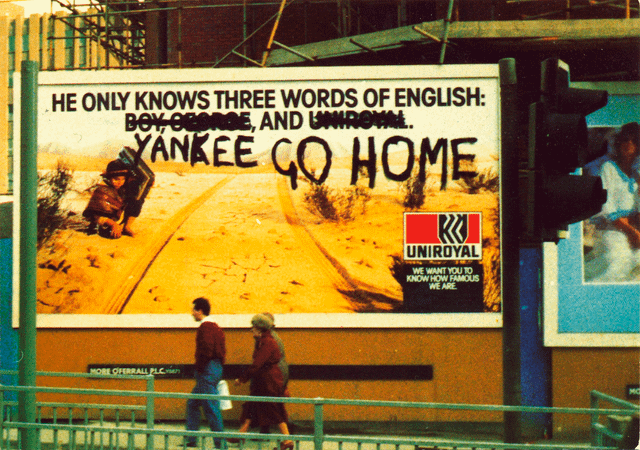
But to the extent that Reform are worried about a Trump ricochet, there is obviously an opportunity to monopolise the anti-US foreign policy position in British politics, which will neutralise this threat. This can be accomplished by simply going further in terms of disengagement than what most people on the left are calling for. The Green Party maintains we should “wean ourself off of the US military alliance”, rather than actually exiting NATO. A right-wing populist party should make the case for a NATO exit whilst simultaneously calling for the closure of US bases on British soil. Trident should be closed down and replaced with an independent nuclear deterrent, ideally developed in tandem with an RN lead French government, as part of a wider project of pan-European nuclear defence.
Rather than seeking allies in the “global south” we should call for a genuinely Gaullist policy of foreign policy amoralism, which means forging substantive links with countries with non-aligned value systems. That means being willing to threaten to bring Russian and Chinese military assests into British sovereign territory to counteract future hostile American manoeuvres, particularly those coming from a future Democratic administration supportive of our domestic enemies.
The AfD, which has called for the expulsion of US bases, is now leading the polls in Germany. While the party’s relationship to Atlanticism is complicated (there have been factions within it which were almost Likudite, in that they have called simultaneously for close ties with the US, Russia and Israel, whilst opposing Iranian regional ambitions) it does has a revolutionary nationalist element, as well as a Russophile wing, and such anti-American stances come naturally to the party. It might be more difficult for Reform to accomplish this transition, but British right wing voters might support a NATO Brexit amidst a broader global conflagration.
More broadly, Trump’s threats to Iran and his lashing out at allies might actually achieve that which multipolarists, who are vehemently opposed to the war, want; the disintegration of the American lead order. Trump has threatened that Britain will no longer have any guarantee of US assistance in the event of an attack, has threatened to pull American troops out of South Korea and allegedly mused withdrawing from NATO. A European right-winger might dislike the rhetorical framing this is occurring under (essentially Bushite lambasting of “cheese eating surrender monkeys”) but it is nevertheless accomplishing their geopolitical goal of the end of the 80 year occupation of the Old World.
Bear in mind that many European right-wingers supported Trump in 2016 precisely for these reasons. As we enter the Trumpian Gotterdamerrung, we are being taken back to the original international radicalism of 2016. It was Trump who was meant to be the harbinger of the end of the Antifa occupation of the West. He is now now fulfilling that promise, much to the consternation of the European online right.
Irrespective of the outcome of this conflict, the ‘Western alliance’ will be weakened if not actually dissolved. The potential knock on effects of this are interesting, both in terms of the domestic as well as the international accelerants of chaos this will introduce. Europe, isolated from the cloistral protection of American armed power, will increase its own defence spending (this has already happened with the “ReArm Europe” plan under which 150 billion euros worth of loans have been allotted to aid defence procurement). Germany is mulling introducing conscription and is requiring its male citizens to request permission for more than three months absence from the country. An already indebted Europe will need to borrow and raise taxes in order to fund increased military expenditure and also to meet the needs of a growing retinue of pensioners and immigrants. The Europeans who will be footing this multibillion bill will also be the ones carrying the burden of military service. This is hardly a sustainable state of affairs, but it is the agenda of most European centrists. How such a situation falls apart is yet to play out, but it is reasonable to predict that it will present opportunities for the right.
In conclusion, Trump’s intervention against Iran will hamper the electoral prospects of the American right in the near future. Even if we are coming to the end of the Trump era, we must recognise that he had flaws - his ideological support for Israel, his impetuosity and negligence of domestic priorities - he was absolutely necessary to turn an, until 2016, non-existing US national populist right into a reality. Indeed, many of things which nativist ideologues dislike about Trump, and which make them wish for a ‘respectable’ exponent of their worldview, were actually critical to his success. Trump won the primaries and the presidency twice because many found his ‘crassness’ and rhetorical belligerence on foreign and domestic issues appealing in themselves. Even if Trump’s presidency ends in widespread disavowal of him, it won’t be the end of the American right.
As for Europe, its voters are ultimately more motivated by anxieties about immigration than they are about whether their local populist party has a tangential connection to the GOP.
Things are unpredictable but, at the risk of sounding trite, history rarely advances linearly. We are in a period of transition which opens up risks but also opportunities.


Trying to figure out what it is about this article that rubs me the wrong way, aside from its elitist tone. Used to greatly admire GB, but right now you couldn’t pay me to live there. A doofus PM, a somewhat goofy king, a government that prosecutes and jails people for tweets, rape gangs. Maybe you need another Cromwell. Western Europe is all messed up, don’t try to shift blame.
Insanity, we quite literally depend on the US military for our security. We cannot defend our own soil from simple invasion, let alone a mass military attack on the British mainland. We need them, sadly. If we were not so anaemic I’d see your view more clearly, but this is just suicidal. It would also massively sour the relationship between the US and the UK, which is what we do not need. It’s not a benefit, unless you just dislike America to the point of suicidal self harm.