

Those of us who perused anonymous blogs back in the heady days of 2016 would sometimes encounter the argument that Irish immigration infused the American public sphere with a pugnacious social conservatism that held this country back from ever tipping too far into left-wing utopianism. Sean Hannity, Bill O’Reilly, more admirably, Pat Buchanan, were argued to speak for the Irish and Catholic ethnics, and Irish-American support for Nixon and Reagan, as well as opposition to integration in Boston, was pointed out to present Irish immigration as America’s saving grace in the late twentieth-century. As someone of Irish descent myself I always welcomed this argument and found it a pleasant tonic for the wounding of ethnic pride after, say, gay pride floats in the Saint Patrick’s Day Parade.
This argument is fairly tendentious; as I argued in my previous essay ‘Selective Breeding and the American Establishment,’ America already had a native ideology, noted for its fierce intellectualism and self-confidence, that successfully advocated for social conservatism and ethnic cohesion. What’s more, much of this ideology’s postwar collapse I attribute to the ethnic churn in the American elite precipitated by Ellis Island and the expansion of our elite universities’ admission policies in opposition to the protests of WASP stalwarts like Madison Grant.
The most politically salient fact about Irish Americans in the 20th-century is that their ethnic loyalty made the Kennedy family into one of the leading families, if not the first family, of American politics. The actions of individual Kennedy siblings therefore assume an outsized role when one assesses the impact of Irish migration. Probably contrary to the wishes of most of their working-class supporters, the Kennedy brothers used their position as members of ‘the first family of Irish America’ to very effectively support the moral and legislative revolution of the 1960s.
The brothers John, Robert, and Edward “Ted” Kennedy brought moral inspiration and forced through reform; John supporting African decolonization, Civil Rights, and nation of immigrants propaganda, Robert throwing Kennedy gravitas behind MLK radicalism and peace activism, and Ted, “The Lion of the Senate,” enshrining egalitarian leftism in the legal codes, most notably in the 1965 Immigration Act. Anyone who wants to understand America’s postwar, 1960s moral drift should study the development of these brothers and try to puzzle out how three flaming liberals could have been reared by someone like Joseph Kennedy Sr. who, for all his Roosevelt support, was an isolationist and staunch American realist of the old school. To my mind, you will not find a better resource than Nigel Hamilton’s JFK: Reckless Youth.
Revisiting this book today I am reminded of the confusion I felt reading about the life of François Mitterand, the youthful nationalist and Vichy functionary who nonetheless became a leading proponent of replacement migration. The Kennedy siblings grew up in a time of great ideological ferment, and the old racially-conscious and elitist WASP ideology I previously described has a heavy presence in this book. This shouldn’t be too surprising, the Kennedys spent their youth in elite northeastern environs, what’s interesting is that, contrary to the old cant about ‘blacks and Irish need not apply’ the Kennedys didn’t feel themselves deeply excluded by this ideology and, in fact, Joseph Kennedy jr became, like his father, an enthusiastic proponent of the ideology.
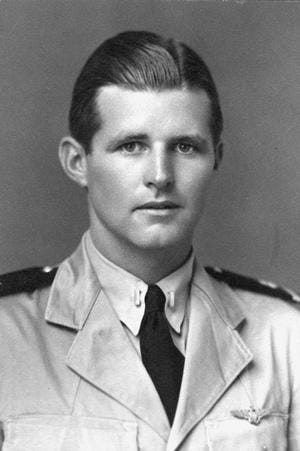
First in age of his siblings, namesake and favorite of his father, Joe Kennedy Jr. was the natural leader of his powerful clan. While Reckless Youth does a good job conveying young Jack Kennedy’s seductive appeal to both men and women, his older brother is the one who stands out in these pages for his leadership potential, independence of mind, and aura of destiny. While Jack Kennedy spent his time at Harvard developing his ideology of robust liberal interventionism, Joe Jr. appears to have become a convinced adherent of the older WASP ideology.
Here, some background about their father is in order. While initially a financial wheeler and dealer somewhat indifferent to ideology but loyal to Franklin Roosevelt, Joe Kennedy Sr. found himself drawn increasingly towards Isolationism and the Old Right viewpoints of the America First Committee as his ambassadorship in London became embroiled in the build up to World War II. Joe Sr., like many other men of his class and background, respected Hitler as an opponent of Communism, and was suspicious of the motivations of many of the loudest proponents of war, his suspicion only increasing when his measured attempts at diplomacy earned him hysterical denunciations in the American press. As the ambassador to London, Kennedy became a faction of his own, representing and in turn defended by men like Robert McCormick, Gen. Robert E. Wood, and Charles Lindbergh. The first incarnation of the Kennedy family in politics was as proponents of what the men chronicled in Bendersky’s Jewish Threat would call “Americanism.”
Joe Jr. was in vehement agreement with his father’s arguments, in fact he took them much further, showing bravery and independence of spirit even at the risk of jeopardizing his own, and his father’s, political standing. Joe Jr.’s political views are often taken to begin with a visit he took to Germany in 1934 where he wrote an admiring letter about it to his father, but it should be pointed out that in the same year he visited Russia and returned a convinced Communist, so at this stage he was probably just impressionable. By 1938, in his senior year at Harvard, Joe jr. was a convinced anti-Communist and isolationist, although to what extent is somewhat murky. Some biographies claim that he went so far as to found a student branch of the “Hands Off Spain Committee,” a conservative Catholic group organized to prevent the sending of weapons to Republican Spain. His senior thesis was titled “Intervention in Spain” and, apparently, took a hard-line against the socialist side.
It’s at Harvard Law that Joe Jr. really comes into his own, politically. At this point he begins popping up over and over again in JFK: Reckless Youth as a dogged America First activist. At the 1940 Chicago Democratic convention, Joe Jr. was the sole member of the Massachusetts delegation to vote against Roosevelt’s renomination, over the vehement protest of Roosevelt’s advisers and even against his own father’s wishes. In 1940 he established “The Harvard Committee Against Military Intervention,” holding the line while his younger brother tried to sway their father towards war:
If Ambassador Kennedy reluctantly gave way to Jack’s argument over aid to Britain, Jack’s brother did not. Instead, Joe Jr. hurried back to Harvard after Christmas to an “America First Organising Lunch” to which he’d been invited, scheduled for December 30. Then, at the Ford Hall Forum on January 6, 1941, against vehement protest, he spoke against sending supplies to Britain, even if this resulted in the defeat of England. If the Nazis proved victorious, Joe. Jr declared, a barter trading system should be devised between America and Hitler to preserve the economic status quo. At a meeting of the American Foreign Policy Association in Boston on January 26, 1941, Joe Jr. elaborated on this, declaring that the United States should not even send food convoys if this threatened to bring America into the conflict. This led to a vitriolic debate with Jack’s former professor Arthur Holcombe.
The following year we find even more:
Joe Jr. had meanwhile given an address at the Jewish temple of Ohabei Shalom in Brookline on April 29, 1941, in which he claimed it would be “perfectly feasible for the United States to exist as a nation, regardless of who wins the war,” and stated that he was flatly opposed to convoys of Lend-Lease aid being sent to Britain.
After Pearl Harbor, Joe Jr. took the natural step for sons of the American elite and began doing his best to pursue a combat position, in his case by becoming a naval aviator flying bombers out of the UK.
Here, I want to pause for a minute to point out the amusing preponderance of aviators in the history of the American Right: Charles Lindbergh, Hilaire Du Berrier, John Crommelin, Howard Hughes, Carleton Putnam, George Stratemeyer, George Wallace’s running mate Curtis Lemay, even James Forrestal had a stint as a pilot during WWI. Something about taking to the skies has an irresistible appeal to men of an Anti-Communist mien. Sadly, the skies turned out to be Joe Jr.’s undoing, he died on August 12, 1944, when an experimental proto-kamikaze bomber plane he was testing exploded before he could bail out. Joe Jr.’s now empty shoes of “future Kennedy president” were left for his brother to fill, rising through the ranks of American politics and guiding his younger brothers away from their father’s isolationist conservatism and towards his own egalitarianism and interventionism.
What if by some circumstance, Joe Jr. had not taken that flight, or the plane had not exploded prematurely? In many ways, Joe Jr. would have been ideally positioned to carry over the message of a hardline anti-Roosevelt and anti-Communist “America First” nationalism into the postwar ideological landscape. Joe Sr. counted among his close associates both Joseph McCarthy and James Forrestal; a trio of Irish-American anti-Communists. In Forrestal’s diaries he describes lamenting with Joe Sr. over golf that Roosevelt was determined to give Eastern Europe away to Stalin. Each man in his own way pursued his own anti-Communist line, with McCarthy conducting his famous investigations while Forrestal urgently trumpeted Kennan’s Long Telegram throughout the federal bureaucracy.
Joe Sr. would try to get his sons involved with this cause, which is how Robert Kennedy’s first political position was as staffer for Senator McCarthy alongside Roy Cohn, but none shared the enthusiasm of Joe Jr. The fact is that the legacy “America First,” “Americanist,” Wedemeyer-Patton-Old Right ideological grouping was desperate for a charismatic leader. Their last hope was an attempt to draft Gen. Macarthur for the Republican nomination, but Macarthur lacked the enthusiasm and could not sway the required delegates, and so the adherents of the old WASP ideology ended up scattered into ineffective clusters like the John Birch Society.
Imagine if this group was led by a young Senator Kennedy. A young man who could point out that he’d had the courage to oppose the spread of Communism from even before the war, mentored by the elder statesman Forrestal (and galvanized by his suspicious death), the Kennedy network at his disposal, even, through the correspondence of McCarthy’s advisors, one degree removed from Francis Parker Yockey. In such a timeline, instead of Chappaquiddick and China Joe, the triumph of Irish-American assimilation would be the ascension of a hard Rightist president, who would surely have backed European colonialism wherever it was challenged, bombed Communism out of existence, and ruthlessly purged the federal bureaucracy of NKVD spies and other foreign activists. Oh well. Maybe in our timeline we will at least be able to say that it was Ireland which took the first steps to turn back Replacement Migration.
Another excellent piece. I’d love to see more from this author on 20th century rightist history. I haven’t seen it covered so well before. Who were the British parallels to figures like Forrestal and Joseph Kennedy Jr? It seems awfully depressing that, today, not a single hereditary peer has fallen into a right-wing rabbit hole and used their position to bash mass immigration 24/7.
Very insightful article. From my understanding, American Catholicism was divided between conservative Germans and the Irish who were consistently pushing for liberalization. In spite of this, Irish-Americans frequently produced Father Coughlin/Father Feeney types. I've always viewed their political presence in the US as an extrapolation of this trend, although I could be wrong. Namely a natural predisposition towards liberalization counterbalanced by their constant generation of 'our guys'.
What I can say is that the Irish-Americans who supported the republican cause throughout the troubles didn't seem too fond of the whole socialist thing - they tended to just view it as an ethnic feud which the British were somehow aggravating. You can discount it as apocryphal, but Brendan Hughes supposedly refused an arms donation on account of the Irish-American donors candidly discussing how he could use the weapons to 'kill prods'. Brendan replied something to the effect of the working class Ulsterscots being fellow victims of British imperialism yada yada, the prospective donors just stared at him blankly.
It is important to note that any manifestation of Irish political will is going to be colored by the complexes they've accumulated and the historical circumstances they have been forced to adapt to. Gaelic Ulster (anyone of substance from the south were 'hiberno'-normans and the south is culturally indebted to Ulster anyway) was remarkably conservative, the people were ardent royalists and were extremely religious (all anathema to the J'accuse spirit I know). Doesn't sound particularly shocking, but they were renowned for their obstinate zeal. Following the Flight of the Earls and the collapse of the Jacobite cause, the Irish were adrift. This was until they were scooped up by the Anglo-Irish gentry (descended from supporters of Cromwell) and were converted to their own brand of colonial nationalism created over trade restrictions placed on Ireland and the like. Seduced with promises of emancipation and brotherly love, this soon metamorphosized into the fist-in-the-air-joint-in-the-mouth Irish nationalism we're familiar with today. This change could be attributed to progress, but it is so clearly at odds with the inherent character of Ulster. On that note, the Graham Chapman episode on the Falls was absolutely brilliant.
The Irish-Americans seemed characterised by a nervous desire to assimilate and be accepted as 'real Americans'. Despite the ethnic solidarity between the poorer migrants, the more educated among them (lace-curtain micks in the words of Sam Hyde) appeared desperate to prove that they weren't some sort of seditious fifth-column. This led to them attempting to liberalize the Catholic Church and to distance it from Rome. I suspect this translated into them overcompensating and exaggerating whatever the dominant political consensus happened to be. If they wound up in cosmopolitan Northern cities that were vaguely liberal, they would go full libtard. If they picked up on the whole hawkish WASP ethos you discussed in your last article, then they would adopt this with extra bravado.