

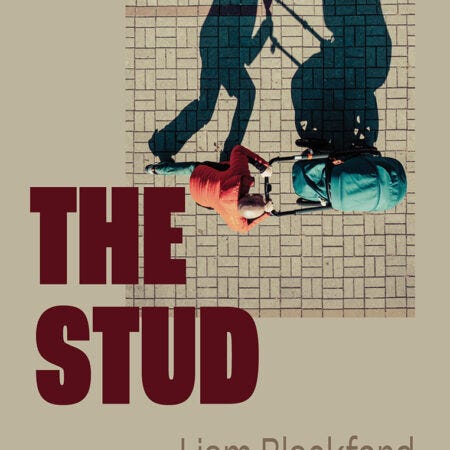
J’accuse does not typically read this sort of literature but Verdurin press kindly provided a free copy and commissioned us to review The Stud; even then, I was very reluctant to do it until I saw that Thomas Peermoahamed Lambert had swooped in, like a fox in the night, to provide a dustjacket quote. The idea that you would waste your time on ‘right wing literature’ after having had the good fortune to receive the A.M Heath shilling makes me see red. I would liberally kill and pillage for the opportunity to be published at the same age as Yukio Mishima and talk to liberal, respectable people who had never heard of ‘Rupert Lowe.’ I feel like a glue-huffing favela person, stumbling about some urban sewer to find that his favourite meth lab has been converted into an eco-hotel. Something must be done.
The Stud is a novel of the 2010s; of ‘Chic Nihilism’ (lol), Chateau Heartiste and the Michel Houellebecq translations. It portrays a world of affluent, intelligent liberal women confronting sexuality as something untamed and dangerous but sexuality itself is more or less unproblematic. By this, I mean there is little real misogyny or misandry, no intrusion of truly weird fetishes and nobody actually struggles to have sex per se. This is a novel conceived before My Twisted World, reflecting a pre-dating app generation. The society in which such fiction is set is one where the sexual revolution has happened but created unintentional consequences. A set of assumptions are therefore baked in: this society often ‘worships youth’, ‘puts individual pleasure on an altar’ etc. This may’ve been an accurate description of Hello magazine c. 1998, it is emphatically alien to the lived experience of young people in the post-lockdown, “age gap discourse” world. The sexual question today, as far as it is worth talking about, is that both men and women of European descent are having less, or no, sex across the board. The discussion surrounding David Walliams has seen the state broadcaster talk about 18 and 21 year olds as being ‘groomed’. Is it not ridiculous to talk of “sexual liberation”, even as a negative, in these circumstances?
So it is too that The Stud “reveals that no political system, however progressive or rational, can eliminate the unpredictability of human relationships.” We shall see that the political system in the novel is not noticeably rational, or progressive. The book is set in an independent state of Western Australia where a variety of pro-natal policies have been introduced, one of these is a ‘male-labourer, female-leader’ arrangement where a man cohabits with several women for money and raises the children of such unions: a sort of degenerate form of polygyny (in the purer form of which I am a long-standing advocate). Our main characters are ‘Martina’ a stereotypical girlboss of the 2010s and ‘Luke’ a “simple bloke” (similar formulae like “typical Aussie bloke” achieve almost Homeric levels of repetition in The Stud). There are some other women as well, like Eloise, who has big tits and a ftm transgender person called “Yorkie.” There are occasional cameos from Martina’s children. I don’t know what happened to the children in this book. I am sorry I just started scrolling maniacally down the file whenever “Craig” and “Miriam” made an appearance. Maybe one of the babies died. Maybe one of them started breathing fire and shooting lasers from its eyes. I don’t know. I don’t care. There is nothing less interesting to read about in fiction than childrearing.
Speculative fiction is a not-so-secret avenue for writers explore their fetishes. George R.R Martin has filled his Song of Ice and Fire with copious references to excrement which, allegedly, reflect a yen in that direction. George Orwell’s sadistic sexual personality probably had some part in the composition of 1984, or, more worryingly, the imperious mien of the Pigs in Animal Farm. I wish that the author of The Stud had taken this route because, alarmingly early on, it became apparent that heterosexual people may as well be aliens to him. He has no idea how heterosexuals act or what motivates them. Some quotations:
“After graduating high-school, Luke had led a simple young bloke’s (sic) life in Perth… He had a cheerful outlook and was never too fazed by life’s ups and downs… Some of the girls wanted Luke to be their boyfriend but he would let them down gently.”
How do you do my fellow straights.
“He liked women, but it would be weird to take a different woman to bed every night.”
Written like a man who definitely, 100% “likes women” himself.

Love a bit of banter with the missus.
Gay writers can produce fiction of universal appeal when they either self-insert as heroic but implausibly bisexual variants of themselves 25+ years younger (Montherlant, Simon Raven) or allow their fantasies to run wild (Mishima, Saki). Many good gay writers are also good in spite of their inability to write heterosexuals (Proust, Gore Vidal) because they satirise heterosexual relationships and hold heterosexuals in contempt. The attempt to portray the ‘normal’ straight guy is inevitably ridiculous because Gay men think straight men are retarded for not having sex with men and so write these men as retarded. “Luke”, in this book, is basically a retard. The appearance of a phallus in a straight novel, and a marriage in a gay one, signals the transition to farce. It has the same feel to heterosexuals as when Alan Moore decides to write a “gay” character who exclusively has sex with men his own age, stopping every second to “condemn Organised religion.”
This would normally be only a minor problem but since the entire plot of The Stud rests on a non-satirical analysis of heterosexuality it is a fatal flaw. The ‘male-labourer women-leader’ arrangement isn’t ‘dystopian’ it is just not something any heterosexual or bisexual person would think up or consent to. It doesn’t strike them as disgusting or chilling to read about but as a parody of a film made by someone who hasn’t seen the original. No woman has ever considered paying a random middle-aged man to raise her children alongside other women, no 28 year old man would ever consent to spend his life rearing the children of hags for 60k p.a. Or, letting the implausibility of the plot device slip for a moment, why do the women involved choose a 28 year old ‘simple bloke’ as their ‘stud’ rather than, what most hormonally healthy women would choose, an 18 year old figure skater with Tadzio hair and two PhDs?
Indeed, the fantasy seems limited, even within the gay community, to a particular fetishistic subclade thereof who enjoy mimicking heterosexual domesticity and obsess over ‘stability’. I try to find something nice to say about any book I review because writing a book is no small thing. What is nice about The Stud is that it unintentionally reveals how much the modern, bipartisan, idea of ‘masculinity’ (none of that twinky tonk looksmaxxing nonsense) is clearly derived from this community. The author isn’t incompetent stylistically, scenes are carried well if the characters are a little dumb and I think had he decided to write a book closer to his own anxieties and experiences, it wouldn’t have been a bad one.
This is complicated by the ‘political’ content of the novel’s worldbuilding. The ‘woman-leader male-follower’ arrangement is described as just one of many in the world of The Stud; it is explicitly stated that all marriages receive generous, pro-natal financial assistance but there also exist more patriarchal forms of polygyny. The author fails to realise this would massively impact the the lives of the ‘typical Aussie blokes’ described as entirely passive partners of Martina, so that they would not, economically, have to consent to feminist social norms; while those who did would suffer a loss in status, so that they wouldn’t have any ‘mates’ to hang out with ‘at the beach.’ It is explicitly said in the world of The Stud that college-age girls are specifically trained to join pro-natal harems of willing men; why, in this world, does a stripping Aussie bloke like “Luke” not have two sexy legal side-chicks to keep him entertained while “Martina” is banging on about woke nonsense? Indeed, if the fertility crisis has gotten so bad that governments are resorting to authoritarian measures, it is not explained why girlbosses like Martina exist at all, when the first port of call would be taxing female education and employment.
When news reaches our protagonists that an anti-natalist group has conducted a terrorist attack, they pejoratively call the perpetrators “radical feminists” but why would a society which clearly goes to vast lengths to protect female empowerment see radical feminism as a bad thing? Why, indeed, has a catastrophic plunge in birth-rates led to Western Australia striking out on its own, beyond the remit of Canberra? The ‘dystopian’ society here is a melange of mutually contradictory ideologies banded under the name ‘Liberalism’ with no common theme except that they annoy TERFs. The Stud basically doesn’t really know what it is trying to say. I was never sure whether I was reading a dated satire on liberalism, a work of transgressive fiction a la Delicious Tacos or an earnest prognostication about the future. It does none of these things well but its main problem is shared by better books of the same genre like Elementary Particles. The whole problem with Liberalism is that it doesn’t rationally plan human sexuality. Even the most humane pre-war schemes of this kind, like Huxley’s Brave New World, would be considered ‘eugenics’ by the moral economy of 2026. There remains, increasingly quite stringent, controls on human sexual agency and to discover what we are we may compare these works with the writings of Nabokov, seldom mentioned in these discussions.
