

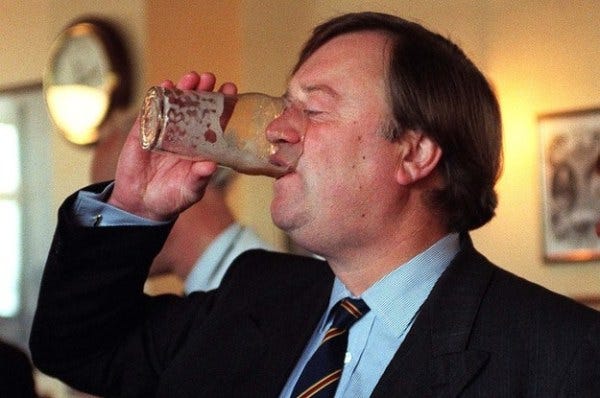
In a predictable display of fecklessness, this week the portly denizens of the British Right have wafted into the replies and quote tweets of MP Hannah Spencer like a shiftless clump of frogspawn, foaming at the modest suggestion that the Westminster apparatchiks they otherwise spend all their time whinging about the ineptitude and inefficiency of might have their habitual day-drinking brought under scrutiny. Rather like their response to Farage’s comments on Wank from Home, they once again seem to have hallucinated that she was demanding an act of Parliament to ban the liquid lunch, rather than simply complaining that she finds it unpleasant and unprofessional when her colleagues come into the Commons stinking of lager. Why exactly this has caused such upset for the 39-ans temporarily embarrassed SpAd remains a mystery, but let us be generous, let us be benevolent, and condescend to survey the arguments they have burped and hiccuped up one by one, beginning with the lighter spots of bile, making our way to the larger solid chunks.
Among the first retorts the Gentlemen’s Relish brigade managed to dribble onto Ms. Spencer’s shoes was the blithe and oft-repeated remark that there was some hypocrisy in the fact that a party that has pledged to decriminalise drugs would draw the line at a stiff afternoon shandy. Yes. Very good. Touché. You’re right. Polanski and Co. want to see MPs shuffle into the Commons strung out on heroin and shoving keys up their noses; they want Mothin Ali doing donuts in a leased Mercedes S-class outside Whitehall, whipping empty canisters of NOS at passersby through the driver’s side window. That’s what’s coming. That’s the world they want to build. That’s the reality.
What has made this histrionic line of thinking so irritating is it has generally been delivered in a smug, world-weary tone, totally incongruent with the feeble grasp of logic the argument itself displays - ‘Make it make sense,’ says Mr. Farage, presumably having forgotten to attach the GIF of a member of the cast of the US Office, shooting a look of sassy bemusement at the camera. The conversation around drug decriminalisation should be a tedious, possibly pointless, back and forth of public health statistics and cost-benefit analyses and so on and so forth. At no point in this discussion does the question of whether it should be legally or socially acceptable to be intoxicated at your place of work enter in, because these two propositions have absolutely no bearing on one another; there is nothing inconsistent in maintaining that decriminalisation might result in fewer overdose deaths, and also that you should get fired for shooting up at your desk. The British state, as Peter Hitchens rightly reminds us, fails to seriously police drug offences already, so acquiring illicit substances is too easy and risk-free for us to have a good picture of what real criminalisation might look like, rendering the debate, in this author’s opinion, basically uninteresting. Nonetheless, the proponents of legalisation have never insisted that they be granted the right to get high on their lunch breaks, a line in the sand Farage has apparently not seen fit to draw.
We then move on to the slightly meatier accusation that Ms. Spencer was being performatively puritan on the question of alcohol as a gesture towards the Muslim voters the Green Party are looking to court. At first glance this might appear to have some weight to it, but upon inspection is no more intelligent or convincing than the first point. As their long, squalid love affair with the Labour Party, irrespective of its stances on gay marriage and abortion, and their burgeoning tryst with the Greens, should by now have proven beyond all doubt, unlike certain forces on the British Right, or the advocates of the Online Safety Act, British Muslims have the rare decency not to demand their moral and religious preoccupations be given voice in national politics. The Greens are now the only party seriously upholding the cause of transgenderism in Parliament (excepting maybe the SNP? The Lib Dems? Who knows or cares.), following the Supreme Court verdict last year that prompted much of the British establishment to change their positions on this question overnight. Muslim voters are evidently happy to ignore this, because they possess the social and familial structures to police these matters within their own communities without the help of the state, and seem to have zero interest in the moral lives of the rest of the country. They did not vote for outspoken LGBT-advocate Hannah Spencer with the expectation she would act as a covert agitator for sharia law. She is not doing “taqiyyah.”
O, would that she was! Over in the Outremer this week, Al-Sharaa’s transitional government has paraded former officials of Assad’s narco-state before the public in chains, subjected to the steely gaze of Judge Fakhruddin Al-Aryan; “Do not commit injustice when you are powerful,” he thundered at the opening of proceedings, “for injustice will eventually bring regret.” Meanwhile, the by now not-quite-so-recent revelations of the rank corruption of our own native class of regime crooks, most notably Mandelson and Prince Andrew, has yet to result in a single court date, and the British press seems to have been issued a blanket gag order regarding the ongoing trial of the three Ukrainian rentboys charged with the attempted arson of Keir Starmer’s home. Will Judge Al-Aryan moan that he is not allowed to sink a pint of Ruddles Best while the jury goes to recess? I should think not.
A few days ago, this debacle took a turn for the boring; bolt the chicken coops everyone, shotguns at the ready and tally-ho, because The Critic’s fox has come a-prowling. Things just got a whole lot less interesting. Per the house style guide, their piece on this serves as a Greatest Hits compilation of the arguments the author has seen floating around in the fetid pond water of “Anglotwitter” in the days prior, though the article mostly rests on a boozy nostalgia for an undefined period in British history where a culture of drinking on the job was combined with higher productivity. Churchill’s morning scotch; Wilson’s two brandy lunches; bottom-pinching city bankers swanning off Sweetings for a pint of champagne.
Graciously, the piece is happy to concede that an ‘understandable part [of the anti-drinking sentiment] might be resentment that MPs (and journalists) continue to enjoy a workplace drinking culture which has otherwise more or less died out in both the public and private sectors.’ Yes, ‘and journalists!’ Needless as that little interjection might seem, let us not forget that the author himself is a journalist. So while we uppity proles might not ‘get’ why we need to defend the right of our betters to get drunk at work, for those of a higher kind of stock - those who really know how the sausage gets made - day-drinking is a much-needed reprieve from the high-pressure lifestyle that comes with being a Prime Minister, a cabinet member, or a person who writes for The Critic. Yes, ‘And journalists…’
