

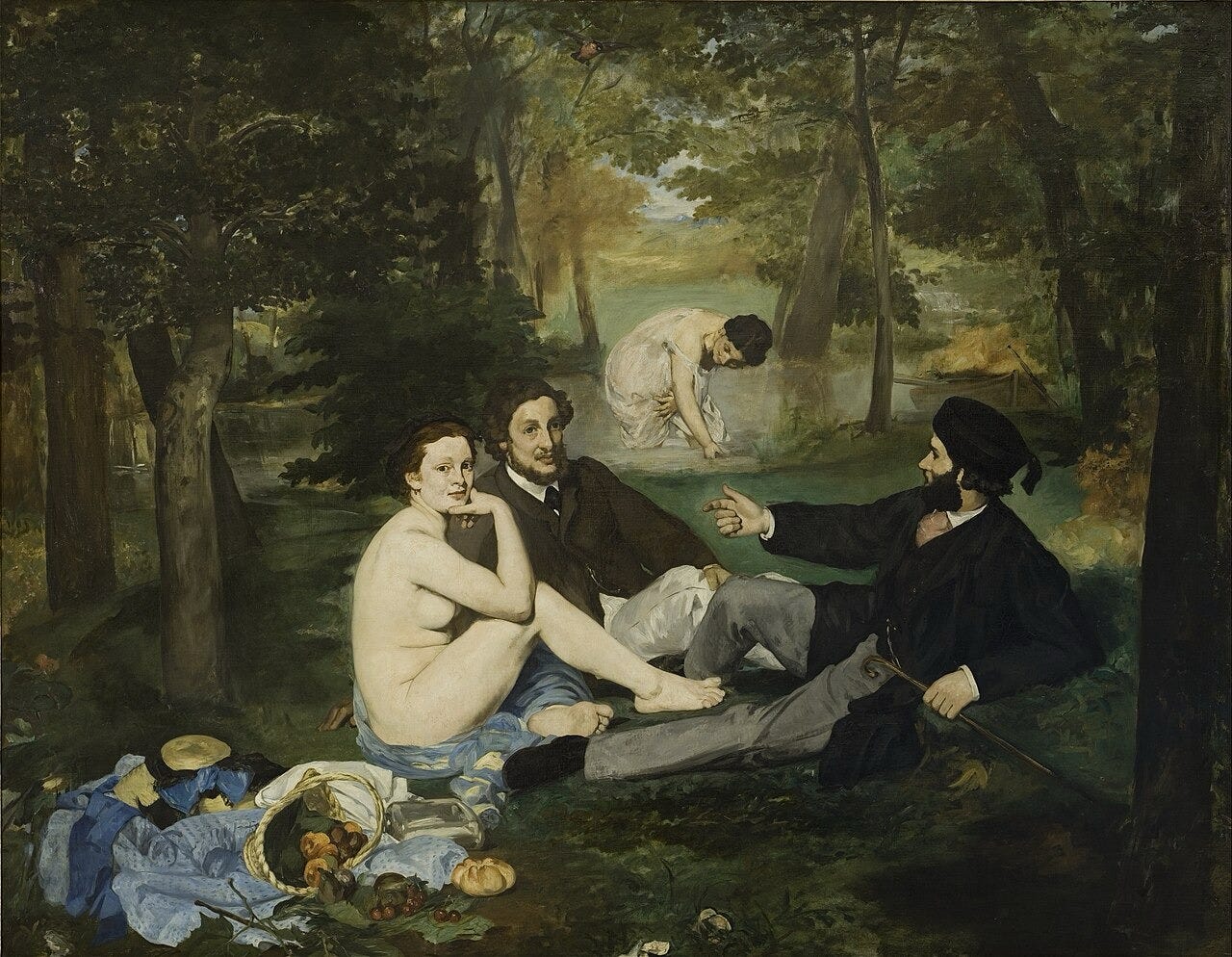
Thanks to unforeseen circumstances, I now find myself, like James Price, waving goodbye to Kilburn. Goodbye to the last bitter dregs of the London Irish, goodbye to the snarling Arabs and their enormous piles of fruit, a fond goodbye to all that. We are a few stops down the Mildmay Line, back in the leafy bosom of Kentish Town; back with mother and father and the endless dogs, back in a foldout bed in the home office that, in the intervening years, my childhood bedroom has become. Some damp miasma seems to be hanging over this part of London. In recent appearances, a permanent sheen of migraine sweat has settled like wet silk over the face of the local MP, and shows no signs of letting up; you and me both, Mr. Starmer, you and me both. Keir and I find ourselves in the same spot, gearing up for what’s looking to be another tangled, clammy summer of striving and crisis. Still, there are worse places than Kentish Town to spend the month of June. Readers may remember, or perhaps not, that some months ago I let off a little falconet in these pages, against the English tradition of painting. But a few flightless weeks flapping about Hampstead Heath have drawn my attention to another, much finer, English tradition, fine enough indeed to cover a multitude of sins; the English school of landscape gardening.
The inverse of our situation vis-à-vis the fine arts, here the English School looks its best when set against that of the French. The French garden is premised on long lawns broken up with winding parterres and well-trimmed topiaries. Its principles are architectural - the struggle against nature for manly precision: the clean line, the solid mass, the harmonies of calculated geometry. Naturally, the purest example is that of Versailles, or else the Tuileries Garden in Paris. The English garden opts instead for a look of studied Byronic dishevelment; the treeline broods over high grass full of wildflowers, the pond calls itself a ‘lake’, and is fed by a brook, not a fountain. Its groundskeeper takes as a maxim: the highest art is to conceal art - his hope is that the landscape will resemble a Constable painting. This is the style exemplified by London’s Kenwood House, at the North-East corner of the Heath, or Scotney Castle in Kent. In a broader sense, it is the style we find all across the English countryside, wherever it contrives at looking ‘wild’. Most of our ancient forests had been torn up for agricultural land by the end of the Middle Ages, and little of what was left survived the Industrial Revolution. Ours is among the most well-cultivated, well-ordered landscapes on the planet: the bulk of our existing woodlands were re-introduced by artifice over the course of the 20th Century. The J’accuse reader, a dedicated partisan of Reason and Candor, might here find himself turning up his nose. The English garden is dishonest, sentimental, and, in its preference for the rustic and the rough-edged, has the dowdy, anti-modern stench of the Arts and Crafts movement. So far, so bad. But there is one great practical advantage the English School offers over the French: privacy.
Say, at some dreary Sunday luncheon at the Tuileries, you and your associate grow bored of your fellow guests and invent some excuse to peel off from the group - where will you go? Behind the trellis, into the hedge maze, under the gazebo. Private space is clearly demarcated, and announces itself in right angles and hard partitions. Should you and your confidant eventually skulk back to the picnic, should you stick your head above the parapet, the rest of the party have a direct line of sight across the flat plane of the lawn. You are shot through with furtive glances from over the grassy knoll… and where have you two been? Not so at Hampstead Heath, where everything is louche and unclenched. The landscape is all hiding spots, all long, pubic grass and shady clearings. Here you are free to leave the madding crowd to their cold cuts and glide off into the thicket undetected. Such has ever been the purpose of the public garden, emerging in the 19th Century to meet the needs of a growing middle class (and the working class on Sundays) who had time to spend at leisure, but unlike the landed gentry, no grand estates to scuttle off to, away from bad air and prying eyes.
There is an undercurrent of sleaze here, and perhaps my dear Reader has already detected the slightly purring tone with which we have been curling that word - ‘privacy’ - over our tongues. The pleasure gardens of 19th Century London or Paris were not only the settings for properly Christian forms of leisure, but also the sanctuary to which a young couple might steal away from their families to molest one another en plein air. The haunts of, in Marx’s words, the ‘ruined and adventurous offshoots of the bourgeoisie … discharged jailbirds, escaped galley slaves, swindlers, mountebanks, brothel keepers, porters, literati, organ grinders, ragpickers … in short, the whole indefinite, disintegrated mass the French call la bohème.’ Here, Second Empire France buckled under the weight of its appetites, and was forced to make concessions to the English style in search of privacy - Napoleon III’s public gardens, most notoriously the Bois de Boulogne, designed in a hybrid mode modelled on Hyde Park.
This is the tradition that, as any number of North London’s, to use the old-fashioned term, confirmed bachelors can attest to, perseveres at Hampstead Heath. And though its long-standing reputation as a den of vice (especially of that vice, the Greek vice, the Turkish vice: bumming) is well earned, those of us who grew up nearby will confirm that, despite what you might have heard, most of these liaisons are not between middle aged closet cases, but perfectly healthy, heterosexual teenagers. A late bloomer, at that age my relationship to these goings-on never went beyond that of an accidental, impassive voyeur, like a stray car witnessing a robbery. But still, it happened, I was there, I saw it. I assume, though I don’t care to prove it, it is still happening.
Compare the brilliant, luxurious freedom afforded by the 19th Century English garden with that of its contemporary equivalents, the developments built in the last two decades to host London’s 20-somethings on their weekend afternoons. Trendy retail developments like the Boxpark in Shoreditch, or King’s Cross’ Coal Drops Yard. There is no escape from the mob: not in the streetwear boutiques, not in the Japanese homeware shops, certainly not in the restaurants, where a server is waiting to pop down next to you in a presumptuous squat and ask - in that outrageously chirpy tone that, when I worked like that and heard it in my own voice, inspired barely any more hatred than it does now - So guys, what’ll it be? An infinitely less dignified gesture than getting your cock out in a public park.
In his last appearance in these pages, discussing the ‘birth rate’ question, Mr. Pervert made the following observation on modern relationships, against the line peddled by conservative elements on the Right, that young people are delaying having children for the sake of a long, debauched 20s full of nameless sex:
“I’ve seen frequently this pattern: an intelligent, articulate woman, not bad-looking has a series of monogamous relationships, often including cohabitation (which in my view is marriage in all but name). None of these “work out,” none result in children. At some point she realizes she’s 44 and childless.”
The topic of his essay is one I generally steer clear of, seeing as it involves people other than me having sex - a prospect I have only ever met with indifference, bordering on contempt. Nonetheless, it is one to which this discussion of the English garden might have something to add, so we will pinch our noses and wade in. His characterisation of contemporary romance is perfectly apt, but let us examine the relationships of cohabitation he is describing with a closer eye. The reason the pattern he sets out is so common is largely economic - rising rental prices and stagnant wages make splitting a one-bed a very attractive option to a young couple who might otherwise prefer a greater degree of independence, and hold off moving in together until marriage. This produces a perverse form of domesticity that possesses only the worst traits we associate with married life - the drudgery of routine, arguments about dishes, falling asleep in front of TV - and none of the forward momentum that might come with the possibility of buying a house together and raising children. Huge swathes of London’s population under 35 are living a lifestyle identical to that of a pair of 60-something ‘empty nesters.’
