Burnham's bombs in Iraq
The Marquis
By the Marquis
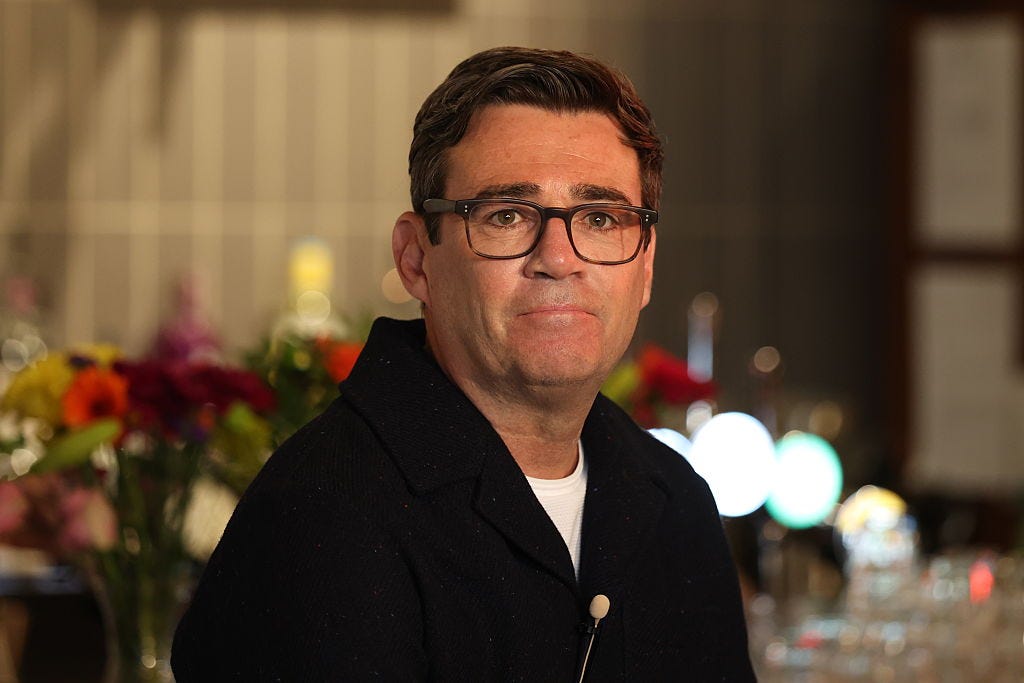
If you count yourself a man of the Left, everything about Andy Burnham should make your hair stand on end. Part of the 1997 intake, Burnham cut his teeth as a dogged Blair loyalist who voted for the Iraq War, against an inquiry into its legality, and rushed to the spirited defence of the government at the time of the Hutton Inquiry into the death of Dr. David Kelly - the alleged source of a BBC report which accused the government of ‘sexing up’ its dossier on Iraq’s WMD program. Per Burnham, comments like those of Rod Liddle, that ‘judicial enquiries always end up backing the Government’ were ‘a slur on Lord Hutton’s reputation, integrity and record’ - the record in question being that of a dour Presbyterian Law Lord, who won a name for himself defending British paratroopers accused of shooting civilian protesters in the back at the 1973 Bloody Sunday Inquest.
There is also the matter of exactly what he’s been up to since, in his decade at the Manchester Mayoral Office. There is nothing distinctly ‘left wing’ about the regeneration of Manchester under Burnham - it did not happen though a boom in social housing construction, or by convincing car manufacturers to bring more unionised jobs to the area. It has been led, overwhelmingly, by luxury property, gaudy new-build high-rise apartments that look like enormous Premier Inns, and the attendant financial services sector which follows after like carrion birds on the trail of a marauding army. The big winners in Burnham’s Manchester have been a handful of local developers who can’t keep themselves out of court for two minutes. Men like Elliot Lawless, founder and CEO of Elliot Group - arrested without charge for fraud in 2019 - who has £200,000 in cash in his house and a lazy-eyed, methadone clinic stare that immediately makes me splutter out the words: ‘I’ve not got any change on me but I don’t mind buying you a Lucozade from the shop.’ In other words, the principle behind Burnham’s governance of Manchester has been, for all intents and purposes, trickle-down economics - and as Burnham himself says, apparently speaking from experience, trickle-down economics has not worked: between 2021 and 2023, Manchester suffered the steepest drop in standards of living of any major city in the country.
After a hotly contested battle for the Labour leadership, Andy Burnham used his victory speech to dub Neil Kinnock a ‘legend’, whose ‘unmatched rhetoric’ first inspired him to get involved in politics. It’s not immediately clear what’s so inspiring about two-time general election loser Neil Kinnock, though Burnham is right that he ‘wouldn’t be standing here without him.’ Becoming leader in the wake of 1983’s defeat, blamed on an unapologetically Socialist manifesto, Kinnock set in motion the ‘modernising’ process that would culminate in New Labour and the redrafting of Clause 4. What had been a straightforward demand for public ownership of industry was replaced by references to ‘realising our true potential’ and ‘living together in a spirit of solidarity, tolerance and respect’ - the platitudinous ‘primary school assembly’ language that Burnham, ever a diligent student of Blair, speaks so fluently.
For all his vagaries, Burnham does indeed have an intelligible politics, the lynchpin of which is a prickly cynicism towards politics itself. For Burnham, Parliament is a snakepit of bickering careerists, guilty of something called ‘factionalism’, too remote from real people to get anything done. Westminster has a foul odour - so foul, in fact, that he will move Number 10 200 miles North to get away from it. Setting up camp in Manchester will give Burnham lots of opportunities to storm down to London and bark things like ‘What’s all this then?’ and ‘You lot need to pull your finger out!’ - to be greeted by our journalists, with grim inevitability, with flatteringly grandiose references to the ‘wrath of the Northmen,’ or Cromwell’s outbursts against the Rump Parliament.
It is the general public, and not the quarrelling toffs, who are best placed to find solutions to the problems in their own postcodes, undistracted by the tit-for-tat party politics that plagues their representatives. Smaller is better. It is an idea with a very obvious lineage. If we cast our minds back to the 2000s, to the mandatory Red Nose Day school fundraisers so popular in the New Labour era, we will note that charity was always pitched at the ‘village’ level. We’re building a well for the village. We’re sponsoring a donkey for the village. Our town is ‘twinned’ with a village in Mozambique. It was taken as writ that the sort of foreign-aid devouring corruption we might find at the upper echelons of the Third World’s governments was not to be found in ‘the village,’ among community elders and local do-gooders. The New Labour thesis is that the world is a, to borrow McLuhan’s coinage, a ‘global village’, an interconnected patchwork of local communities that should be emboldened to order their own affairs, within the bounds of rules of engagement around Human Rights, to be set by international courts - a thesis of which Burnham and Starmer represent only different points of emphasis.
Per Burnham, Britain’s own patchwork of communities finds itself misgoverned by a cadre of out-of-touch apparatchiks in Westminster - it’s us versus them, and the ‘us’ is very, very large indeed. There are no meaningful divides amongst the British people themselves except regional ones. It is a worldview in which, at the local level, we enjoy an astounding degree of organic social harmony, ‘of solidarity, tolerance and respect’. So much so that when a multimillionaire developer gets handed preferential loans from the Greater Manchester Housing Authority to build luxury flats, it’s something the working class residents of places like Oldham or Rochdale should feel is a win for them too. That, somehow, is a win for all of Manchester, ‘together in a spirit of solidarity, tolerance and respect.’ The emphasis on regionalism renders class divides basically irrelevant. The poorest in Liverpool supposedly have so little in common with the poorest in London that no unitary national government could serve the interests of one without the other being ‘left behind’ - but Elliot Lawless supports Everton and grew up around the corner, so that is a man to be received in ‘a spirit of solidarity, tolerance and respect.’
Mercifully for Burnham, the British Left finds itself in no position to put up much of a fight - like Burnham, they too have abandoned a class-oriented vision of politics. The Left today, as typified by Polanski and Bastani, has coalesced around two relatively modest proposals; student debt forgiveness and levying a Wealth Tax. The former is, for obvious reasons, a middle class concern - because of how student debt is repaid, you have to be on a relatively comfortable salary before it starts eating a noteworthy chunk of your paycheck.
The latter is, despite the bristly rhetoric sometimes levied in its defence, basically uninteresting. Per Gary Stevenson’s estimates, a wealth tax would raise £24 billion a year - enough to run the NHS for a month and a half. It’s difficult to imagine even Polanski believes £24 billion will accomplish anything exciting, and critics of the policy are perhaps mistaken in taking its advocates at face value. This is a rhetorical strategy disguised as an economic one.
As in Burnham’s worldview, slogans like ‘Tax the Billionaires’ draw a very large circle around ‘us’, one that includes virtually the whole country, and a very small circle around ‘them’ - and as in Burnham’s worldview, whatever divides there are within that generously portioned ‘us’ fade out of view. It is not a worldview upon which it is possible to build socialism, because it is a worldview in which class conflict basically does not figure. The ‘2:1 in Sports History from University of Bristol’ people who swell the ranks of the Green Party membership and the subscribership of Novara Media have found a way to lump themselves in, a little dishonestly, with the genuinely deprived - ‘together in a spirit of solidarity, tolerance and respect.’
True, there’s a lot of downwardly mobile graduates in their twenties and thirties who, with stagnant salaries and rising rents, are feeling the squeeze. People who feel ‘broke.’ But there’s a difference between ‘broke’ and ‘poor.’ ‘Broke’ is what happens when too many of your friends have birthday dinners at expensive restaurants in one month. ‘Broke‘ lasts until your next paycheck, the end of your twenties at most - at the very worst, until your parents die and you inherit the house. But ‘poor’ is for the foreseeable. And, if I may address myself directly to the type I have in mind: you, mon semblable, mon frère, are not poor.
There’s sentiment on the rise across right and left, that middle class young professionals are getting a bum deal - either thanks to the tax bill, or thanks to austerity and avaricious landlords - and should petition the state to deliver them; a sentiment expressed on the Right by the ‘Nicholas 30 ans’ meme, and on the Left as something recently dubbed ‘Normie Populism.’ But the professionals do not have the same organic grounds for class solidarity that produced the trade union movement. Their salaries vary too wildly, they find themselves competing internally for pay rises and promotions (with renewed vigour thanks to the threat AI will automate most clerical work) and lack the same specialised skill sets one might find across a factory floor that would require them to rely upon each other in a delicately arranged division of labour. With some exceptions, they mostly share the same, perilously ‘transferable’ skills that come with a 2:1 in Something from the University of Somewhere. There are certain cultural signifiers by which they might recognise one another - lunch break chat about Meal Deal preferences, quoting Peep Show from memory - but this falls short of a particular class interest beyond a desire to pay less tax and less rent, one they share with virtually everyone who has ever lived. They are ‘in the same boat’ in the same way we might describe a quantity of potatoes as ‘in the same sack’ - an inert, jostling mixture of the same.
The Left has always played host to a certain number of middle class adventurers, but they have never so successfully steered the conversation toward their own interests as they do today. As long as that’s the case, the Left will find itself run aground, hung on upon frivolous irrelevancies like refusing to go work during Summer until your manager buys an air conditioner and - if only for lack of any better ideas - kowtowing to New Labour hucksters like Andy Burnham. And as long as that’s the case, nobody will ever, ever face justice for what happened to Dr. David Kelly.


