

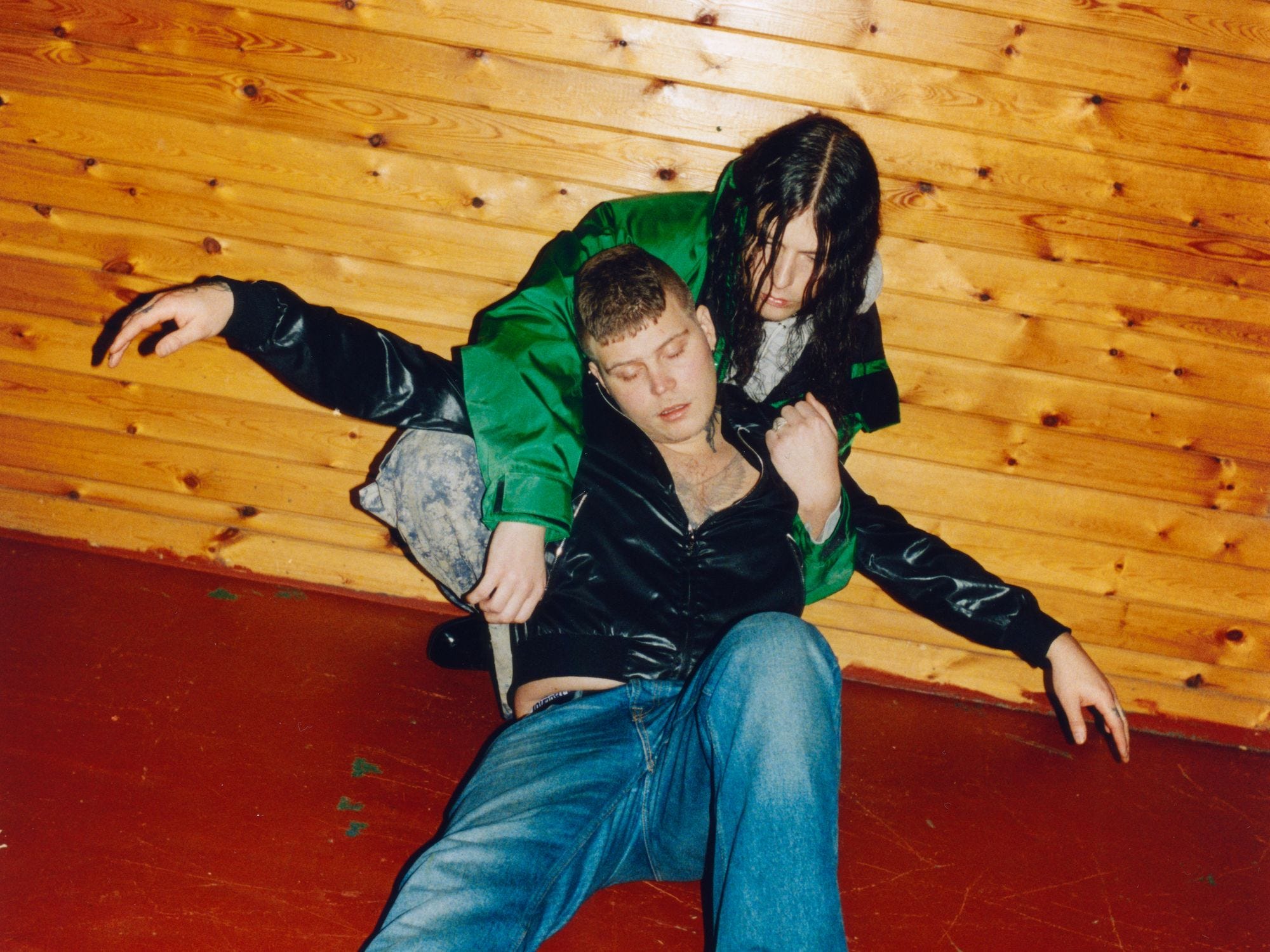
Recently, I have found myself thinking about swedish rapper Bladee, and why I and so many others like me like him so much.
It is apparent that the zoomer generation doesn’t care much for explications of why whatever it is they like is worthy of them, the pedestal they put it on. You might not think this matters a whole lot, you might even think it represents a change for the better when contrasted with the Zillennial‘s transplaining of mf doom and J Dilla. And yet, the move toward an understanding of taste as entirely subjective, if nothing else, has certainly done a grave disservice to the arts themselves insofar as its insistence on the fundamental worthlessness of negative critique has made positive critique redundant. People, as The Lindy Man would put it, can’t tell you what it is they like about art anymore.
To me, Bladee is unquestionably one of the greatest artists of the 2010s, and yet, it seems that neither I nor anyone else has given any serious thought as to why that is, or at least not articulated their findings anywhere online.
One small exception is this article from last year, in which Lord Mikka briefly touches on Bladee in a quest to get at what it is he likes so much about the music of another 2010s „white boy“ rapper, Capoxxo. I must credit this “Lord” at least partially with inspiring this article; I will come back to his findings towards its end.
If you recognize the name Bladee, you will probably fall under one of a few distinct camps, some of whose denizens will already have stopped reading or not even have clicked on the article in the first place. I will expound here a bit on their nature, because it will allow me to introduce my tripartite understanding of Bladee’s discography.
There are those who I with more grace than they deserve will call here „TikTok-fans“. They started listening to Bladee after his album Icedancer blew up in early 2019. Around that time he released a song called Perfect Violation, which is generally considered a major break in his discography. (It features the line „A Dream Of Life, It Might Come True“, so beloved by RW Twitter, and showing up on the back of a lot of Bladee merchandise.) Anyway: the song is very obviously about reaching a drug-induced physiological and mental rock bottom, and looking for a way out of it[1]. After its release, Bladee drastically pivoted away from trap music, and flirted with androgynity for a year, which is what the TikTok-fans, drawn in by Be Nice 2 Me blowing up on TikTok, latched onto.
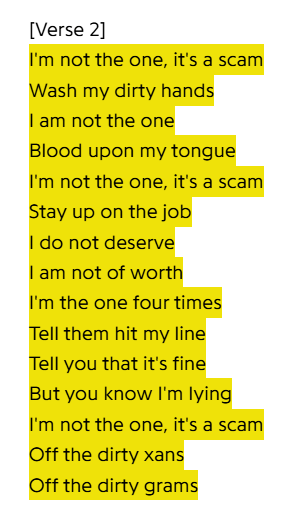
This early-to-mid 2019 pivot is often falsely attributed to Bladee ostensibly getting hit by lightning sometime in late 2018 or early 2019 in Thailand, but even a cursory look at the interviews in which he talks about this incident makes it clear that the lightning story is a sort of metaphoric cover up for an overdose he must have suffered either in Bangkok or on tour[2], which probably caused him to ease up on the hard drugs and turn towards the (((spiritual))). Contrary to popular belief, there are things to be said about post-2019-turn Bladee, but this period is not the subject of this article, as I generally think that by that time, his best years as an artist were behind him.
A subset of the TikTok-fans are the Transsexuals. You’d be mistaken to think “them” making up a large part of the fanbase: it is simply that “they”, with their territorial online politics, have succeeded in largely capturing the parts of the web in which Bladee is being discussed, chief among which is the subreddit, r/sadboys. The association of Bladee with „femboys“ and the incessant proliferation of „ironic“ fan-fiction including members of Drain Gang is their making; their control over the subreddit etc. allowed “them” to make sure that these will be among the first things to come up whenever theres any mention of Bladee in a wider online context.
I could rant on about this for a long time, but I’m sure you are very familiar with this dynamic[3].
Then there are the oldheads, who have been there from the very beginning. When they reminisce about Bladee, they think of what I will from here on call the pre-2015-sound, comprising his first few singles and his first Mixtape Gluee, and ending, in my opinion, with the April 2015 release of 7/11, the first single of his second mixtape rip bladee.
While I generally like most of Bladee’s pre-2015 music, it substantially differs from everything that came after.
The production[4], mostly by Bladee’s teenage friends Whitearmor and Yung Sherman, ultimately sounds like nothing before or since, but at the same time, it is somewhat easily datable to the first half of the 2010s by virtue of being incommensurable with any of todays established hip-hop subgenres, both underground and mainstream[5]. If you had to label it something, you’d do well to call it „cloud rap“[6], but then again, before Yung Lean and Bladee, what is today called „cloud rap“ did not really exist. Also: a lot of the pre-2015 production and especially mixing does sound somewhat amateurish at times, reflecting the fact that all of the individuals involved where amateurs in their late teens, who could not rely on any precedent due to the novelty and innovativeness of their music. In a way, the fact that one can listen to some of the old singles and notice these irregularities and „mistakes“ is a testiment to how close they got to whatever it was they were going for in that time period. Otherwise, there would have been no frame of reference, and thus no perceived „irregularity“.
TL;DR: the first half of the 2010s saw what is today called underground hip-hop coalesce around a variety of very idiosyncratic sounds, that aren’t like anything the „underground“ produces today, and in this aspect most of Bladee’s pre-2015 music belongs firmly to the past.
This 2015 break is also very apparent in the lyrics, and the vocal delivery. Bladee himself has admitted at cringing at a lot of what I believe to be his pre-2015 songs because of, in his words, his „bad English“ at the time. While I personally find his ESL ramblings to be quite charming, they mostly lack any and all coherence, and give the impression of someone yanked about by a limited inventory of phrases picked up from the internet: clichés from online culture at the time (MY GF LOOKS LIKE ANIMÉ) and non-inverted straight-ahead bravado, as was quite popular at a time where a lot of European rap was dominated by gangster rappers who weren’t yet judged by whether they had committed the crimes they rap about in real life, but simply by the outrageousness and machismo of their lyrics.
Neither of these two things would ever really appear in Bladee’s music ever again, and as his English improved and his life changed (I know the inhabitants of at least one camp are waiting impatiently for me to touch on the death of Barron Machat), his lyrics became considerably darker and less tout droit.
A lot of the „oldhead“ demographic wasn’t opposed to the 2015 turn and kept listening, but some of them, now that the initial virality/coolness of Yung Lean and his Weird Sidekick had subsided, trend-hopped on to greener pastures, having of course been totally oblivious to the the singularity of what they more-or-less incidentally bore witness to. To them, The Funny Swedes were minor background characters of a half-a-decade permeated by the stench of weed, paling in comparison to the outrageousness of some of their contemporaries, like the hard-piping noonoo Ruben Slikk or the violently mentally ill SpaceGhostPurpp. Some of this lot returned later, after Bladee had „blown up“, to claim their OG brownie points, and, unsurprisingly, found widespread acclaim among „the fanbase“. Needless to say that I have nothing in common with these people; thankfully, most of them have long since smoked and injected themselves into a state of permanent disability, and thus will not present any more problems in the future.
In both vocal delivery and production, the 2015 turn is marked by a shift towards already established hip-hop styles: the beats become grittier, their drums now mostly comprised of the to-this-day mandatory hi-hats and 808 basses, over which Bladee now more often than not raps instead of the hazy, layered and often incomprehensible autotune crooning of the pre-2015 sound.
As alluded to previously, the content of Bladee’s lyrics also changes substantially. Somewhere around 2014-15, he moved to London, which must have been the main contributor to the nature of this change. The subject matter is darker, weird grammatical oddities[7]mostly disappear, and Bladee’s pronunciation becomes clearer/easier to understand.
There is an alarming tendency among todays Twitterati, no doubt caused at least in part by the aforementioned lack of „positive criticism“, to get hung up on one-liners, and declare artists lyrical geniuses for coming up with a decent line or two.
That being said, I think that Bladee’s main qualities as a lyricist do come mainly from the standalone originality/uniqueness/quotability of some of his lines, rather than any sort of „overarching themes“.
In short, his lyrics go from hard-to-parse and occasionally cringeworthy to mostly irrelevant and occasionally great.
He does, however, totally let go of the bravado/machismo played straight that characterizes so much of rap music, which is something you really cannot credit him enough for. I do not think one can:
a. Find an instance of standard rap bravado in post 2015-turn Bladee that is not either inverted/subverted in some way (I know that they hate me, but they wanna be me) or overtly ridiculous (I should’ve never went to school, I should’ve been the one to teach).
b. Find another rapper before, let’s say, 2018, that manages to avoid standard rap bravado without making this avoidance part of his shtick (think of NF or maybe someone like Joyner Lucas).
Do keep this in mind before accusing me of making a big deal out of something seemingly basic. We’re talking about hip-hop here.
In short: post-2015, Bladee moves away from cloud rap, in both his production and his vocal delivery, and into trap[8], the at this point newly established base template for almost all of hip-hop to come in the 10 years after, and changes his lyrics in the above-mentioned way.
Bladee’s output from April 2015 to Spring 2019 (TBD) has historically been regarded[9] as his best. It is the reason I hold him in such a high regard, and thus is what prompted me to write this article. I do not want this to be a „play-by-play“ of this period, in the manner of so many video essayists, who are masters at camouflaging mere summary as propah criticism, but before getting into what I think makes Bladee stand out, I will have to list some examples, so that the reader may follow – or develop reasons for not doing so. If you want to say something about art, you have to look, as Ezra Pound famously said, at the thing.
I think Bladee is at his best rapping verses, not singing hooks (although he’s got a few good ones), and in Bladee’s best verses, he enters a flow state, listening to which feels like skiing down a perfectly groomed slope after exiting the lift in the morning, or what I imagine being able to dance freely feels like. Here I will collect just a few of these verses, which I think have been underdiscussed, and which illustrate the points I will attempt to make:

There is, immediately, the feeling that the man rapping does not really care. It is a true lack of care, not affected, not pointing to anything or serving as some sort of rhetorical device. Whether or not they really were, these verses feel improvised. They feel and sound like the slurring of some drunk or high person: something is escaping the artist. There is a feeling of a total presence in the present, a riding the wave that is the present, continuosly rising in height just to fall, just to rise again on its journey forward along the beat and the playtime of the track. There is an innocence, again: a feeling of someone being carried this way or that, not necessarily of his own volition.
On a macroscopic scale, this matches up to what Bladee’s music from that time period seems to be about. Here is someone that is paradoxically happy, someone who, in the midst of what is ostensibly an awful existence in the throes of shopping and drug addiction, cannot help but feel good, despite a lingering awareness of the vacuity/vanity of his lifestyle. There is a constant ping-ponging between unequivocal misery/boredom/Geworfenheit and the attempt to escape it through the rapping lifestyle.
What makes Bladee so unique is that he NEVER juxtaposes these two states. Whenever one or the other takes over, there is no feeling of a slimy rhetoric backdrop being set up for either the glorification of drugs etc. or the Sinners Desperate Repentance (Feel Free To Join In). What I have said does not go for all of his songs published in this time period, but in the above-linked verses, you get the feel that what he says is simply what he’s thinking of at the time. Much like with my bravado point earlier, you might think this trivial, but rest assured, it isn’t. Immediate honesty of this kind is incredibly difficult to pull off simply because it isn’t something one pulls off. In a way, it isn’t even honesty, but something transcending honesty and dishonesty altogether. It isn’t something one can attempt, or an ability one can refine over time. A lot of young white men Bladee’s age have assuredly felt what he felt, growing up in 21st century Europe. How many have succesfully withstood the need to make a theory out of, to systematize, the emptiness, or pointlessness, or Seinsvergessenheit or whatever so characteristic of our formative years? How many have withstood the tempting urge to narrativise their way out of said emptiness, to escape their holes using the black magic of the self-application of mediocre rhetoric? How many have shown themselves worthy of the name-, mind- and painless ailment/suffering of our age? If your whining about the senselessness of life is naught but a means to „enchant“, to narrativize, rhetoricise, romanticise your life, you are a NOONOO, and your life isn’t senseless – well, at least not in the way Bladee’s life is 😊
With Bladee, it is as if he’s never heard about any of this stuff; as if he has never really given it any thought. An old tweet of mine goes:
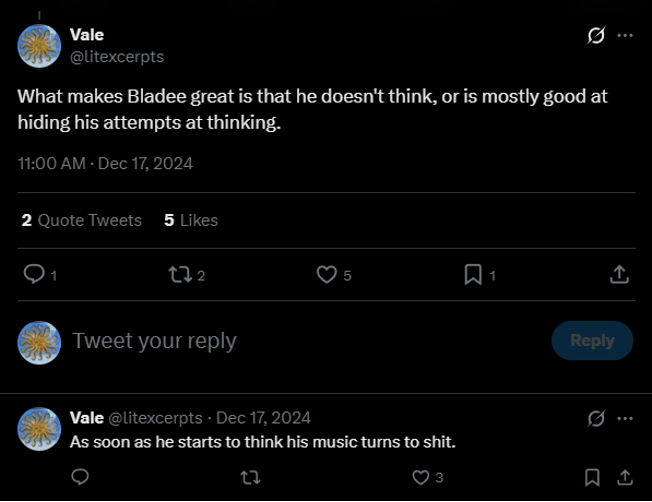
I am getting ahead of myself, but what ends Bladee 4-year run is precisely that he starts to think.
If you somehow manage to combine all of this with production that throughout this period has consistently stayed ahead of the Curve of Cool, unique and somewhat charming vocal delivery, and a good innate sense of melody, you get something approaching the work of genius.
Bladee is an Idiot Savant; since I am not Bladee, I’m forced to result to petty theorizing: what will get us out of this rut is the Idiot Savant.
I think what I have tried to get at in these last few paragraphs is probably what Lord Mikka praised Capoxxo for in the article I mentioned at the beginning of this text, in which he also mentions Bladee – only he thinks that Capoxxo has surpassed our hero. Let us examine:
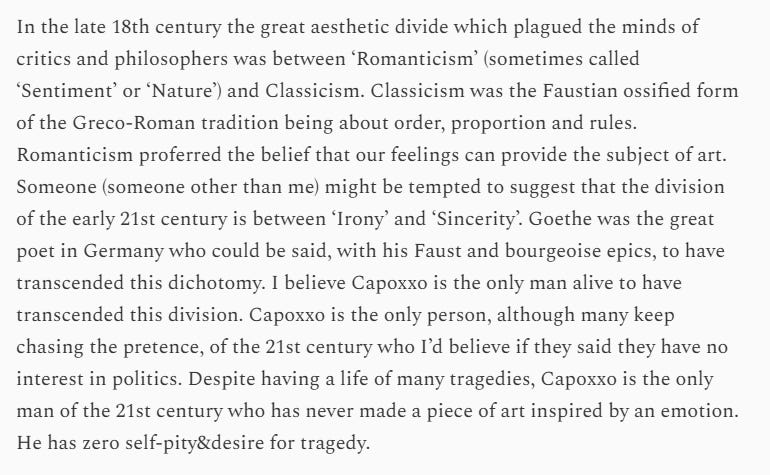
We recognize the dichotomy between honesty and dishonesty from a few paragraphs earlier[10], only with dishonesty being replaced with „Irony“. Seeing as most of the deployed instances of irony in at least the last two decades are fundamentally dishonest and serve only as a coping mechanism their author pretends to both himself and his audience to not be aware of, I am fine with equating the two. The claim that „[…] Capoxxo is the only man of the 21-st century who has never made a piece of art inspired by an emotion […]“ is not to be misunderstood as there being no traces of Capoxxo’s emotions in his songs. Rather, Capoxxo, and by extension Bladee, is his songs. It is incredibly difficult, if not impossible, for the large majority of us to make a song about, let’s say, love, without getting caught up in the idea of making a song about love, a love song, a piece of art inspired by an emotion and this idea becoming your new launch pad/point of departure instead of whatever the original impulse was. You become enthralled, and I promise this to be the last Heideggerian intrusion on this text, by Gerede.
All that to say: if there is talk of loneliness in one of the verses I listed, it is because Bladee is lonely. If he sounds restless, it is because he is restless. If there is apparent juxtaposition, it is because Bladee is lonely and restless at the same time, or in succession.
„The words are true“, Jerome Kern once texted, „The song is you.“
The perfect authenticity of the Wechselspiel of these different Bladee-states, the up-and-down-and-up-again, guided at once by rhythm, melody and Bladee, the surfing of the perfect wave: that is what makes Bladee great.
I suppose I shall say a few words about the future. As I have mentioned earlier in the article, I like a good amount of Bladee’s post-2018 stuff, but I like it as music. That is to say, I can imagine the songs I like from this period being made by another artist, not Bladee. What made him unique is mostly gone, and although I liked most of Cold Visions, it is not the „return to „Evil Bladee“, i.e. pre-2019-turn Bladee, it is touted as being by the Tik-Tok-fans.
Bladee’s dream of life seems to have come true, but there are plenty corpses still about: I am sure a worthy successor will eventually reveal himself.
[1] It’s also surely one of his best songs.
[2] To start, the lightning incident the way he explains it makes no sense, and he keeps switching up his story. Also, there are a lot of references, like this Ecco2K tweet, about something going wrong on one of Bladee’s Bangkok trips.
[3] See Xitter user @BEASTgroyper – who has nothing to do with Nick Fuentes -- for a more in-depth treatment of this unfortunate phenomenon.
[4] I am referring here to the „beats“
[5] This incommensurability is, I think, the common denominator of 2010-2015 hip-hop music.
[6] The etymology of „cloud rap“ conjured up by Lord Mikka in his article is in fact incorrect: the „cloud“ in „cloud rap“ does not derive from SoundCloud, but instead originated with Lil B as an attempted one-word description of the genre’s signature hazy and foggy sound – as far as I can tell.
[7] That is: grammatical oddities that aren’t part of general rap slang, and that Bladee himself doesn’t establish, like using “I’m” instead of “I’m going to”, as he does e.g. in the famous chumbucket tweet.
[8] And occasionally, Drill (rip bladee, some songs on Eversince, some of the leaked Adamn Killa collabs)
[9] This consensus came under attack from the Crest/Amygdala troons some years ago, and is probably going to fall in the next few years.
[10] -- in my text, that is --
Tour de force.