Andy Burnham: The King of Chickentown
An essay
By the Marquis
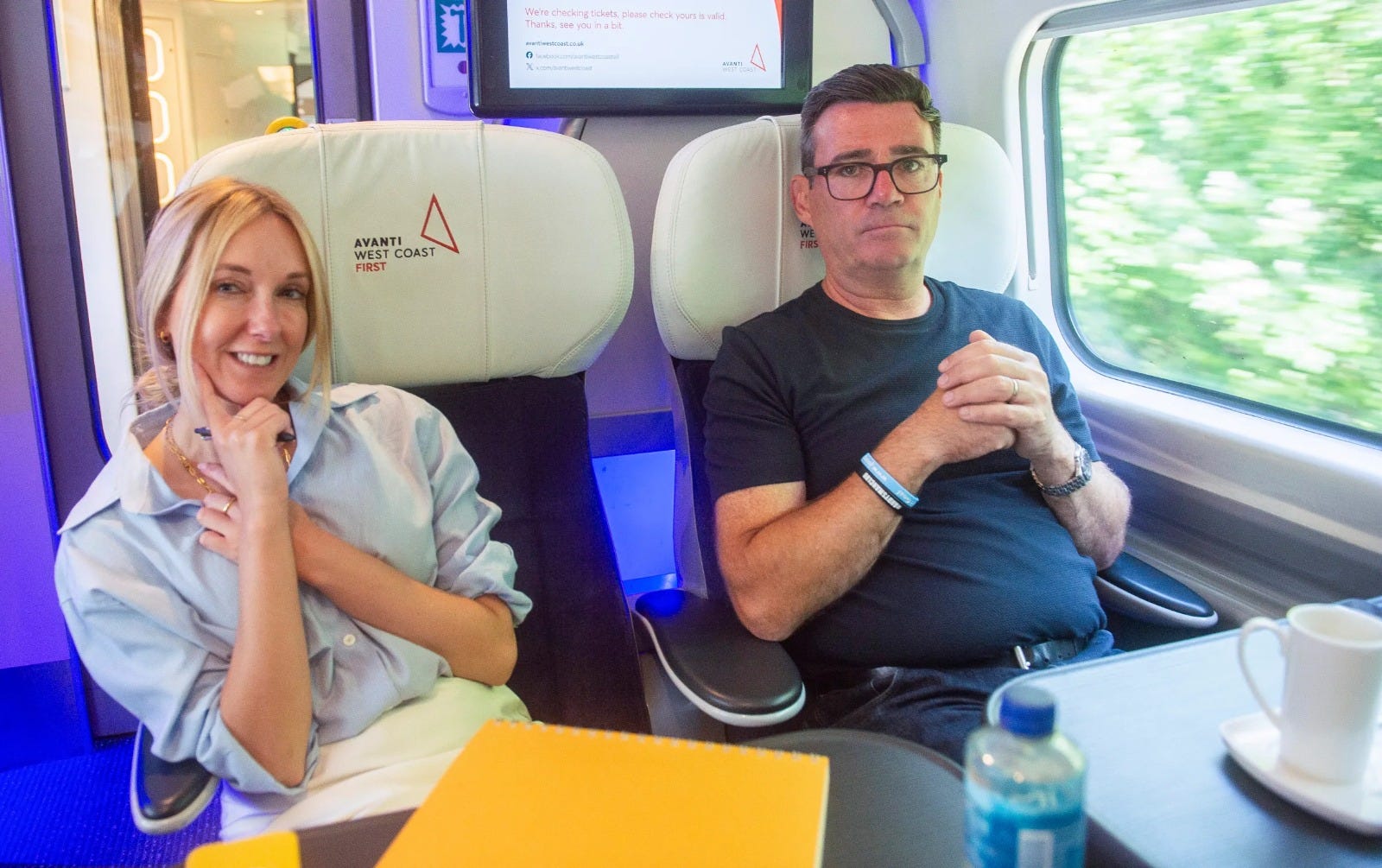
It is the perfectly temperate afternoon of June 29th. The heatwave is spent, or in a lazy mood, and the express train out of Chickentown is sliding on its belly back to Euston at a steady pace. The sweaty, uncertain, inch-by-inching phase of the summer has been and gone and things are slouching into new constellations. A soft, boring rain is drizzling over England. The heat is looking rather more bearable, the riots have fizzled out, Starmer is packing his suitcases, and, no question about it, no leadership contest, no general election, Burnham will be our next Prime Minister. Good hunting, I never heard a single shot! Uncle Andy has fixed it for us to have a No. 10… up North.
The North of England is to Labour what black America is to the Democrats, the underdog protagonists of the ‘Heroic Age’ in both parties’ hagiographies - the civil rights movement and the mid-century heyday of trade union power, respectively - and in Burnham they have found their Obama.
It has all happened with breathless ease. Elected mayor in 2017, hot off the heels of John Cooper Clarke’s ascension to the GCSE syllabus, Burham arrived right in time to reap the benefits of George Oscborne’s ‘Northern Powerhouse,’ ‘Levelling Up’ agenda, handed large sums of money from central government to spend on showy demonstrations of state benevolence - projects like the Bee Network and the Good Growth Fund. 2017 was also the high-watermark for Game of Thrones-based watercooler chat. These two factors conspired to win him the moniker ‘King of the North’, before he’d even won the mayoral race, thanks to what has proved to be an irritatingly consequential article from Politico magazine.
Now that he wants to return to Westminster, long-time Labour Together apparatchick, MP Josh Simons, has graciously stood aside to grant him a by-election on home turf. Everybody in the country hates Starmer; Reform’s pitch is that they’ll get rid of Starmer in 2029, and Burnham’s pitch was that he could get rid of Starmer within the week. Inevitably, the latter won out. With two failed attempts under his belt in 2010 and 2015, Burnham’s never quite managed to win a leadership contest by conventional methods, in an open confrontation. Luckily for him, Keir has already done the dirty work of removing from the party the only faction that might of put up a fight - Corbyn and his allies, who in 2017 and 2019 won more votes than any Labour candidate this century - so now he gets to slink into No. 10 by de facto, and is free use the office to pursue his own pet causes: the inexorable march of devolution. An Andy Burnham for every postcode. The stars have aligned quite magnificently for him; nobody in British politics has had it quite so easy.
It’s crucial to Andy Burnham’s political formation that he has spent a decade as a mayor. Mayors are funny characters; as with Mamdani, it’s a position from which it’s quite possible to become a popular national figure, without the expectation that you will provide material solutions to real problems, and where what would otherwise be career-jeopardising corruption scandals and policy failures - and Burnham’s had a few - are relegated to the pages of local newspapers, fast-forgotten peccadilloes. Like Mamdani, it has been enough for Burnham to gesture at regional cultural signifiers, cut ribbons, shake hands with people in pubs and greasy spoons, talk about football, quote lyrics from Oasis and The Smiths. It’s this policy-light, home-spun-charm-heavy approach that he is now bringing to Downing Street; or more precisely, Downing Street is being brought to it.
As with the BBC’s move to Media City, No. 10 North will produce virtually no new jobs. As with the BBC’s move to Media City, No. 10 North will be a place the pre-existing class of SpAds and staffers will have to be bribed, with public money, to schlep up to. That is, if anyone expects them to bother - I imagine there’ll be a lot of permission granted for Work from Home, and perhaps a few of these characters are already gearing up for a greasy, frantic few years of state-sponsored midday self abuse.
There seems to be a lingering superstition in British politics that even being in the rough vicinity of Downing Street is enough to grant us Londoners mysterious powers of influence. The mechanism by which this happens has never quite been explained. Maybe they think we’re all welcome to just pop into No. 10 and have a chat, put the kettle on, rattle off some demands, throw some excrement at the wall and see what sticks - “have our say”. And maybe in Manchester, a city where people still thank the bus driver and (if the tourists in town for Magic Mike Live are anything to go by) stand still on escalators, things could work something like that. It’s what Burnham, at least, seems to have in mind. But London is not Manchester. London is a city with a world class Olympic Village. A city the size of several Olympic swimming pools back-to-back. A city of Global Bustle, of people running late for very important dates.
There’s been a slightly ‘Nick 30 ans’ flavour to some of the whinging about Burnham thus far that needs to be nipped in the bud - as if we in London are all ‘net contributors’, and the dirty scroungers up North are trying to steal our money. For one (an argument I’ve laid out in some detail elsewhere), in the era of Blair’s crony PFI economy, the government’s system of procurement pumps too much money into the private sector for ‘net contributor’ to mean very much at all. More importantly, as someone who grew up in London, I don’t want my city to be represented by the likes of Max Tempers. Our 80k-per-annum-top-five-meal-deal-rankers: Big Four Audit; Peep Show GIFs in the work group chat; ‘I’m probably a bit of a cross between Mark and Jez, to be fair.’ No. No thank you. But unlike Mr. 30 Ans, most of us in London aren’t on 80k a year, don’t work from home, still have places to be, money to earn, overdrafts to poke our heads above for those first few triumphant days of the month. It costs a lot to live here - we might make more than they do in Manchester, but we’ve got less of it left after rent, which costs us 48% of our income on average, while the North West spends roughly 37%. Though that’s a share that, in their defence, has gone up in recent years - a trend that some of their local press and politicians have seen fit to dub ‘Londonisation.’ As councillor Richard Kilpatrick put it:
‘Some form of rent control must be trialled to prevent the Londonisation of our great northern cities [...] If we want to remain a city of artists, musicians and freelancers, we need less London vibes and more Manchester values.’
It doesn’t seem to have occurred to them that there is some irony in ‘London’ serving at once as a byword for wealth and privilege, but also for getting ripped off by your landlord. ‘London vibes’ means spending half your paycheck before the month’s even started, and ‘Manchester values’ means not doing that so you can pursue a career making Instagram Reels music.
So no, we don’t “pop in” at No. 10, we don’t swing by and “have our say” - we’re too busy for them and they, evidently, are too busy for us. Our proximity to the halls of power has not granted us any of the same economic and cultural special treatment that Manchester has been able to wrangle from 200 miles away. Living within an hour’s walk from the Prime Minister’s house doesn’t seem to win you any favours. At least, it hasn’t for us. Maybe it will for them.


