Against Rearmament
And war
An essay by the Marquis
‘Comrades.. Comrades. Can.. Can we please stop talking now please. Can... Right. Comrades. Cease conversations please. We’re about to begin.’ The International Anti-War Conference is off to a late start, and our grizzly, trade unionist compere is addressing the crowd in the manner of a teacher wrangling an unruly school trip - a tone of beleaguered authority much added to by the fact that the lectern has cropped his “NO WAR” t-shirt right at the crest of the belly, so it now reads, very simply, in XXL-size black Impact font on white: “NO”.
Scheduled to start at the crack of 10am, and not filling out until a fair bit past that, this is, I suppose, the ‘Early Birds’ session. The speakers are the conference’s lesser-known delegates, from the smaller unions, the student groups, and the upper-middle ranks of various British and Continental anti-war movements. They have more to prove and get less time to prove it in, and for that reason give some of the more detail-heavy, concise, compelling speeches of the day. The consensus is that, across Europe, governments like ours, Macron’s, Merz’s and Meloni’s are all engaged in a push for rearmament; motivated partially by the war in Ukraine, partially by the realisation that the US’ foreign interests, as in Iran, may not always overlap with ours, and partially at the behest of the military-industrial lobby. Thankfully, there are forces across Britain and the Continent ready to push back, and already we have won some meaningful victories.
The Trades Union Congress has overturned its initial support for Labour’s increased defence spending, and a German delegate spoke movingly on how valiantly the students there have rejected the move towards reintroducing conscription that began with the Military Service Modernization Act at the start of this year. The week prior to the conference, the Iranians seemed to prove they were not to be bullied, and forced Trump to sign a peace deal that even his opponents to the Left would criticise as too lenient, news the conference met with optimism verging tentatively on bravado - we did not know at the time, though might have guessed, that the memorandum would collapse within less than a month. The proscription of Palestine Action and thuggish treatment of its members is, while a loss, a sign the government is scared and lashing out in a spasm of paranoia. The warhawks have shown us they’re slightly weaker than we thought, and soon, we may hope, maybe the peaceniks will have them on the run.
Given the tone of British politics today, where all sides seem to be competing as to who can pledge the most to the defence budget, it all feels refreshing and urgent - especially given that the new militarism in Europe has come, in Britain and elsewhere, largely from our false-friends on the centre-left, and not our old enemies on the right. Merz has set out a €377 billion plan to build “the strongest conventional army in Europe.” Macron (following his famed 2022 Zelensky-style ‘pajamas and stubble’ photoshoot) has been railing at the French defense industry for not meeting his production demands for a “war economy.” Starmer, and now Burnham, have been dancing around a ‘reindustrialisation through rearmament’ program that has the slightly dowdy, mothball odour of the Blue Labour bench. Al Carns, ex-serviceman and, before Burnham’s ascendency, Maurice Glasman’s pick for Labour leader, has gone as far as suggesting he’s open to “some kind of national service.”
Perhaps you’ve noticed the Army recruitment adverts plastered all over the Tube in recent months. One features a man whose top half is in camo, but in a football kit from the waist down; the tagline reads: ‘Kit. Formation. Drills. You’re already speaking our language.’ If you’re wondering who’s been given the contract for the Army’s recruitment program, it’s our old friends at Serco. The government has hired a company that provides asylum seeker HMOs to convince young people to join the army by way of a blokey football analogy; it reads like a one-line caricature of the Starmer-Burnham period an editor would rightly cross out with the note: ‘too on the nose.’
‘Reindustrialisation through Rearmament’ is a dead end. Per research published by the Scottish Government, military spending ranks 70th in ‘employment multipliers’ out of 100 categories of economic activity. As Russell Whiting, Parliamentary Officer for the Campaign for Nuclear Disarmament, points out, it is out-ranked by “everything from agriculture to energy to food manufacture, chemicals, iron and steel, to computers, construction, and a host of others in between.” Its real motives are lurking elsewhere. As Britain and Europe become more and more demographically and politically fragmented, our governing parties increasingly assailed by the populist right, the new jingoism is an attempt to inject us with a much needed bit of esprit de corps, to engineer a more regime-friendly mode of patriotism than that of Reform or AfD. As Maurice Glasman, one of Labour’s more devoted proponents of rearmament, puts it: “Diversity isn’t our strength, solidarity is.” Solidarity with who? With what? When the Union Jack gets flown by rioters in Southampton or Belfast, it’s the flag of the people against the state. When it’s flown by ex-military politicians like Al Carns or Mike Tapp, it’s the flag of the people with the state. In ‘solidarity.’
As it stands, British military spending, relative to similarly second-rate powers, is not especially low. We spend roughly 20 per cent more than France, and Germany spends roughly 20 per cent more than us - the latter thanks to an aggressive policy of rearmament pursued since the outbreak of the war in Ukraine. Taken as a percentage of GDP, we spend more than either of them. Whatever is going wrong at the Ministry of Defense is owed less to a lack of funding than it is to the woeful inefficiency of our procurement program. We spent £5.5 billion developing Ajax, an armoured vehicle that, because of issues with noise and vibration, left test-drivers vomiting in expert medical care last year. Ajax will not be ready until the end of the 2020s, over a decade late. A new fleet of Nimrod reconnaissance aircraft cost us £4 billion, got scrapped in the 2010 Defence and Security Review, and then, from beyond the grave, snatched an additional £500,000 in waste recycling bills. These are the kinds of once-in-a-lifetime bargains that make the government say: “Please hand over your tax money now, we’ve got an investment opportunity you won’t want to miss.”
And they’re still asking that, even in the midst of what they keep calling a ‘cost of living crisis’ - an admittedly trite euphemism for something nonetheless quite real, for life punctuated by throbbing panic. Panic at opening the banking app, panic at the landlord and (like you’re a dog, like someone has turned you into an actual dog) the postman coming with his DO NOT IGNORE letters, panic at calls from unknown numbers that might have debt collectors lurking on the other end, panic at the yawning gap between what life costs and what it gives back. In the face of problems as immediately anxiety-inducing as these, we are being told we need to fork over £15 billion for new nuclear warheads, weapons we have all agreed never to use first but only in revenge - as if, should we in Britain ever be turned to dust, we might find some comfort in the fact that, somewhere on the other side of the globe, somebody else has been turned to something less than that.
In the opening of his essay on the nuclear question, Thinkability, Martin Amis tells us he was born four days before the Cold War shifted into gear, four days before the Russians ran their successful tests on the atom bomb, and knew it: ‘My mother says I looked like Orson Welles in a black rage … I was terribly sleepy and feverish. I kept throwing up.’ In February of 2001, I was born with a similar premonition about 9/11. All spring and all summer, my warnings went ignored. I was a voice crying out in the wilderness and it was thankless, tiring work. For 7 months I was inconsolable. I refused food. I wept all night and slept all day. I soiled myself constantly. I stacked replica towers out of blocks and household objects, only to knock them over for what, to the heedless adults, looked like no reason at all. The first time they took me on a plane I screamed bloody murder for the entire journey. By the time it finally happened I was so bitter, so exhausted, so far past caring at all that, while mother and father gaped at the television with dumb horror, it did not even occur to me to bother interjecting: ‘I told you so.’
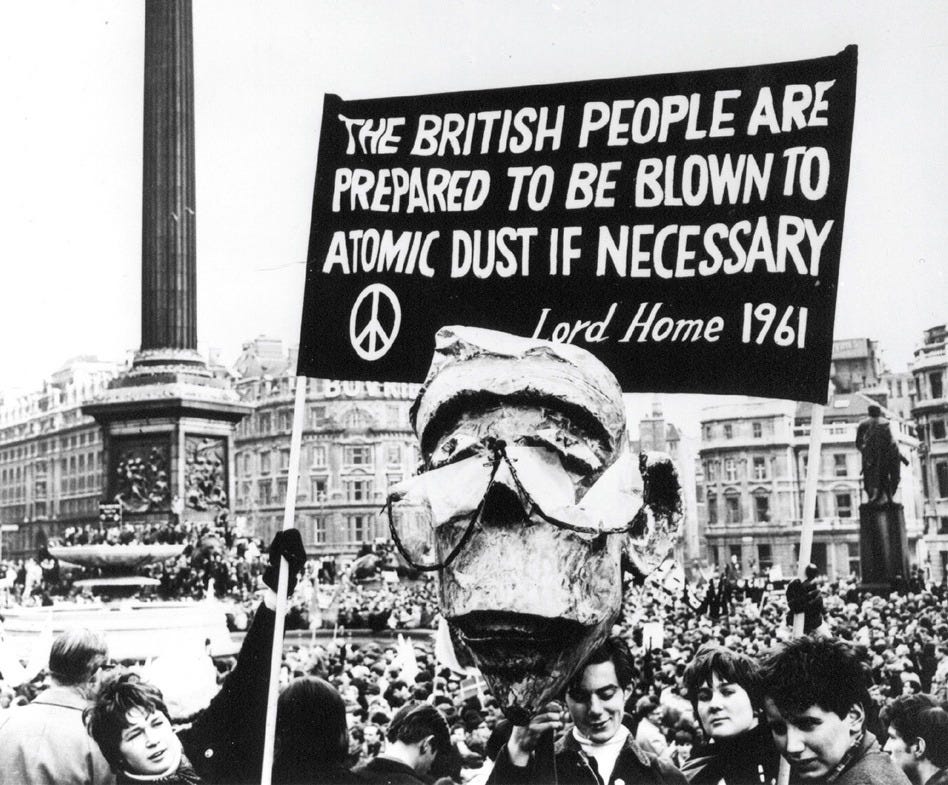
In the world that has emerged since, beyond the fall of the Berlin Wall, beyond the 90s optimism of McLuhan’s ‘global village’ that followed, the nuclear question has been arranged in new constellations. Had the Soviet Union dropped the bomb on New York, that ensured Moscow would be next and the rest of the world after that; what would be left of man is a stray animal padding about the ruins of his house, and that proved reason enough for us to hold off. It was unthinkable. In our own multipolar age, the possibility of nuclear war is somewhat less unthinkable. Mutually Assured Destruction could be taken as a given when there were two great powers holding each other in tension; it is less clear what happens today if, for example, America drops the bomb on Iran, if Pakistan drops it on Afghanistan, if, should they get one (and why shouldn’t they?), Rwanda drops it on the Congo. Who can be guaranteed to retaliate then? Who will pledge themselves to the series of escalating dares that ends in the murder of everything that exists? Nuclear war is no longer a synonym of the end of the world. There would be marches, and tribunals, and lengthy speeches at the UN, but it is altogether possible that life, for the majority, could carry on, scuttling backwards and forwards over the face of the earth. That is rather more ‘thinkable.’ The cause of the CND is obviously not so fashionable as it was some decades ago - today at Methodist Central Hall, they are sitting quietly where they often sit these days, at the back of a room where people are talking mostly about Palestine. It’s lost a certain apocalyptic grandeur and, having seen the new t-shirts, admittedly the graphic design department is not what it used to be - but the warheads are still there, Chekov’s Gun is still fizzing on the mantle.
Watching everyone file into the Main Hall for the afternoon session is the first chance we’ve had to see and eavesdrop on all the attendees at once, and make out a rough sketch of who’s here. About a third of the audience are French; an usher tells me that Mélenchon’s LFI had a hand in the organisational side, and the room is full of French trade union members in bright red bibs. One of the event’s loudest cheers goes to a Russian speaker, simply for the fact that he’d chosen to make his remarks in that wonderfully martial, Eastern-bloc-inflected French that makes me daydream about the Foreign Legion. I have no idea what he said but it went down well. As for the rest of us, at least half look to be hovering around retirement age. If recent polling on the Greens is correct, these causes are supposed to belong to the youth. So why is everyone here so old? Where are all the young, fashionable, attractive Polanski voters we’ve been hearing so much about?
In any case it’s time for the heavy hitters. The highlights come largely from the trade unionists; Ian Hodson from the Bakers, Food and Allied Workers Union, who rightly ignored instructions from the ushers to lower his voice and soldiered on in a rousing, preacherly crescendo, and Jo Grady, General Secretary of the University College Union, who spearheaded the push to overturn the Trades Union Congress’ initial support for Labour’s rearmament plans.
An unexpected personal favourite was Mothin Ali, largely because he was the first to mention Keir Starmer by name, prompting immediate panto-villain boos and hisses from the crowd which turned abruptly into cries of “F-ck Starmer!” The French people sat next to me shouted F-ck Starmer. I half-shouted F-ck Starmer. The old man next very much shouted F-ck Starmer. He rounded off by mocking the right-wing journalists who’d harangued him over the closing lines of his victory speech upon becoming a Leeds City councillor in 2024, asking the room to repeat those lines in a call-and-response - the last of which was a knowingly saucy “Allahu Akbar!” Admittedly, ‘Allahu Akbar’ was not quite the crowdpleaser ‘F-ck Starmer’ was. I don’t think the French people said it. I mumbled it. The old man very definitely did not say it. Either way, Mothin returned to the bench with a likably boyish twinkle in his eye: top marks for audience participation.
Mothin Ali aside, there seemed to be an inverse relationship between the fame of the speaker and the quality of the speech. Jeremy Corbyn’s address was the prime example: a vague, whistlestop tour of the various causes we’d been hearing about all day, which the crowd responded to with something short of enthusiasm. It’s strange to think that this is the same man who had 100,000 people chanting his name at Glastonbury less than a decade ago. There’s about 20 difficult seconds toward the end where, thinking he was about to wrap up, a good portion of us began a round of stingy, confused applause, until the compere arrived to quietly signal he’d overran. At one point he begins a sentence with the phrase, ‘Let us stand up…’ - a demand that, with some difficulty, one poor old woman at the back took rather literally. She was alone in that.
At around about this point - too hot, too bored, and realising it’s three hours until the bar opens - that my companion and I beat a clumsy, apologetic retreat through the crowd and head back up to leafy North London. On the journey, we duck and weave through Parliament Square, converted into a grazing paddock for frumpy Remain voters today who, now summer’s upon us, are holding one of their semi-regular demo-slash-picnics on the green. Further up, there’s Magic Mike Live in Trafalgar Square, one demo on The Strand where a man with a megaphone is railing, in broad but nonetheless furious, terms, against child trafficking, another against corruption in Zimbabwe, and on the bus, an American couple who are finding the street names in the Square Mile inexplicably, side-splittingly hilarious. Everyone is yelling about something today. It’s a clammy, frizzy day, and everyone is yelling about something. Saturday’s humidity would become Monday night’s thunderstorms and you could’ve guessed it: there’s a flustered mood in the air, a mood of thunder sweatily deferred. Starmer’s resignation, as it happens, would be announced later that evening.
One month on and a just over a week into Burnham’s premiership, we might wonder how the forecast has changed on the war front since; it’s looking like stormy weather.
For the first time, Britain has given permission to the US to use our airbases to launch strikes on Iran, Burnham apparently more convinced than Starmer that the mullahs can never be allowed to produce a nuclear bomb. Personally, I’d rather them have one than that alcoholic Halo 2 NPC, Pete Hegseth, if only because, should they ever drop it, we’d be spared the added indignity of our nuclear winter being preceded by one of Hegseth’s trademark Mortal Combat lines like ‘Let’s finish this fight!’, or ‘We came here to win!’
Burnham voted for the Iraq War, against an inquiry into its legality, and tabled an Early Day Motion in 2004, politely requesting that journalist Rod Riddle shut up about the death of weapons inspector Dr. David Kelly (the alleged source of a BBC report accusing the government of ‘sexing up’ its dossier on Iraq’s WMDs) and apologise for his ‘slurs on the reputation, integrity and record’ of Lord Hutton, who chaired the inquest ruling Kelly died by suicide. From the point of view of the anti-war party, he is not, by any stretch, ‘one of ours,’ and the appointment of Chancellor John Healy, who initially resigned from Starmer’s cabinet over complaints about inadequate defence funding, should come as no surprise.
The push for rearmament will continue apace, funded by cuts to the welfare bill. Putting aside debates about welfare spending in and of itself, there is a very obvious rhetorical note that singling out that department in particular seems intended to hit: a note of no-nonsense machismo. Goodbye nanny state. This is a Labour Party that’s ‘not squeamish’ about ‘difficult decisions.’ A Labour Party that’s rolling up its sleeves, tightening its belt and puffing out its chest. Here swaggers in a more manly, brassy Labour Party, one that’s up for a ‘robust conversation’ about ‘the trans thing’, and definitely not up for a ‘robust conversation’ about what happened to Dr. David Kelly.
Today, Burnham is set to announce ‘a major investment in our nuclear deterrent, supporting 22,000 apprenticeships.’ I urge all individuals of Merit to call the DWP and get your PIP claims in now. Grab whatever you can fit in a clenched fist, before it slips away into the black hole of the MoD budget. Long COVID, anxiety, chronic fatigue, just ‘not feeling up to it’; whatever it takes. Tell them you need someone on standby to chew your food for you and spit it back into your mouth. Nothing you might spend it on is a bigger waste of money than Burnham’s vanity missiles.
There are decades where nothing happens, and there are months where nothing happens, and there are weeks where things get very slightly worse in a way that is so boring and so predictable that it nevertheless feels like nothing happened, and perhaps never will - speaking for the peaceniks, the opening salvo of the Burnham government was one of those weeks.


