AfD Ante Portas
By Franz Pokorny
Near to the end of last year, J’accuse wrote about the diverging interests between a Merz ministry stepping tentatively towards Military Keynesianism and the CDU’s old industrial constituencies. It was suggested that the Business Bloc, frozen out of the chic, minimalist corridors of power in Berlin, would be forced to turn to the AfD. And so it came to pass in the land of Germany.
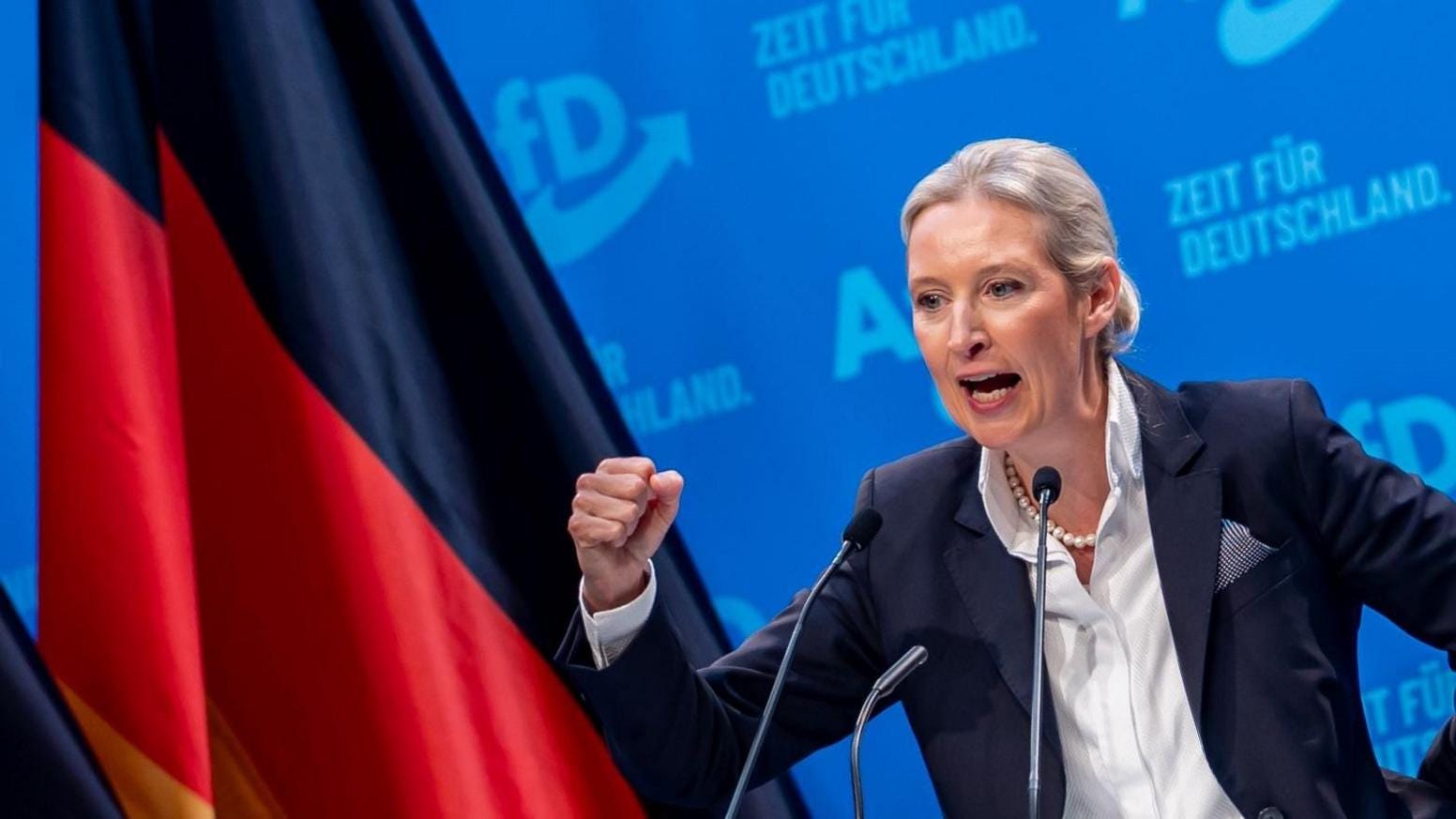
When Hans-Werner Sinn, economics professor at Munich and doyen of Merkelite fiscal responsibility, confers his blessing upon the AfD as a „business-friendly party“; when Die Welt, the flagship broadsheet of the Axel Springer publishing house, describes Björn Höcke as „moderate“ and „presidential“; when the high priests of the Munich Security Conference invite a small AfD delegation to attend their annual gathering, the winds can only be blowing in one direction. Those tuning in from their couch in Münsterland still haven’t realised it, but Germany’s industrialists and their transatlanticist intellectual allies have extinguished the firewall.
The business ascendancy began on January 5th — the first day back in the office — when the monocled industrial barons forced out Friedrich Merz’s private secretary Jacob Schrot and replaced him with their own silver-tongued business vizier. A chancellor spends more time with his private secretary than anyone else in his government; it is he, more than anyone else, who controls the flows of information to and from the executive. Schrot, a vain and ambitious young CDU apparatchik with strong views on foreign policy and little else, was a man moulded in Merz’s image, acting as a sounding board for the mercurial chancellor’s ambitions to lead the free world. The fun and games are now over for him, and mercantile common sense restored.
The new pragmatic mood has manifested above all at the European level. While keeping Prometheus bound at home, Merz’s coalition partner, the Social Democrats, perhaps aware of the fractious atmosphere within the CDU, have given the chancellor a free hand to pursue an ambitious European agenda in partnership with Mme. Meloni. A joint Italo-German „plan of action“ sounded the gong. We can pass over the generic centre-right proposals to slash red tape, streamline regulations, and roll back the „green deal“ that make up the greater part of the document — these are secondary from the perspective of Europe’s strategic orientation, since the philosophy behind them could theoretically be paired with a more sovereigntist posture. What matters is that Meloni and Merz’s protocol explicitly rejects this course, instead offering a more businesslike, less bible-bashing version of the vision set down in Trump’s National Security Strategy: a Europe cutting down on Woke Waste and bolstering defence spending while baking American (and British!) technology into its security architecture.
In contrast to the Carneyite fantasies of a libtarded Metternich System to cordon off the ogre of Mar-a-Lago, the protocol reaffirms „a strong transatlantic bond based on joint values and shared interests“. While such high-minded rhetoric is often no more than an exercise in vibesmaking, this finds concrete form in an effort by the two governments to water down French proposals to onshore defence industrial supply chains through „Made in Europe“ rules governing, amongst other things, government procurement. This legislation will be introduced in any event; the fight in Brussels is over how stringent these rules will be (including whether, for instance, “Europe” is understood to include Britain), and the answer will determine whether or not European rearmament is to be a geopolitical project or simply an industrial stimulus. The slow breakdown of the Franco-German 6th generation fighter project between Dassault and Airbus, interpreted by some in France as an act of political sabotage from the German side, and the latter’s possible reorientation towards a British-led initiative, all indicate that the weight in Berlin is shifting towards the latter.
Now that the Trump Train has ground to a halt, the old Schäublians seem to have quietly shelved their plans for a Europe That Can Say No. Today there is little talk of (further) joint sovereign debt issuance, and Merz bemoans the euro’s strength against the dollar. In the high halls of the Dark Rechtsstaat, the view seems to be that Greenland was America’s Suez; a margin call against a waning power that, now that the dust has settled, sets the basis for a renewed working relationship on unequal terms. The quiet mainstreaming of the AfD, in addition to being a useful lever for the business bloc to pull against the left by maintaining the fiction of having an outside option (one which they have no intention to take), fits into this scheme insofar as it allows wide-eyed Americans to feel like they’ve got their money’s worth from their big Europe trip; the tradcath equivalent of a gondola ride. At the Munich Security Conference, a complacent mood prevailed: common European values were reaffirmed, the democratic public sphere hummed with civil society dialogue, and all under heaven was in its right place. Everything changed so that everything could stay the same! In this recent interview with Wolfgang Ischinger, chairman of the MSC and Slightly Dark transatlantic broker par excellence, you can almost hear the cat purring as he strokes its shiny coat in a sinister, sophisticated, European manner:
„Question: The new US National Security Strategy published in December reads in parts like an extrapolation of the speech US Vice President JD Vance gave last year at the MSC. Still, it shocked many in Europe. Did it shock you, too?
Ischinger: It shocked me less than most, I think, because the way I read the National Security Strategy is that it consists really of two different documents. One part of it is a JD Vance kind of speech. The other part is written by foreign policy or security professionals, and they are meaningful. And we should insist on those elements of the strategy which are of positive relevance to us. Like the idea that Europe is very important to the US.“
Compare these remarks with this recent article — written in a suspiciously neutral register — in the Berliner Morgenpost by Melanie Amann, a well-connected former Spiegel journalist with a long track record of mischief-making in and around the AfD:
„No, the AfD politician [Rüdiger Lucassen, one of the three AfD members invited to attend the MSC — fp], whose party is designated a right-wing extremist organisation by the Verfassungsschutz, is anything but isolated at the Munich Security Conference, and this applies not only to his contacts with the media. Though German politicians from the SPD to the CDU/CSU to the Greens and FDP might yet snub him, there is little sign of a firewall against the AfD from the foreign participants at this meeting of the international security community, especially amongst the American politicians. Nor from the military men, industrialists, or academics, insists Lucassen. After all, he knows many of them from bygone days: „I don’t sense any angst about making contact“, he claims.
[…]
On Friday evening, Lucassen attended the MSC’s military reception. The General Inspector of the Bundeswehr, Carsten Breuer, spoke in a normal manner with him, he reports with satisfaction; so too Florian Hahn, the CSU’s State Secretary at the Foreign Office. By his own account, the AfD politician met with various generals from Germany and the USA, including the NATO Supreme Allied Commander Europe. He is already well-acquainted with the military attaché at the U.S. Embassy. According to diplomatic sources, the State Department requested its Berlin embassy to lift its embargo against the AfD months ago. Representatives of the party must now be invited to all events at the U.S. Embassy, whose personnel is now required to network with them and cable the insights from these conversations back home.“
On the right of the AfD, who hold Lucassen in very low regard, the fear of cooptation is acute. Arguments are tools, and I don’t begrudge anyone who wants to extract concessions from the party central office (and through it the CDU) by threatening a grassroots revolt against any kind of agreement or understanding. No one should delude themselves that the Schäublian elite is an honest broker. But cooperation with the CDU is the only way forward for the AfD. This relationship will never be cordial, and the catharsis of remigration will be impossible to achieve; the goal must instead be demographic stabilisation and an alleviation of state repression so as to win space for a progressive politics to flourish in the long term. The German constitutional order is a well-designed fortress, it cannot be taken by head-on assault. The AfD, as a political party whose sole purpose to translate parliamentary seats into legal changes, is not suited to affect deeper cultural transformation of society; what it can do is buy time.
Not seldom do establishment schemes to manipulate a dissident movement towards its own shadowy ends instead produce an intellectual cross-pollination, or a see a reversal of roles when an unforeseen crisis requires the latter’s cooperation to manage an unexpected shock. Not for nothing is The Sorcerer’s Apprentice Goethe’s most frequently cited poem. Germany’s 20th century history provides no paucity of examples.


