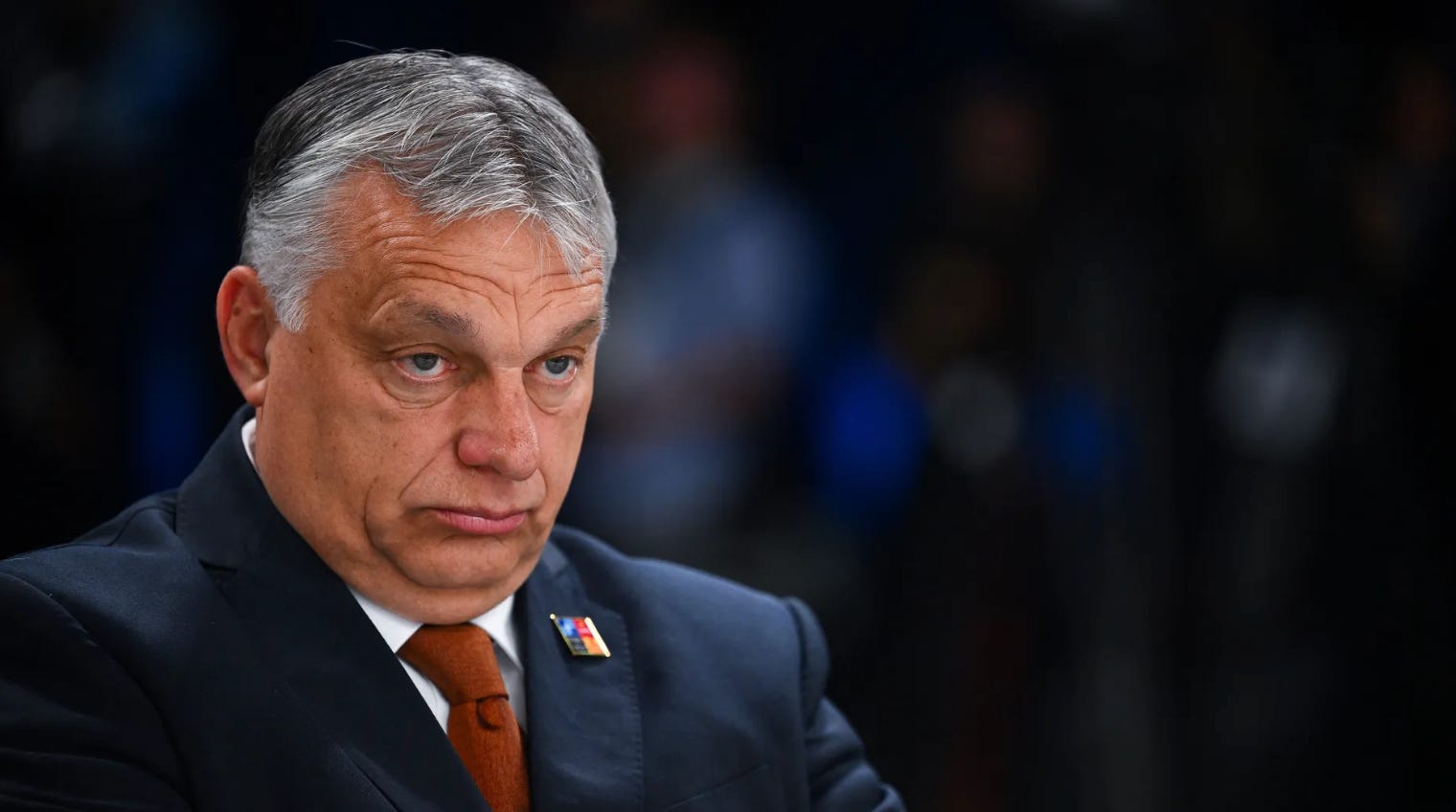
A qualified defence of Orban
Nicolas Moreau
Frank Pokorny’s demolition of the flotsam of post-liberalism which washed up on Budapest’s shores serves as a tombstone to the social conservatism which characterised much of Orbán’s intellectual project.
But the glee of the innumerable posters celebrating at the wake – many of whom appear simply jealous for not having received their own sinecures and who are recycling the talking points of Transparency International – seems to have drowned out any reflection on what right-wing movements might learn from the post-mortem.
In this light, this humble J’accuse reader wishes to assess Orbán’s international intellectual project in its own terms.
In my conversations with Fidesz insiders, this intellectual patronage network had three clear aims, two international and one domestic. Internationally, it aimed to secure powerful allies in America, and protect Hungary in Europe. Domestically, it sought to provide a counterweight to the left-liberal propaganda which had turned the heads of the Hungarian youth.
The American project was undoubtedly the most successful. The gaudy CPAC and gaggle of failed American intellectuals did not just succeed in turning heads but in cementing the position of Hungary in the minds of the post-liberal VP and emperor Trump himself. Despite their unforgivable crimes – such as preferring steak and eggs to humble goulash bogrács pörkölt – this washed-up cast of post-liberal refugees did somehow succeed in providing Hungary with an outsized reputation among the American Right. This ‘success’, as we shall see, brought its own problems.
The results of the European project were more varied. Some of the work in Brussels successfully prodded the at times lazy European populists to take seriously the damage done by environmentalism, and unmasked the EU’s version of USAID. Among party leaders, Orbán solidified his reputation, as the litany of social media messages from right-wing leaders from Le Pen to Alice Weidel demonstrated. Yet, while the Rassemblement National and perhaps Vox are within touching distance of power, and at times Gert Wilders or the FPÖ were nominally at the helm of their countries, these friendships offered only marginal help in Hungary’s endless battles with the European Union. The relationship with Polish conservatives – almost undone by the Russo-Ukrainian war – was one of the strongest, and served, whilst PiS were in power, to somewhat protect Orbán. Yet from this relationship Fidesz seemed to learn very little. Morawiecki’s defeat by Tusk in 2023 prompted almost no soul searching among Orbán’s intellectual cast, and now they will suffer from the implementation of Tusk’s playbook of “militant democracy” in Hungary.
Domestically, the post-liberal enclave in Budapest was at best immaterial and at worst counterproductive. Endless sermons on family values or the encyclicals of Pope John Paul II, of the kind that characterised the print magazine of the Orbán-funded European Conservative, provided a steady stream of conservative cringe which cemented the perception of the lifelessness of right-wing politics among Hungary’s precarious youth. It is no surprise that insiders estimate that the students of the Mathias Corvinus Collegium – the institution home to many of the American refugees and tasked with creating a generation of patriotic youth – broke 10:1 in favour of Peter Magyar.
All three of these objectives have their roots in the strong feeling of vulnerability which characterised the Orbán project. Hungary, a small nation subject to a relentless barrage of propaganda, institutional warfare, and NGO funding by the pre-Trump United States and the EU, felt it needed powerful allies abroad and some counter-propaganda of its own at home.
Yet, as Ivan Krastev of all people has noted, this relentless focus on international issues turned Orbán into precisely the kind of globalist he despised. The huge bet on America also seems suspect given America’s declining position, domestic turmoil, and its traditional habit of wrecking its allies. But more profound than this was that the heightened feeling of vulnerability led Orbán to repeatedly cast Hungary as the victim of international cabals. In replacing national pride with a culture of national victimhood – the ‘mouse’ as Orbán described himself to Putin – Orbán undermined his own foundations. From this the most dreadful errors of the campaign emerged: the hysterical boomer conspiratorialism regarding Ukraine and the decision to fight a domestic election entirely on international issues.
Magyar now has his chance to drain the swamp of Orbán’s international intellectuals. Across Europe, the Right must learn the correct lesson. The problem was not a readiness to splash the cash to create a counter-network to that of the globalists, but the over-reliance on washed-up outsiders, especially from the United States, and their turgid social conservatism. A truly radical right wing government could find innumerable creative ways to unleash the animal spirits of domestic intellectual terrorists and posters. If Magyar takes a hammer to dull, propaganda-stuffed public broadcasters and sponsored intellectuals, let us do the same to our own. But to dismantle everything associated with the old regime, we will need to put our own trained assassins on the payroll.


Over the past few days, I’ve been venting my frustrations about Viktor Orbán and to be fair, after 16 years, there’s quite a lot to draw from. I was around 15 at the beginning of that period, and now I’m about to turn 32.
Because the truth is, I do have a certain admiration for him. It’s probably not an exaggeration to say that over the past few decades, he has been the only Hungarian politician of real significance on a European level.
At the same time, it can be stated clearly: there is no such thing as “Orbánism,” and there never will be. He never truly managed to build an intellectual hinterland. At most, he laid down a kind of framework for one.
Perhaps his greatest innovation, both in Hungarian and EU-level politics, was turning campaigning into a permanent state. Of course, the post-2006–2008 Hungarian situation provided the initial impetus, but from that point on, politics effectively became a continuous battle for the next two decades.
This ability to dominate the moment, to exploit crises effectively, is probably his most significant achievement internationally and something that can be learned from.
On the domestic level, this was tied to something similar: whenever the local left tried to import some Western nonsense, he never let the issue go. People could complain that these topics were irrelevant in the local context — things like trans issues, the constitutional definition of family, or when Péter Niedermüller made remarks about “repulsive white men,” clearly echoing American discourse. But Fidesz never dropped these topics, and repeatedly forced the left into embarrassing narrative defeats.
The left simply couldn’t resist taking the bait over and over again and while online audiences might have sympathized with them, elections were never decided on the internet.
By now, however, it’s clear that Orbán has lost momentum. He’s no longer in the same explosive form he once was. During much of the recent campaign, others were put forward (often disastrously) and he was only brought in when it was already too late. And yet, for the past 20 years, he was the one through whom Fidesz could be sold.
As I mentioned, there is no Orbánism as a coherent right-wing intellectual system. There is only Orbán and Fidesz as an extension of him.
Whether a comeback is still possible remains an open question. He achieved 39%, which is a solid result, but in some sense, the accumulated weight of the past 16 years has stuck to him. (How could it not? Fidesz = Orbán.) There’s a real risk that he turns into a Gyurcsány-like figure, lingering on with an increasingly sectarian base, while gradually becoming a generational lolcow.
Which is unfortunate, because there is a legacy worth preserving. And if the goal is to maintain the long-term advantage of the Hungarian right, this path does not serve that.
He spent the last 16 years in full combat mode and to some extent, that deserves recognition, because it was a period when the right often faced unfavorable conditions internationally. But both he and the country have grown tired of this constant narrative warfare.
It may simply be time to let go.
This is my short defense of him, as someone who was in Hungary for most of that period. But there’s so much more that could be said.